
Your patient sees why your plan works, and the explanation goes home with them.
Your patient comes back ready to work, so you treat instead of convince.
For about a dollar a day, your patient understands the plan as well as you do. Cancel any time.
You already know what to tell your patient.
The hard part is that they hear it, nod, and a week later the reason has faded, so you explain it again in a session that was already short. You are still the one who explains. Pelvic Lens gives you something to explain with: the model already made for the pelvic complaints you see every week. You open the one for your patient's complaint, turn the pelvis to the angle you want, zoom in on the structure you mean, and animate the cough, the strain or the squeeze while you talk. One movement on the screen says what would take you a thousand words. Then you send the video home, so the same explanation is on their phone when the doubt comes back.
- Open the model in the session, turn it, zoom in and animate it while you explain.
- Send your patient the video by text or email.
- Let great care spread the word. Each video ends with your practice name and booking link, so when patients share it with family, friends, or colleagues, they’re introducing others to your care.

"It only happens when I cough." Show them why, and what stops it.
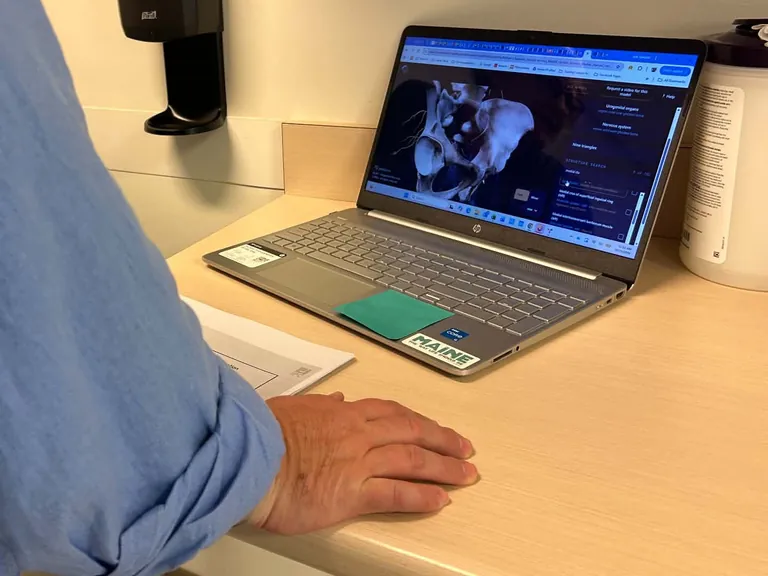
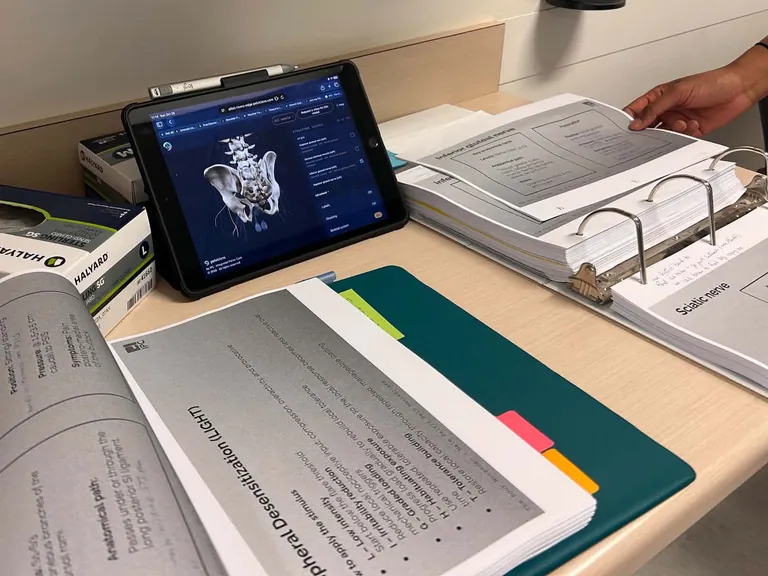
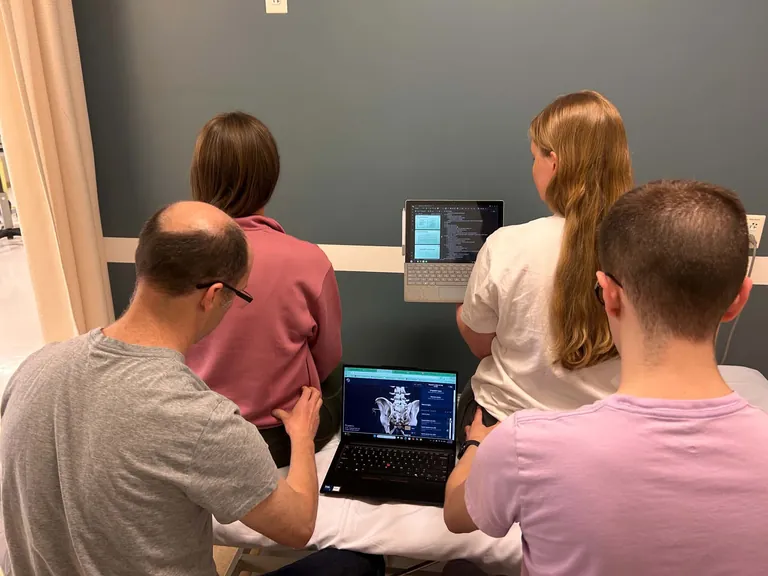
Bring nerve pathways and pain sites to life.
Animated nerve impulses and pain waves illustrate pathways and associated pain sites.
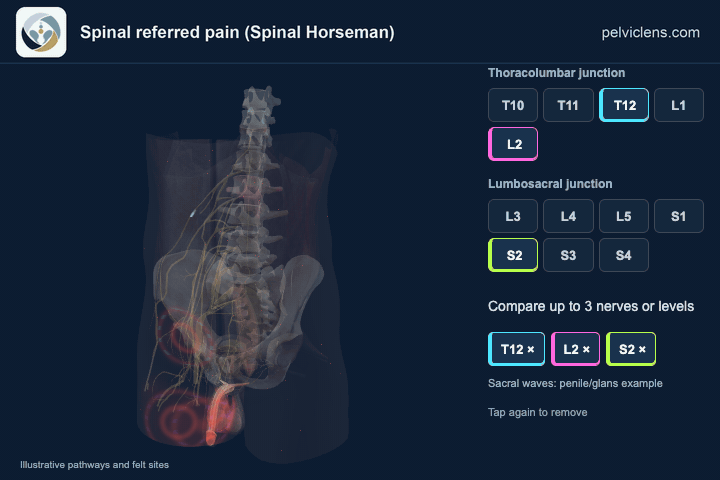
For a patient with groin and testicular pain, I pulled up Pelvic Lens to show the sciatic nerve, then the genitofemoral and ilioinguinal nerves from further up the spine. He likes to understand and make sense of things and found the diagrams helpful.
 Erika VillemurePelvic Health PT, Sexual Health Counselor
What changes in your clinical day
Your patient does their exercises, because they know why.
You know the feeling of giving your best explanation and hearing "I didn't do it" a week later. It is draining when you care more about the plan than your patient does. When they have watched why it works, and can watch it again at home, they come back having done their exercises, and you get to treat instead of convince.
Your session goes to treatment.
You have forty-five minutes, sometimes thirty, and a plan to get through. Your patient understands in a minute what used to take ten, so the time goes to the hands-on work only you can do.
You have nothing to prepare.
The model for the complaint is already made, so you are not drawing on paper or searching for a picture or a video between patients.
Your patient arrives ready to work.
They have seen why the plan matters and watched it again at home, so they come back engaged, with better questions and fewer doubts.
You are ready for the patient you rarely see.
When a man after a prostatectomy or a patient with a bowel problem lands on your schedule, you walk in knowing exactly what you will show them.
Your care brings you the next patient.
Every video carries your practice name and booking link, so the friend or the doctor who sees it knows who explained it.
You end the day with time and energy left, because your patients are working with you. That is what $29.99 a month pays for.
Subscribe$29.99/ monthYou do the explaining. The model shows what you mean.
If you love going through the anatomy with your patient, this is built for you. You are still the one who knows the body and tells the story. The model gives you the picture to tell it with: turn it, zoom in, animate it, and one movement on the screen says what would take you a thousand words. Your patient understands without the long explanation, so you spend less of the session explaining and more of it treating a patient who is engaged and ready to work.
"I leak." "I can't wait." "It hurts."
You hear these every week, and you have explained each one again and again. The model for each is already made. Open it, turn it, zoom in, animate it, and explain it as it moves.

Spinal referred pain to the testicle
"It's my testicle. Why are you looking at my back?" Show the pain referred from the thoracolumbar junction or the lumbar spine to the testicle, and the back exercise stops looking like the wrong treatment.

Stress incontinence after prostatectomy
"I do my exercises, so why am I still leaking?" Show the cough that leaks, then the same cough with a submaximal pre-contraction. He sees that timing, not strength, stops the leak, and keeps going.

Erectile function
"Will it ever come back?" Show cavernous nerve signalling, smooth-muscle relaxation, filling and veno-occlusion, then detumescence. He sees each step of an erection, so you can show which step his problem is in.

The PFM contraction he can't find
"I don't know if I'm doing it right." Show the lift, then full relaxation, so he can see what right looks like before he goes home and practises it.

Ejaculatory dysfunction
"Nothing comes out anymore." Show emission and expulsion, retrograde flow, and the dry orgasm after radical prostatectomy. He sees where the semen goes, and why there is none after the surgery.

Dyssynergic defecation
"I push and push and nothing happens." Show rectal filling, the rectoanal inhibitory reflex, and straining against a puborectalis that will not relax. He sees why pushing harder does not help.
Also in the library: dribble after peeing, the four ways of emptying, urgency, nerve pain and the whole male pelvis, layer by layer.

Leaking when she sneezes
"I leak when I sneeze." Show one cough-and-leak example, then pause to inspect urethral support, closure and pressure.

Pain that is not where it hurts
"It's my hip. Why are you asking about my pelvis?" Show the pain referred from the spine and the floor to the hip, the tailbone and the groin. The plan stops looking like the wrong treatment.

Prolapse under load
"Why does it feel different when I bear down?" Show abdominal effort and pelvic support moving together, then release the load. She sees why it feels different when she strains, and what her exercises are for.

The bladder that shouts early
"I can't wait." Show the bladder that signals too soon, then how a pause and a gentle pelvic floor squeeze let the urge ease, so the plan makes sense before she tries it.

Pain with intimacy
"It hurts." Show the floor that will not let go, the muscles that guard, then what changes when they relax.

The gap after birth
"My belly never went back." Show the wall under load and what closes the gap, so she stops bracing and starts breathing.
Included in your subscription: pelvic floor movement, prolapse, POP-Q and bowel coordination.
Your explanation keeps working after your patient leaves
You see your patient for an hour a week at most. Between visits they hear from a relative, a search result, an app or another clinician, and what you said in the session fades. Patients forget most of what they hear in a visit, and nobody remembers something they heard once. The video repeats your explanation for you. They watch the cough that leaks and the squeeze that stops it again, and they remember why you asked for the exercise.
During the session.
Turn the model to the structure, zoom in, animate the movement you mean, and explain what to look at while your patient watches it happen.
After the session.
Send the video to your patient by text or email. From the same menu, you can email it to their doctor.
At the next visit.
Open it again and ask your patient to walk you through it. Their own words tell you what stuck.
97% of patients understood better when they saw their own anatomy. But 75% of clinicians said it takes too long.
97% of patients understood better; 75% of clinicians said it takes too long. (Diao 2022) PMID 36454858
With Pelvic Lens the same understanding takes a minute, because the model is already made. Between sessions, the video reminds your patient why the plan works, so they keep doing it, come back for the next session and get better results.
Seeing is believing you.

"That one is mine."
Your patient points at the one that is theirs. The next steps make sense.
Play the four ways of emptying and watch your patient point at one and say "that one is mine." They have recognised their own pattern before you have explained a thing. Guide them through the next steps for that pattern, and they follow because they have seen why.
When your patient recognises their own pattern, they follow the plan and keep their appointments: they come back better, and they come back to you.
The whole pelvis is here. And it moves.
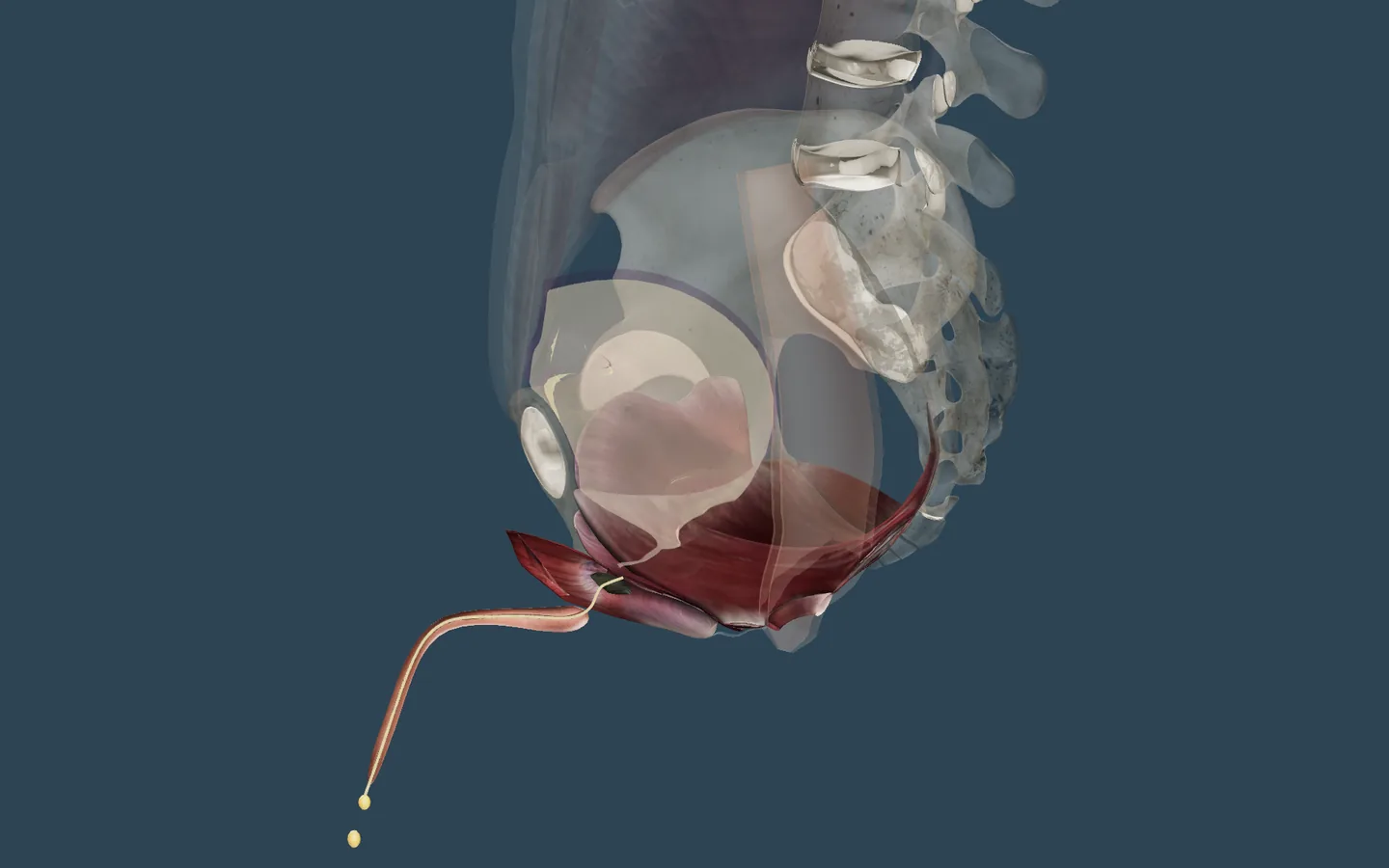
Every structure is in Pelvic Lens, layer by layer, for men and women, so you can turn the pelvis and point at exactly what you mean. It is a real 3D model, not a film.
You turn it, zoom in and out, and stop on the exact moment you want your patient to look at. Then it does what a labelled picture cannot: it shows that structure working. Drag the round handle to watch the same pelvis when your patient coughs, first without a squeeze, then with one. Your patient stops looking at a diagram and starts watching their own problem happen, and that is when your plan makes sense to them.
Ever run out of cues?
"Stop the flow." "Hold in wind." "Lift your testicles." When he still bears down, show him the lift, then the full let-go. The model you need is ready before he sits down.
- Bladder and leaking: bladder pressure when he coughs or moves, the four ways of emptying, leaking after prostatectomy, dribble after peeing, and how drinking and bladder filling change his trips.
- Pelvic floor: the lift, full relaxation, endurance, breathing for the pelvic floor, and normal variants.
- Pain: pain referred from the spine, local tissue pain, nerve pain and sensitisation, a pain map of dermatomes and nerves, and dry needling.
- Sexual health: erection, and ejaculation, including after radical prostatectomy.
- Bowels: rectal filling, and pushing against an outlet that will not relax.
- Anatomy: the whole male pelvis in nine layers, and the nine triangles.

"Stop the flow." "Pick up a marble." When she still bears down, show her the lift, the full let-go and the bear down. The model you need is ready before she sits down.
- Pelvic floor: squeeze, let go and bear down, and how breathing and pressure work with it.
- Leaking and urgency: the cough with and without a timed squeeze, and the bladder that signals too soon.
- Prolapse: prolapse under load, POP-Q by compartment and stage, and pessary support.
- Pain: pain referred to the hip, tailbone and groin, painful penetration, and dry needling.
- Bowels and the belly wall: bowel coordination, and the gap after birth.

The complaints you see less often are ready too. When a man lands on your schedule after a prostatectomy, or a patient cannot empty their bowel, you walk in knowing exactly what you will show them.
Word of mouth, with your name on it.
New patients find you through a friend who got better and recommended you. Pelvic Lens helps that happen more often, without you posting on social media. After the session, send your patient the video by text or email, so they understand their body and stick to their treatment. They can share the link with anyone, so your word of mouth reaches far more people than one conversation can.
- Your patient watches the video again at home and sends the link to a friend with the same problem.
- The friend watches the same video. When it ends, they see your practice name, phone number and booking link.
- The friend taps your phone number or booking link and books with you. No extra work for you: you sent one video.
- You can also email the video to your patient's doctor or another health professional. Now they understand exactly what you do, and know they can refer their patients to you.
Every video you send is a referral you did not have to ask for.

Used with my first patient.
My first patient this morning was a penis owner. Constipation, perineal pain, ED. I implemented some new found evaluative and treatment skills day 1! And used the Lens to show him why.
Today I used the patient videos of pushing against a closed door and when you still feel unfinished. Great visuals to incorporate with patient education, really helps!
Treat instead of convince. Every model, ready for the patient in front of you.
Explain it once, treat for the rest of the session, and send your care home with your name on it. It costs about a dollar a day.
- Every model, and every new one as it ships, for the men and women you treat
- Patient videos with your practice name, logo, phone number and booking link
Cancel any time. Your price holds while you stay subscribed.
My practice or clinic $45.99 a month for 2 clinicians, $59.99 for 3. Each clinician after that is $12.99 a month, up to 9. Pay yearly and get two months free. Choose how many
Frequently asked questions from clinicians
I like explaining things myself. Does this replace that?
No, it makes you better at it. You still choose what to show and what to say. The model is the thing you point at while you say it. Then the video repeats your explanation at home, as often as your patient needs, so you do not have to.
Is it worth $29.99 a month?
Think of the patient who nodded through your explanation and came back having done nothing. That visit costs you more than time: it drains you, and it makes you wonder what you missed. Pelvic Lens costs about a dollar a day. When your patient has seen why the plan works, they come back having done their part, and one patient who stays for their full plan covers the year.
I already have an anatomy app. Why would I use yours?
Because yours stops at the anatomy. Pelvic Lens has the full pelvis too, layer by layer, and you turn it and zoom in the same way. Then you animate it: the cough that leaks, the squeeze that stops it, the pain that travels from the spine, the outlet that will not relax. Each model is built for a complaint you treat every week, and the video of it goes home with your patient under your practice name.
Will my patients do their exercises?
They are far more likely to. A patient who has watched why the leak happens, and what the squeeze changes, knows what the exercise is for. Then they can watch it again at home on the day they feel like skipping it. You stop being the only reminder of why the plan matters.
I am already short on time. Is this one more thing to learn?
No. You open the model for the complaint in front of you, and it moves the way you would expect: drag to turn it, pinch to zoom, tap to animate. If you can explain it out loud, you can already use it.
How long does it take in a session?
A minute is enough to animate the complaint and make your point, which is less time than explaining it without a picture. When your patient has questions, you stay on it, turn it, zoom in and show them.
What do I get on day one?
Everything. You get every model for men and women, with new ones added as they ship: bladder, bowel, pelvic floor, pain, prolapse, sexual function and the full base anatomy. You also get patient videos with your practice name, logo, phone number and booking link on them.
I mostly treat women. Is it worth it for the men I see?
Yes, and especially then. When a man lands on your schedule after a prostatectomy, his model is ready before he sits down, and you walk in knowing exactly what you will show him.
What does my patient get?
The same video you showed them, by text or email, with nothing to download and no account to make. They watch it again when they need it and show it to their partner. It ends with your practice name and booking link.
Does it help me get referrals?
Yes. Send the same video to your patient's doctor and they see, in one minute, what you do and who to send next. When your patient shows it to a friend with the same problem, your booking link is at the end.
Does it replace biofeedback or an internal exam?
No, it makes them work better. Your patient understands what they are trying to feel before you start, so your hands-on time goes further.
Is Pelvic Lens only for IPC graduates?
No. Any licensed clinician can subscribe. If you have trained with Integrated Pelvic Care, you will recognise some of the terminology and the language.
What about my patients' data?
We collect nothing about your patients. The video page asks for no name or email. We count how often it is opened, never who opened it.
How do I cancel?
From Account, the button at the top of every page, at any time. Your access runs to the end of the month you have already paid for, and the refund and cancellation policy has the rest of the detail.
How does billing work for a clinic?
A practice pays one bill. 2 clinicians are $45.99 a month, and 3 are $59.99. Each clinician after that is $12.99 a month, up to 9. Pay yearly and get two months free. Each clinician has their own login. For 10 or more, write to hello@pelviclens.com.
Subscribe, and spend your sessions treating instead of convincing.
Explain it once. The video does the rest.
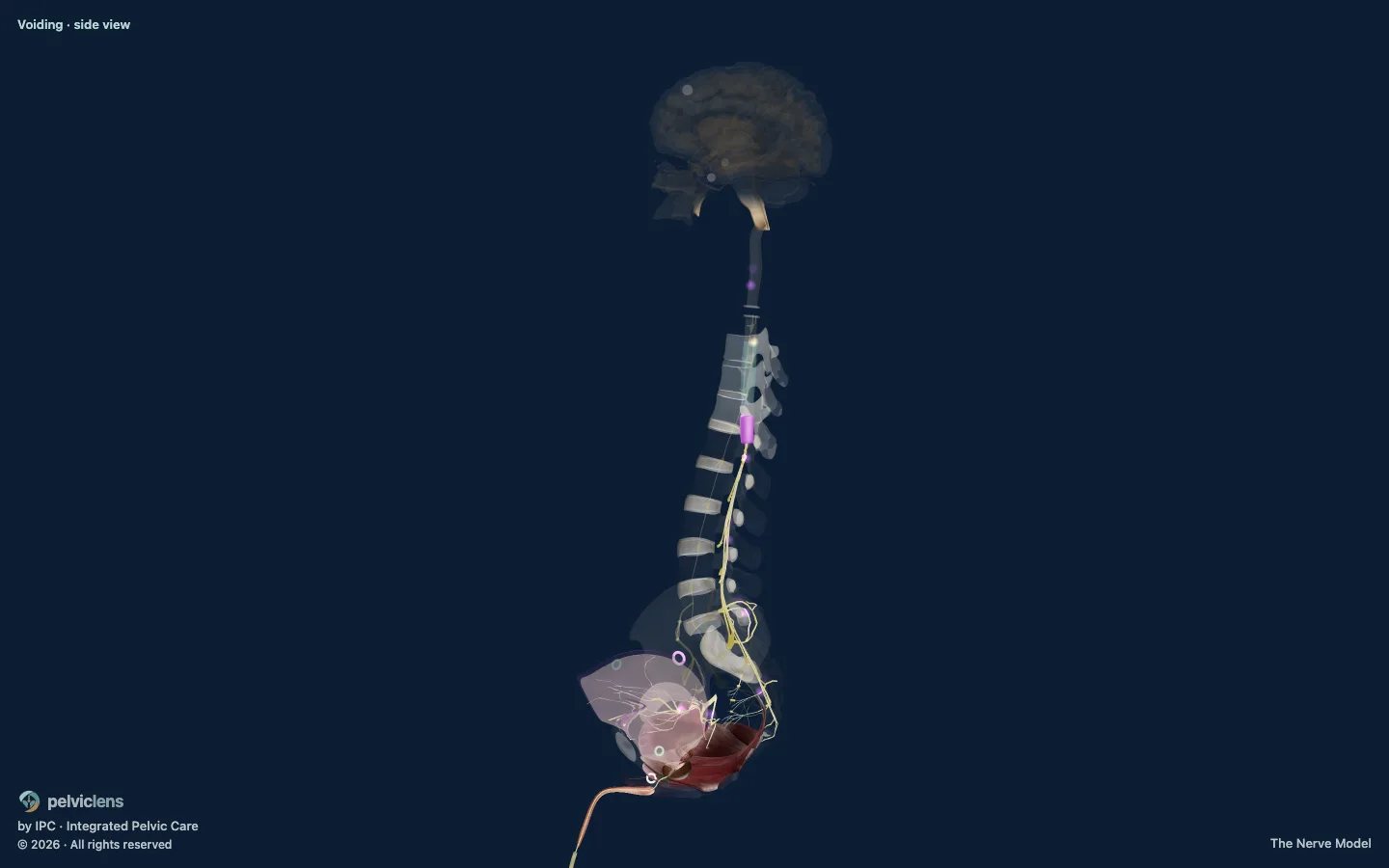
Explain it with the animation. Send them the video by text or email. Friends, doctors and other health professionals see your name and your booking link.
Subscribe$29.99/ monthFor about a dollar a day, your patient understands the plan as well as you do. Cancel any time.
How the pelvis works, and how to explain it to your patient
Each article takes one thing you explain in the session, shows the mechanism behind it, and gives you the words that land with a patient. Written by clinicians at Integrated Pelvic Care, with the evidence cited.
Anorectal angle: normal range in men
Anorectal angle in men: how the puborectalis sets it, what defecography measures, and the cue that separates Guarding from Restriction.
16 min read
Pelvic floor downtraining in men
Hypertonic pelvic floor in men is a label, not a finding: pelvic floor downtraining is down regulation or downward mobility, chosen by the exam.
19 min read
Cystometrogram: how to read the trace
Cystometrogram for the pelvic health clinician: the filling curve read as pressure, Pves = Pabd + Pdet, and what to tell your patient.
16 min read
Intrinsic sphincter deficiency: treatment
Intrinsic sphincter deficiency for the pelvic health clinician: why one valve is left after prostatectomy, and what to train first.
16 min read