
Dyssynergic defecation (anismus) in men
Dyssynergic defecation in men: what manometry, the balloon test and defecography show, and the exam cue that decides the treatment.

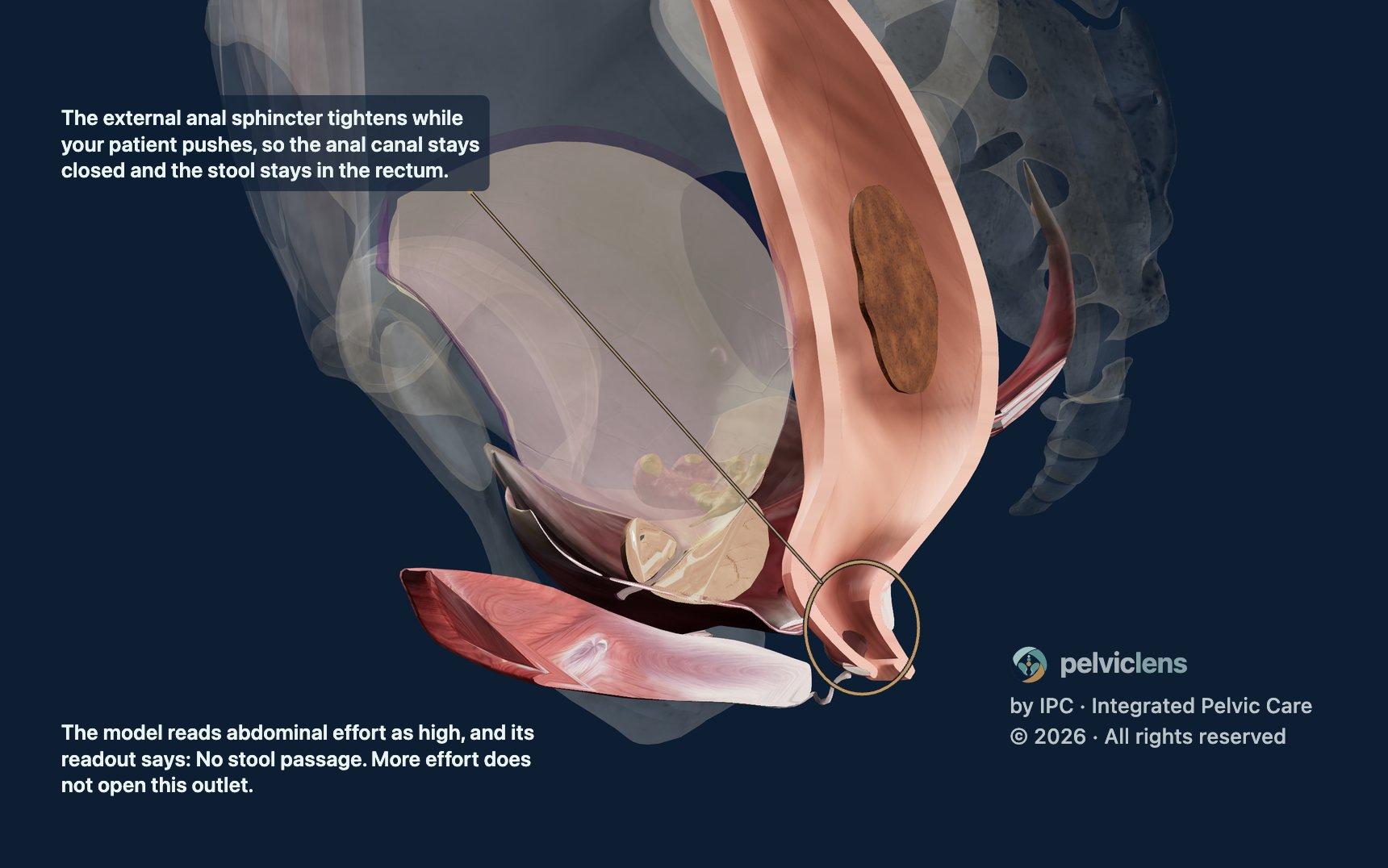
The short answer. Dyssynergic defecation is an inappropriate contraction of the pelvic floor during attempted defecation while the push is adequate [1]. Rome IV diagnoses it from constipation symptoms plus two of three abnormal tests [1]. The exam then picks the treatment: down-regulation when a cue changes the floor, mobility work when it does not.
Key takeaways
- Dyssynergic defecation is a push against a closed outlet: abdominal pressure rises while the puborectalis and the external anal sphincter fail to relax or contract instead.
- Manometric dyssynergia alone is not a diagnosis. The London classification grades it as minor or inconclusive, and reads a male trace against normal ranges that reflect sex [2].
- At the exam, an outlet that changes with cueing points to the Guarding pattern and down-regulation; one that does not points to the Restriction pattern and mobility work.
The anorectal manometry report on your desk reads "type I dyssynergia", and the referral asks you to treat dyssynergic defecation. The report records only that the anal pressure rose while your patient pushed with adequate force [1]. It does not say whether his floor closed against the push (the Guarding pattern) or could not open (the Restriction pattern), and those two floors call for opposite first sessions.
Patient pages call the same disorder a "hypertonic pelvic floor", and the label comes with its own prescription: relax it. The literature names it anismus or pelvic floor dyssynergia. Integrated Pelvic Care's masterclass sets the hypertonic classification aside, and one of its reasons fits here: "It creates the wrong treatment shortcut".
Dyssynergic defecation: the push meets a closed outlet
Evacuation is not one relaxation of the pelvic floor. Three early events determine it: rectal pressure rises to propel the stool, the puborectalis relaxes, and the pelvic floor descends [3]. Then the anal canal opens, and the stool passes [3].
To defecate, your patient tenses the abdomen and directs the pressure backward, so the anorectal angle opens. The floor lengthens and descends under that load. Bearing down is a loaded opening, and the relaxation comes afterwards, as the floor returns to its resting center.
The bend the puborectalis holds, and how far it opens, are set out in the anorectal angle pillar.
Dyssynergic defecation breaks this sequence at the outlet: the push arrives, and the outlet stays shut like a closed door. Whether the puborectalis contracts against that push, and whether a cue changes the outlet, is what your exam finds.
Your patient is sure he has not pushed hard enough yet, so he pushes harder against the same closed door.
Rome IV criteria for dyssynergic defecation
A manometry trace alone never makes the Rome IV diagnosis. The diagnosis starts from the bowel complaint, functional constipation or irritable bowel syndrome with constipation [1]. Impaired evacuation then has to show on "2 of the following 3 tests": balloon expulsion, manometry or anal surface electromyography, and imaging [1].
Rome IV then splits the functional defecation disorder in two. Inadequate defecatory propulsion is a weak push on manometry, with or without an outlet that contracts [1]. Dyssynergic defecation is an inappropriate pelvic floor contraction "with adequate propulsive forces during attempted defecation" [1]. The patterns describe the outlet, not the push, so neither subtype maps onto one.
At referral centers, its prevalence in chronic constipation has ranged from 20 to 81 percent, which Rome IV says "may have been overestimated" [1]. Rome V, published in 2026, defines it by symptoms of difficult defecation plus objective evidence of dyssynergia [4].
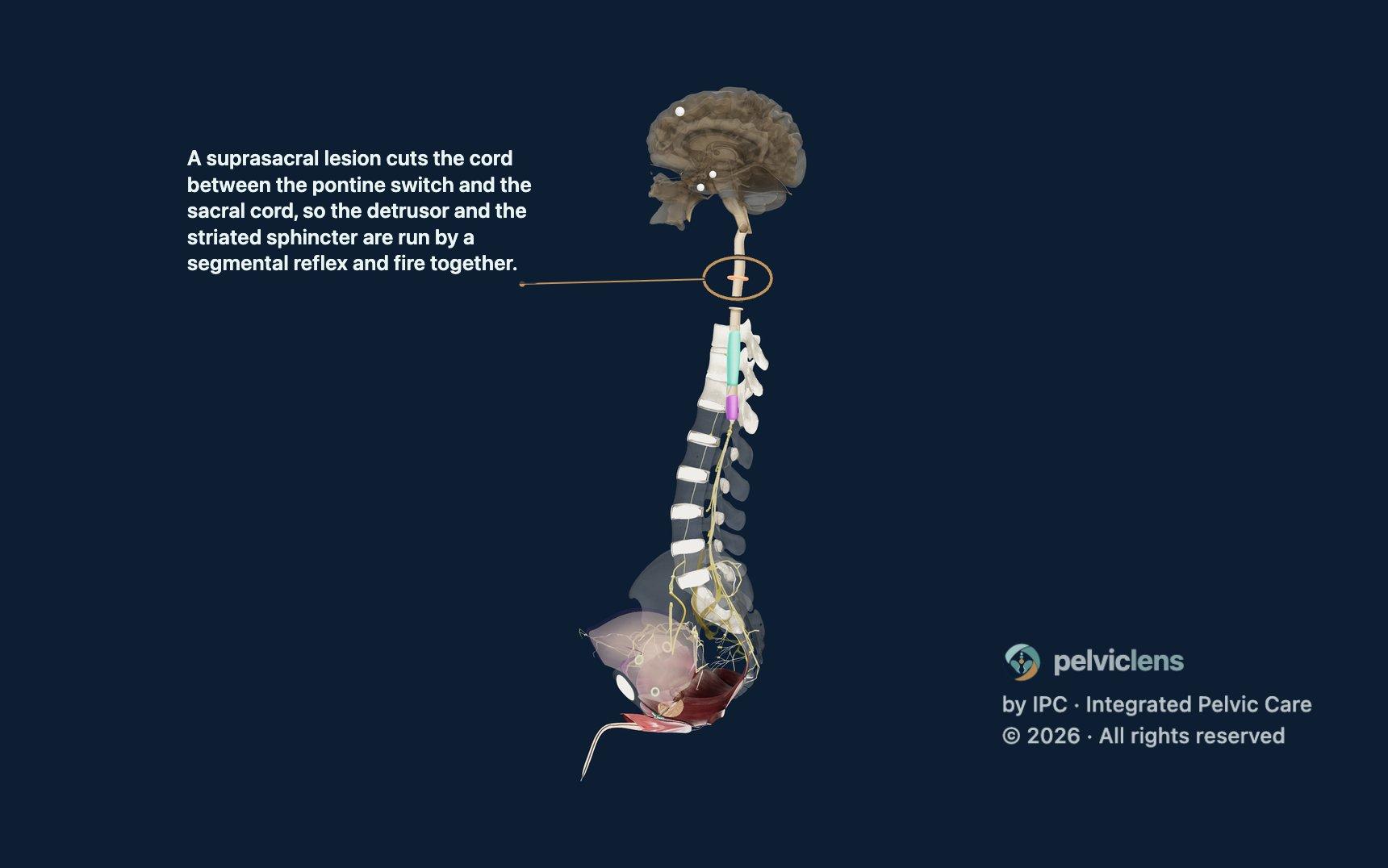
Its bladder counterpart, detrusor sphincter dyssynergia, occurs only with a neurological lesion.
Dyssynergia types I to IV on manometry
The report sorts the push and the anal response into four types, and Rome IV counts only types I and III as dyssynergic defecation [1].
| Type | Push (rectal pressure) | Anal response during the push |
|---|---|---|
| I | Adequate, 45 mmHg or more | Anal pressure rises as the sphincter contracts |
| II | Inadequate | Paradoxical contraction |
| III | Adequate, 45 mmHg or more | Relaxation of less than 20 percent, or none |
| IV | Inadequate | Relaxation of less than 20 percent |
Inter-observer agreement is substantial for types I and IV and only fair for types II and III [1].
None of the four is a diagnosis on its own, since the same patterns appear in people without symptoms [1]. The London classification separates propulsion, an adequate rise in rectal pressure, from dyssynergia, a failure of coordinated anal relaxation. It grades dyssynergia as a minor or inconclusive finding that needs the balloon expulsion test or imaging beside it [2]. The rest of that report is read in anorectal manometry.
Balloon expulsion test and defecography
The balloon asks a plainer question: whether your patient can pass it. The London protocol fills it with 50 mL of tepid water while he lies on his left side, then seats him on a toilet [2]. Rome IV allows 1 to 2 minutes, depending on the method, and a normal result does not always exclude a defecation disorder, because a balloon may not mimic his stool [1].
Across cohort studies, the balloon expulsion test was 70 percent sensitive and 77 percent specific for dyssynergic defecation, and neither seated against left lateral testing nor a time limit of 1 to 5 minutes changed that significantly [5].
Defecography is used when manometry and the balloon are equivocal, or when your patient cannot pass the balloon yet relaxes his pelvic floor normally [1]. Barium or magnetic resonance defecography can also replace the balloon, although agreement between these tests is fair at best [2]. In women the same film often shows a rectocele, even in healthy volunteers, so a bulge is read against her symptoms.
Dyssynergic defecation in men: what differs
Men were a minority of 2,550 adults tested for chronic constipation, yet men and older adults were more often diagnosed with dyssynergic defecation [6]. The sex data are mixed, though: at one tertiary center, dyssynergia was three times more common in women [1].
In seated recordings, men pushed with greater rectal pressure than women, possibly to make up for a floor that relaxes less [3]. In the 34 men who emptied, rectal pressure led anal pressure by a mean of 41 mmHg at the peak of the push. In the 20 who did not, the two pressures met [3]. These are group means, not a threshold, and a male trace is read against normal ranges that reflect sex and age [2].
In an older patient, hemorrhoids can come from a floor that opens widely on bearing down and returns very slowly, which also risks rectal prolapse. Blood mixed into the stool, not on its surface, sends him back to his doctor first. A history of rectal cancer or hemorrhoid removal calls for caution at the start.
Anismus at the exam: closes or cannot open
A manometry catheter cannot feel whether the floor changes with a cue, and your finger can. Whether the report says dyssynergia or anismus, the IPC Male Pelvic Floor Patterns read that closed outlet as one of two floors.
| Pattern | Major criterion |
|---|---|
| Guarding pattern, a regulation deficit: a floor that closes | "Paradoxical contraction/elevation when relaxation or descent is functionally required" |
| Restriction pattern, a mobility deficit: a floor that cannot open | "Absent or clearly limited PFM/perineal descent or opening during bearing down when relaxation is expected, without evidence of active protective contraction" |
Ask your patient to bear down as if to defecate, and when nothing descends or opens, cue him to relax, breathe and relax into your finger. A floor that then changes points to the Guarding pattern, and a floor that stays stuck, whatever the cue, points to the Restriction pattern. The two sphincters under that finger are described in the male pelvic floor anatomy pillar.
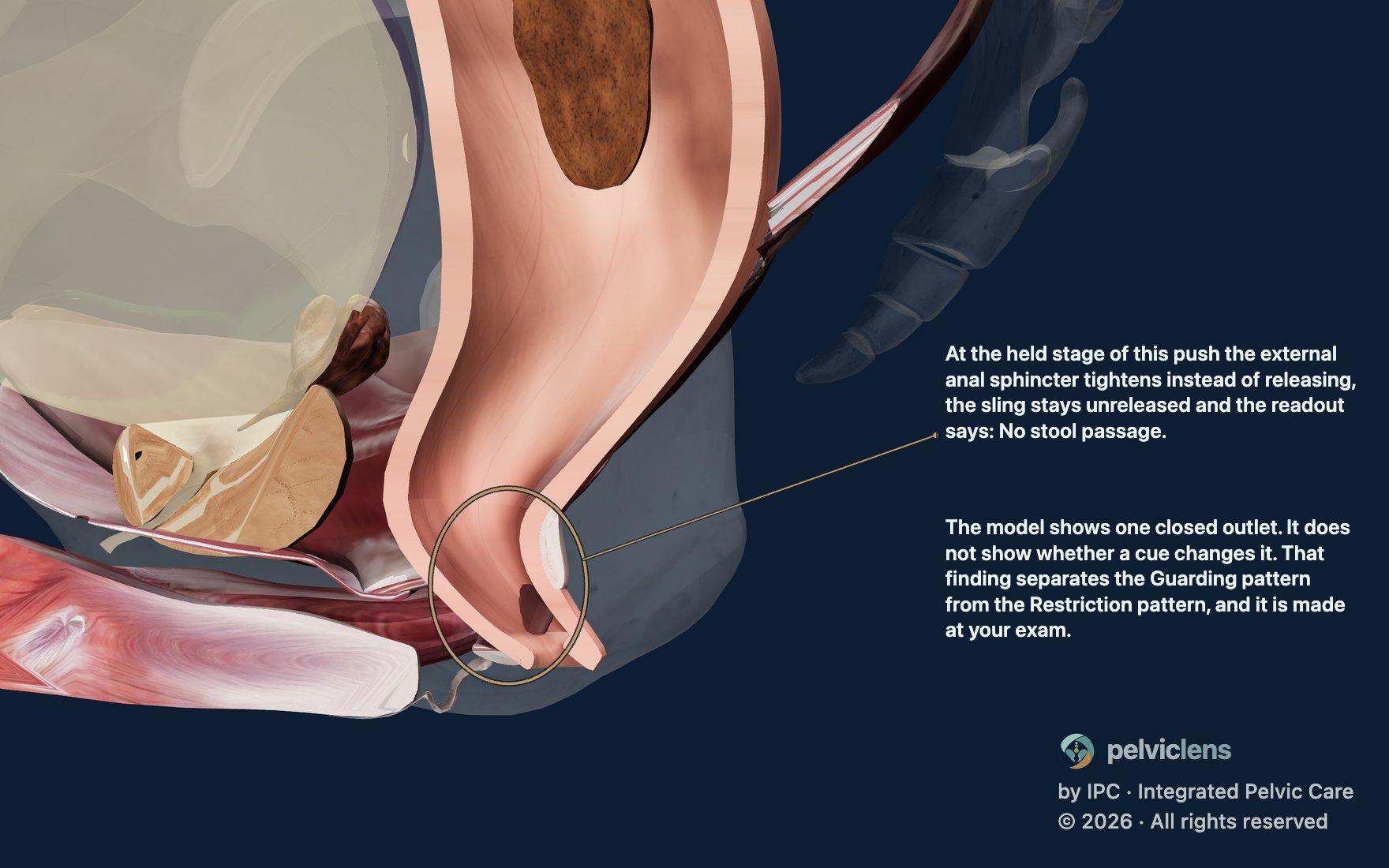
The external anal sphincter holds the anal canal shut as the push meets it, in close-up on the Pelvic Lens defecation model; your exam finds whether a cue changes it.
Excessive descent on the bear-down points the other way, to Underactivation B and its minor criterion "Uncontrolled/excessive descent with load".
The response to treatment is a second clue: a Restriction floor is mildly sore for 24 to 48 hours at most, then improves steadily, while a Guarding floor can flare for several days and fluctuates. Left for a long time, a minor Guarding pattern can become a Restriction pattern.
The Pattern Classification Rule asks for "1 major criterion or 3 minor criteria", and a pattern becomes clinically meaningful when it helps explain your patient's presentation.
The cue chooses between pelvic floor downtraining, which is down-regulation, and the mobility work taught beside it. When the floor that closes also hurts, after years labeled prostatitis, chronic pelvic pain syndrome in men sorts that pain by the Four Horsemen first.
How do you fix dyssynergic defecation?
The fix trains coordination rather than force, and the pattern the exam found decides how. When patterns coexist, treat first the pattern that best explains the main symptom.
For the Guarding pattern the work is down-regulation: the floor returns toward its center with no push and minimal stimulation. Rectal balloon-assisted relaxation lets the sphincter feel safe, and sometimes the catheter with no balloon inflated is enough. Spasm after defecation points to the Guarding pattern and is addressed first.
For the Restriction pattern the treatment is mobility work, built through the defecation exercises taken in order. Your patient drops the pelvic floor to its baseline, then lets it descend on an inhale. He opens on the inhale before the exhale, because an exhale tried first can turn into a Valsalva maneuver. Each opening lasts three to six seconds and is repeated ten to fifteen times, in a static position close to the defecation position. A balloon suits a floor that does not descend on bearing down, and a dilator suits a canal that will not open around your finger.
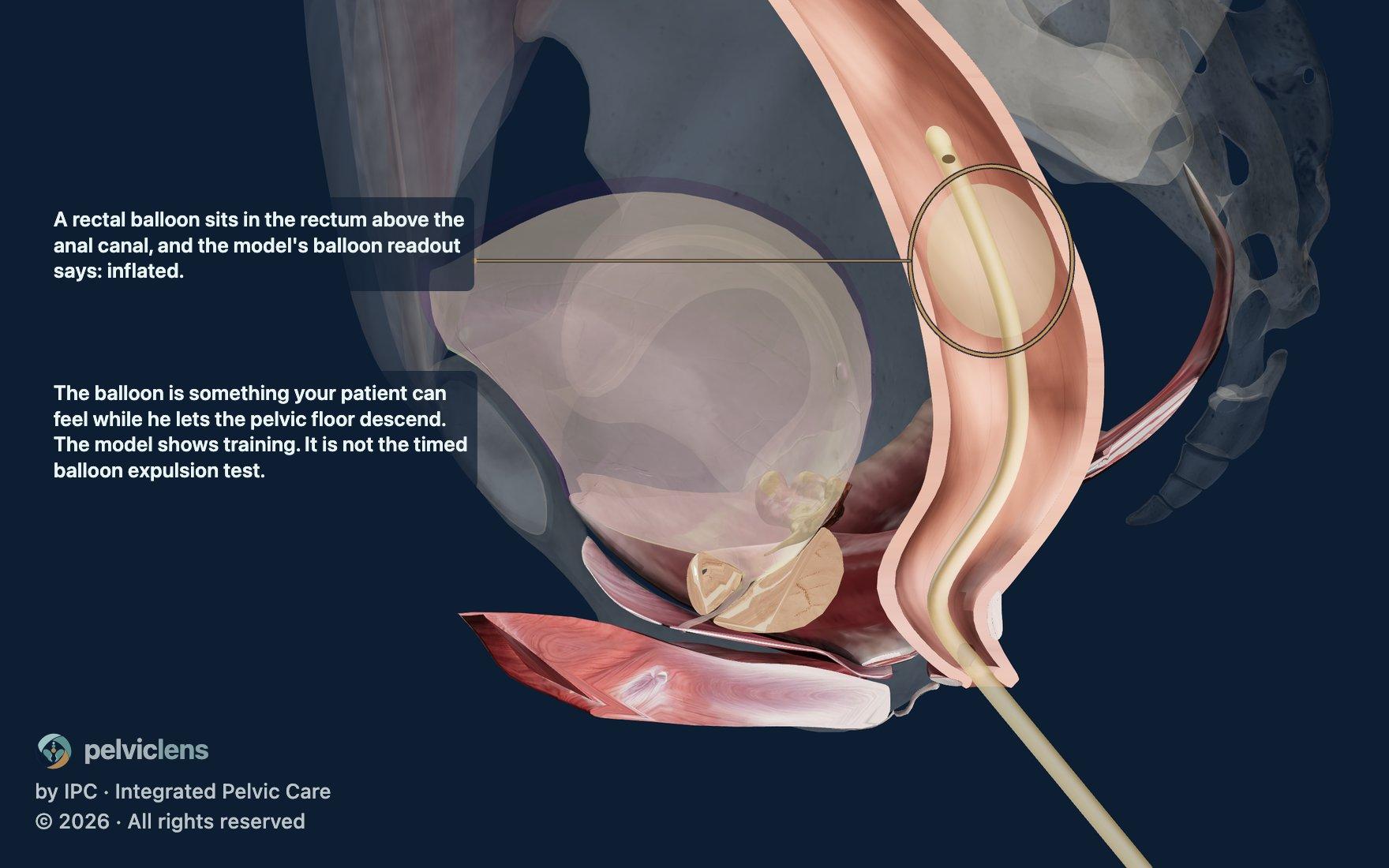
The rectal balloon sits inflated above the anal canal as a target to feel while the floor descends, on the Pelvic Lens defecation model, in training rather than the timed expulsion test.
The toilet routine supports the drills: your patient uses the toilet on a real urge, never without one, and takes his time without sitting long, since rushing squeezes and cuts the stool.
The randomized trials tested pelvic floor biofeedback, mostly in women, and a joint American and European position paper rates it Level I, Grade A [7]. In one trial of 100 adults, 96 of them women, home training with a self-inserted probe showing anal pressure and push effort was non-inferior to clinic biofeedback: 68 against 70 percent responders [8]. Those results belong to the trials. The exercises, balloon and dilator above are the masterclass's teaching.
What to say to your patient
- With the closed outlet playing on the model: "On the model, this ring closes as you push. That is what your test saw."
- When the floor cannot open: "This muscle has lost some stretch. We will help it open."
- When you teach the first drill: "Drop your pelvic floor first. Then breathe in and feel it lower."
- When he tenses with the balloon: "Imagine you are about to pass wind, and let it happen."
Frequently asked questions
What does dyssynergic defecation feel like?
Dyssynergic defecation feels like pushing against a closed door. Your patient may describe straining, incomplete emptying, a stool that stops part way, or needing a finger to help. In one study of chronic constipation, men reported less severe straining than women, so a mild account is checked against his tests.
What is type 1 dyssynergic defecation?
Type 1 dyssynergic defecation is an adequate push, a rectal pressure of 45 mmHg or more, during which the anal pressure rises because the anal sphincter contracts. The same pattern appears in people without symptoms, so a type 1 trace is read with the balloon expulsion test and your exam.
Why does my poop come out in small soft pieces?
Small soft pieces can mean that the outlet closes before the rectum is empty. When your patient rushes, he squeezes and cuts the stool, and the last part, which is the hardest to pass, stays behind. A new change in bowel habit with blood mixed into the stool sends him to his doctor first.
Can dyssynergic defecation cause stool leakage in men?
Yes, dyssynergic defecation can cause stool leakage in men. In men, fecal incontinence is generally soiling or leakage rather than gross incontinence, and Rome IV names dyssynergic defecation among the conditions it may be associated with. A high anal resting pressure traps stool during defecation, and the trapped stool is expelled afterwards.
What is the ICD-10 code for dyssynergic defecation?
ICD-10-CM, the US code set, has no entry named dyssynergic defecation or anismus, so the constipation it causes is coded K59.02, outlet dysfunction constipation [9]. WHO ICD-10 has only K59.0, constipation, with no subcodes [10]. Either code names the outlet problem, not the pattern your exam finds: a floor that closes or a floor that cannot open.
References
- Functional Anorectal Disorders. Gastroenterology, 2016.
- The international anorectal physiology working group (IAPWG) recommendations: Standardized testing protocol and the London classification for disorders of anorectal function. Neurogastroenterology and Motility, 2020.
- Inadequate Propulsion and Pelvic Floor Relaxation in Dyssynergic Defecation: Insights From Synchronous Proctomanometry. Gastroenterology, 2025.
- Anorectal Disorders. Gastroenterology, 2026.
- Examining Balloon Expulsion Testing as an Office-Based, Screening Test for Dyssynergic Defecation: A Systematic Review and Meta-Analysis. The American Journal of Gastroenterology, 2018.
- Age- and Gender-Based Differences in Anorectal Function, Gastrointestinal Symptoms, and Constipation-Specific Quality of Life in Patients with Chronic Constipation. Digestive Diseases and Sciences, 2023.
- ANMS-ESNM position paper and consensus guidelines on biofeedback therapy for anorectal disorders. Neurogastroenterology and Motility, 2015.
- Home-based versus office-based biofeedback therapy for constipation with dyssynergic defecation: a randomised controlled trial. The Lancet Gastroenterology & Hepatology, 2018.
- ICD-10-CM Tabular List of Diseases and Injuries and Alphabetic Index, FY2027. Centers for Disease Control and Prevention, National Center for Health Statistics, 2026.
- International Statistical Classification of Diseases and Related Health Problems, 10th Revision (ICD-10), Version 2019. World Health Organization, 2019.
Related articles
 Men’s healthPelvic floor downtraining in menHypertonic pelvic floor in men is a label, not a finding: pelvic floor downtraining is down-regulation for the Guarding pattern the exam finds.17 min read
 Detrusor sphincter dyssynergia (DSD)Detrusor sphincter dyssynergia on the nerve model: the suprasacral lesion, the voiding trace, and when it is dysfunctional voiding.11 min read
 Men’s healthChronic pelvic pain syndrome in menChronic pelvic pain syndrome in men, long called chronic prostatitis: sort it by the Four Horsemen, then by the pelvic floor pattern.10 min read
Read this article in Français · Español · Português · Deutsch
This article is education for health professionals. It is not medical advice, not a diagnosis and not a treatment plan for any person. Clinical decisions rest on your own assessment of the patient in front of you. If you are a patient reading this, talk it through with your own health professional. Evidence changes: the review date above tells you when this article was last checked.