
Anorectal manometry: how to read the trace
Anorectal manometry read as muscle: resting and squeeze pressure, the reflex, sensation and the push, and what each changes in treatment.

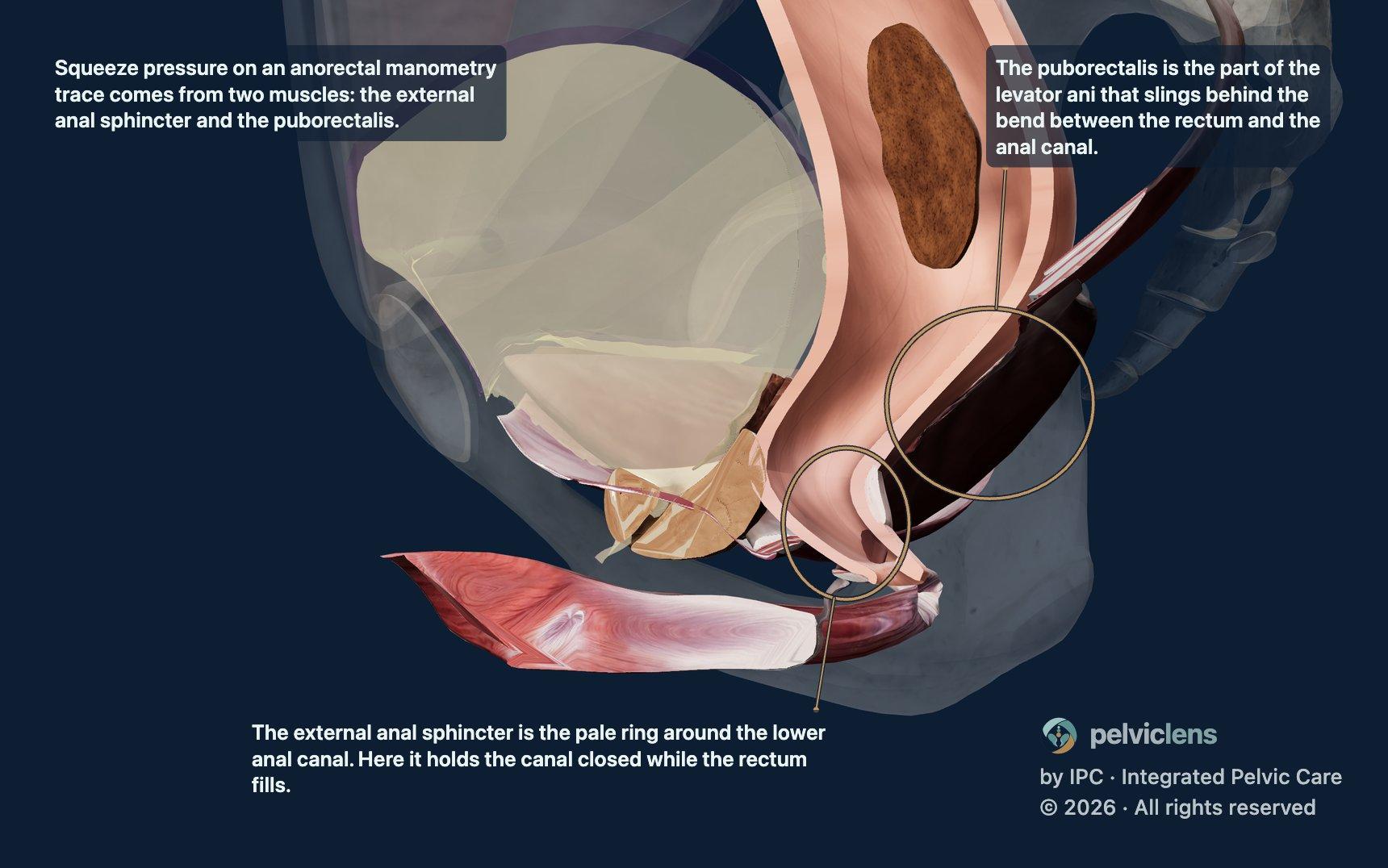
The short answer. Anorectal manometry measures pressure in the anal canal and the rectum while your patient rests, squeezes, pushes and feels a balloon fill [1]. Resting pressure is mostly the internal anal sphincter, and squeeze pressure is the external anal sphincter and the puborectalis [2]. A push pattern alone is never a diagnosis [1].
Key takeaways
- Resting pressure is mostly the internal anal sphincter, a smooth muscle no cue reaches, while squeeze pressure is the external anal sphincter and the puborectalis [2].
- In the London classification, a low resting or squeeze pressure, an absent reflex and abnormal rectal sensation are major findings. A high resting pressure and a dyssynergic push are minor or inconclusive [3].
- The trace names the muscle behind a pressure. Your exam names the pattern, and the pattern chooses the treatment.
The anorectal manometry report in your patient's file says his anal resting pressure is high, and the referral beside it says "tight pelvic floor". Yet most of a resting pressure comes from the internal anal sphincter, a smooth muscle that he cannot relax on request, so a relaxation drill never reaches the number it was prescribed for [2]. Each line of the trace belongs to a muscle, and once you know which one, the report tells you what to examine. The test is also called anal manometry, or anorectal physiology testing in UK units.
Anorectal manometry: the trace as muscle
A manometry catheter a few millimeters wide reads three muscles at once. It carries pressure sensors along at least 6 cm and lies across the anal canal, with a balloon in the rectum above. Your patient lies on his left side with his hips and knees flexed, so the reading samples his muscles lying down, not on the toilet [1]. The protocol records rest, short and long squeezes, coughs and pushes, then a rapid balloon inflation for the rectoanal inhibitory reflex and a slower filling for three sensory volumes. With the balloon expulsion test beside it, the whole set takes 15 to 20 minutes [1].
The anal sensors lie in a high-pressure zone about 4 cm long in healthy men [4]. The puborectalis slings around its upper end, the internal anal sphincter forms the inner ring and the external anal sphincter the outer ring, as the male pelvic floor anatomy pillar shows. The report gives one resting and one squeeze pressure for the whole canal [1], and the puborectalis in that pressure also holds the anorectal angle.
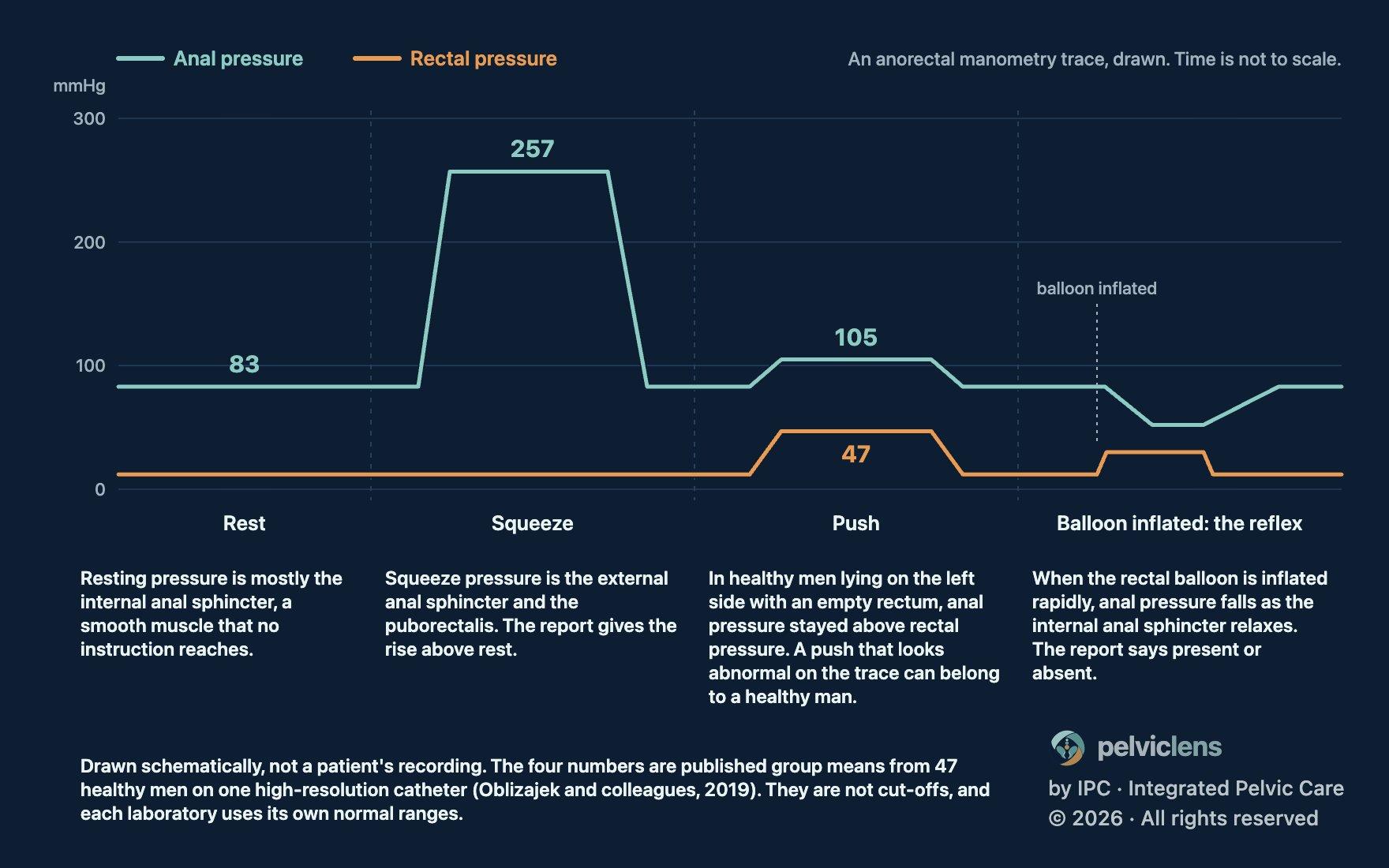
Anal and rectal pressures change through rest, a squeeze, a push and a balloon inflation on this schematic anorectal manometry trace, drawn with published group means from 47 healthy men.
Your patient is sure that the high resting number means he clenches all day, and that he can learn to let it go.
Resting and squeeze pressure: which muscle
The resting number that gets read as tightness is mostly smooth muscle. Rome IV attributes about 70 percent of resting anal pressure to the internal anal sphincter [2]. When a block of the pudendal nerve paralyzed the striated muscles of ten healthy subjects, the internal sphincter alone still held about 85 percent [5].
The internal anal sphincter is autonomic: it gives a uniform tone around your finger that no cue or exercise changes. The proctalgia fugax article follows that sphincter into a pain that comes in attacks. The external anal sphincter is somatic, and the involuntary contractions you feel in a Guarding pattern come from it.
Squeeze pressure reflects the voluntary contraction of the external anal sphincter and the puborectalis [2]. It is the highest rise above resting pressure in the best of three five-second squeezes, and the 30-second long squeeze records how long he holds more than half of that rise [1].
On one high-resolution catheter, 47 healthy men rested at a mean of 83 mmHg and squeezed to 257 mmHg, against 85 and 207 mmHg in healthy women under 50, and resting pressure fell with age in both sexes [4]. Because equipment varies, there are no universal normal values, and the report is read against its laboratory's range for his sex and age [1].
The London classification calls a reduced resting pressure anal hypotension, an increased one anal hypertension and a reduced squeeze anal hypocontractility [3]. "Hypertonic" and "hypotonic" on a referral name a classification of the floor instead, which Integrated Pelvic Care's masterclass sets aside because "Tone is not one thing" and "Tone does not equal function".
The rectoanal inhibitory reflex on the trace
One line of the report records a muscle that takes no instruction at all. The examiner distends the rectal balloon rapidly, and anal pressure falls during the distension [1]. The fall is the internal anal sphincter relaxing, and a maximal reflex can inhibit its whole share of resting pressure [6], while the striated muscles hold the canal. The report states only whether the reflex is present or absent [1].
An absent reflex, rectoanal areflexia, is a major finding in the London classification [3]. Before it is believed, a balloon too small for a large rectum, fecal loading and a previous rectal resection are excluded [1]. In an adult with a megarectum, it may call for investigation to exclude aganglionosis, the defect of Hirschsprung disease [1].
Rectal sensation: three volumes, read apart
The last part of the test measures no muscle. As the balloon fills, your patient reports the first constant sensation, the desire to defecate and the maximum tolerated volume [1]. Rectal hyposensitivity is two or more of those volumes above the laboratory's upper limit, and one volume above it is borderline. Rectal hypersensitivity is at least one volume, including the maximum tolerated volume, below the lower limit [3].
Read the volumes one by one: in 1,618 patients, 92 percent of them women, they agreed only poorly to moderately, and ran higher with age, in men and in constipation [7].
A rectum that senses late weakens the urge, and retained stool may blunt sensation further [2]. The urge is your patient's signal to go, and a push without it becomes straining.
The push maneuver and its false positives
The most quoted line of the report is the one that most often looks abnormal in healthy people. Your patient bears down three times for 15 seconds as if on the toilet, and the laboratory analyzes the most normal attempt because of "the high rate of false-positive results" [1].
Three experts, blinded to who was healthy, found a pattern that the criteria call dyssynergic in 87 percent of 85 healthy women [8].
The men's data carry the same warning. In 47 men who expelled the balloon normally, anal pressure stayed a mean of 58 mmHg above rectal pressure during a push on an empty rectum [4].
So the London classification never grades a push alone. Dyssynergia counts only beside a prolonged balloon expulsion or impaired emptying on imaging, and then only as a minor finding, while an abnormal push with a normal expulsion is inconclusive [3]. The balloon has false positives of its own: 3 of 50 healthy men took more than 60 seconds to expel it [4]. The four push patterns and the Rome IV criteria are set out in dyssynergic defecation.
London classification: major, minor, inconclusive
The London classification grades how much weight a finding can carry, not how severe it is. A major finding is a pattern not seen in healthy controls, a minor finding may also be seen in controls, and the relevance of an inconclusive finding is not yet determined [1].
| Grade | Findings |
|---|---|
| Major | Rectoanal areflexia, anal hypotension, anal hypocontractility, the two combined, rectal hyposensitivity and rectal hypersensitivity [3] |
| Minor | Anal hypertension, and an abnormal balloon expulsion with dyssynergia, with poor propulsion, or with both [3] |
| Inconclusive | An abnormal expulsion with a normal push, a normal expulsion with an abnormal push, and borderline rectal hyposensitivity [3] |
Endoanal ultrasound: the rings behind the pressure
A low squeeze pressure says the canal closes poorly, not whether a ring is broken, and endoanal ultrasound answers that. A rigid probe in the anal canal gives 360-degree views of the sphincter complex [9]. Two rings fill the image: the dark inner ring of the internal anal sphincter and the bright outer ring of the external anal sphincter, below the puborectalis [9]. It detects defects in both, reliably in the internal sphincter, while the external sphincter can be harder to read [2]. It is the first choice for imaging the sphincters in fecal incontinence [2], particularly when surgery is considered, and it complements manometry and defecography when emptying is the problem [9]. A pressure defect on three-dimensional manometry is no substitute, since the two agree only slightly [9].
What an anorectal manometry result changes
The report does not choose the treatment; it tells you which part of your exam needs most care. Your finger already covers part of the test. In adults with dyssynergia, a rectal examination identified normal resting and squeeze pressure in 86 and 82 percent, and was reliable for "normal, but not abnormal, sphincter tone" [10]. The catheter adds most where a low pressure, the reflex or sensation is in question.
Each maneuver has an exam task that tests the same capacity, and the IPC Male Pelvic Floor Patterns are named from those tasks, never from a pressure.
| On the report | What your exam tests |
|---|---|
| A low squeeze or a short long squeeze | The voluntary contraction, for two Underactivation A criteria: "Weak / incomplete voluntary contraction" and "Poor sustained contraction / reduced endurance" |
| A cough with no anal rise | The repeated cough, for the Underactivation B criterion "Absent or consistently delayed expected PFM response during repeated cough, rapid increase in IAP, or functional loading despite an available voluntary contraction" |
| A push in which anal pressure rises or does not fall | Whether a cue changes the outlet: the Guarding pattern shows "Paradoxical contraction/elevation when relaxation or descent is functionally required" and changes with cueing; the Restriction pattern shows limited descent or opening "without evidence of active protective contraction" and does not |
| A high resting pressure | Mostly smooth muscle, so not a pattern: an involuntary contraction or an indrawn perineum, and whether a cue changes it |
| Pain during the test | The Myofascial pain pattern, found when palpation of a tender point reproduces your patient's familiar pain |
A pattern needs "1 major criterion or 3 minor criteria" and matters when it explains your patient's symptoms. The table aligns tasks; it is not a validated reading of the numbers.
Down-regulation for the Guarding pattern is taught in pelvic floor downtraining, with the Restriction pattern's mobility work. The trials tested instrumented pelvic floor biofeedback, which a joint American and European position paper recommends for dyssynergic defecation (Level I, Grade A) and fecal incontinence (Level II, Grade B) [11]. Rome IV adds that it does not help constipation without a functional defecation disorder, the reason to test before prescribing it [2].
Is anorectal manometry painful?
Your patient asks this before he agrees to the referral, and the protocol reports no pain score. A thin, flexible catheter goes in with lubricant, and the balloon filling stops at the maximum volume he tolerates [1]. When anal contact itself hurts, that is an exam finding: "Pain with anal contact or insertion" is a minor criterion of the Myofascial pain pattern, so tell the laboratory before the test.
What to say to your patient
- With the squeeze playing on the model: "Watch this outer ring close and lift. That is the squeeze your test measured."
- When the report says his resting pressure is high: "Most of that number is a muscle you do not control. You are not doing anything wrong."
- When the report says dyssynergia: "The test saw your muscles close when you pushed. Many healthy people show that too. My exam will show what to work on."
Frequently asked questions
What does an anorectal manometry test show?
An anorectal manometry test shows the pressure of the anal sphincters at rest and in a squeeze, and the reflex relaxation of the internal anal sphincter. It also shows when the rectum senses filling and how anal and rectal pressure change in a push. Each result is read against the laboratory's own range, and the push together with the balloon expulsion test.
How do you prepare for anorectal manometry?
Preparation for anorectal manometry is light. Bowel preparation is optional, your patient may empty his bowels beforehand, and an enema is allowed and recorded on the report. He lies on his left side with his hips and knees flexed. The manometry, the rectal sensory test and the balloon expulsion test together take 15 to 20 minutes.
What is a normal anal resting pressure?
There is no single normal anal resting pressure, because the value depends on the catheter, the protocol, sex and age. On one high-resolution catheter, healthy men averaged 83 mmHg and healthy women under 50 averaged 85 mmHg, and resting pressure fell with age in both. A report is read against its own laboratory's range.
Can anorectal manometry diagnose dyssynergic defecation?
Anorectal manometry cannot diagnose dyssynergic defecation on its own. The London classification counts a dyssynergic push only with a prolonged balloon expulsion or impaired emptying on imaging, and grades it as minor. In one blinded study, 87 percent of healthy women showed a push pattern the criteria call dyssynergic. Your exam then finds whether a cue changes the outlet.
How do you interpret anorectal manometry results?
Read the report in the London classification's four parts: the rectoanal inhibitory reflex, anal tone and contractility, rectoanal coordination and rectal sensation. Each finding is graded major, minor or inconclusive against the laboratory's own range, and a dyssynergic push counts only beside an abnormal balloon expulsion or abnormal emptying on imaging. The report names a pressure; your exam names the pattern behind it.
References
- The international anorectal physiology working group (IAPWG) recommendations: Standardized testing protocol and the London classification for disorders of anorectal function. Neurogastroenterology and Motility, 2020.
- Functional Anorectal Disorders. Gastroenterology, 2016.
- The London Classification: Improving Characterization and Classification of Anorectal Function with Anorectal Manometry. Current Gastroenterology Reports, 2020.
- Anorectal pressures measured with high-resolution manometry in healthy people: Normal values and asymptomatic pelvic floor dysfunction. Neurogastroenterology and Motility, 2019.
- Influence of pudendal block on the function of the anal sphincters. Gut, 1975.
- The composition of anal basal pressure. An in vivo and in vitro study in man. International Journal of Colorectal Disease, 1989.
- Volumetric Rectal Perception Testing: Is It Clinically Relevant? Results From a Large Patient Cohort. The American Journal of Gastroenterology, 2021.
- Diagnostic accuracy study of anorectal manometry for diagnosis of dyssynergic defecation. Gut, 2016.
- Expert consensus document: Advances in the evaluation of anorectal function. Nature Reviews Gastroenterology & Hepatology, 2018.
- Digital rectal examination is a useful tool for identifying patients with dyssynergia. Clinical Gastroenterology and Hepatology, 2010.
- ANMS-ESNM position paper and consensus guidelines on biofeedback therapy for anorectal disorders. Neurogastroenterology and Motility, 2015.
Related articles
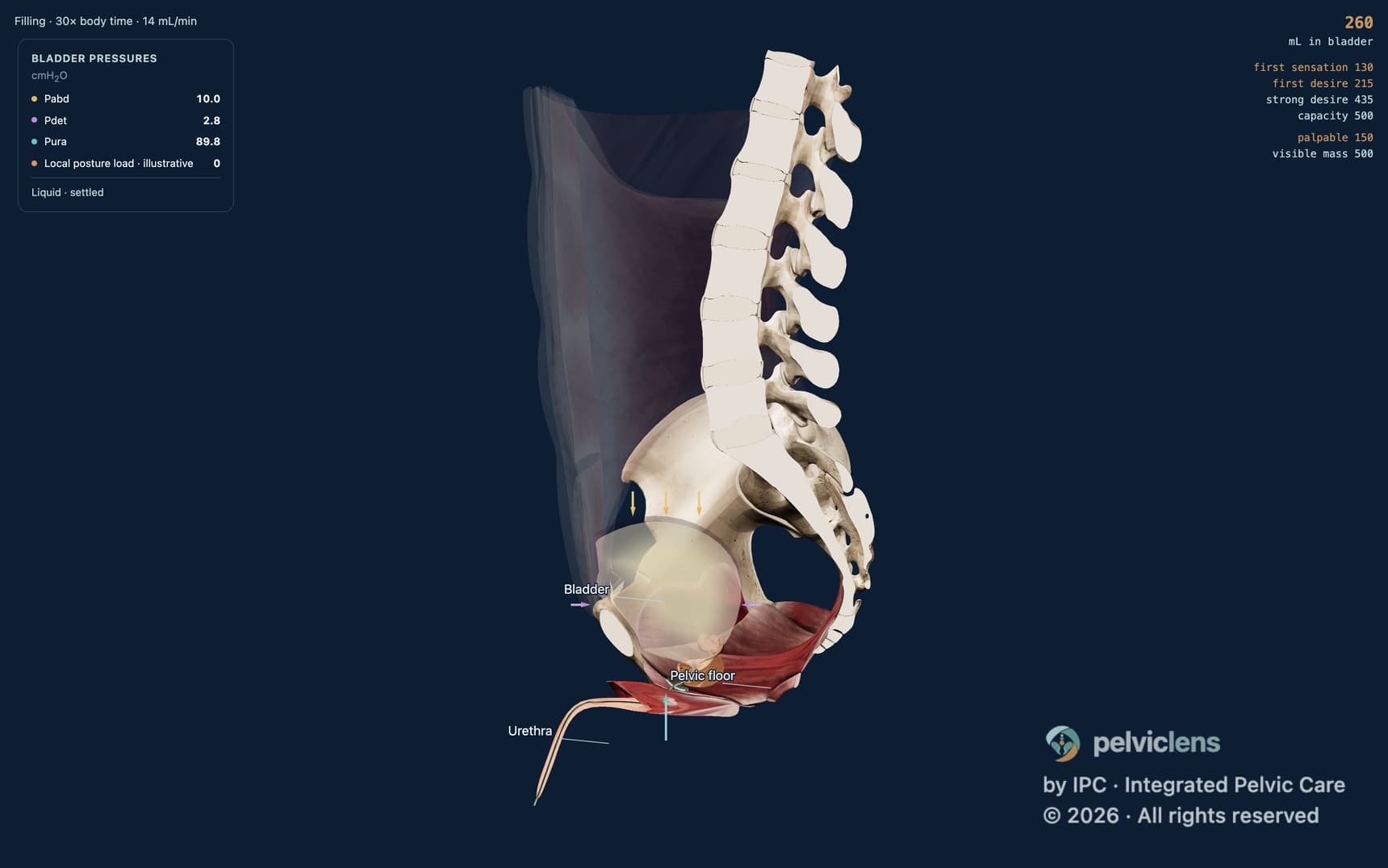 Cystometrogram: how to read the traceCystometrogram for the pelvic health clinician: the filling curve read as pressure, Pves = Pabd + Pdet, and what to tell your patient.16 min read
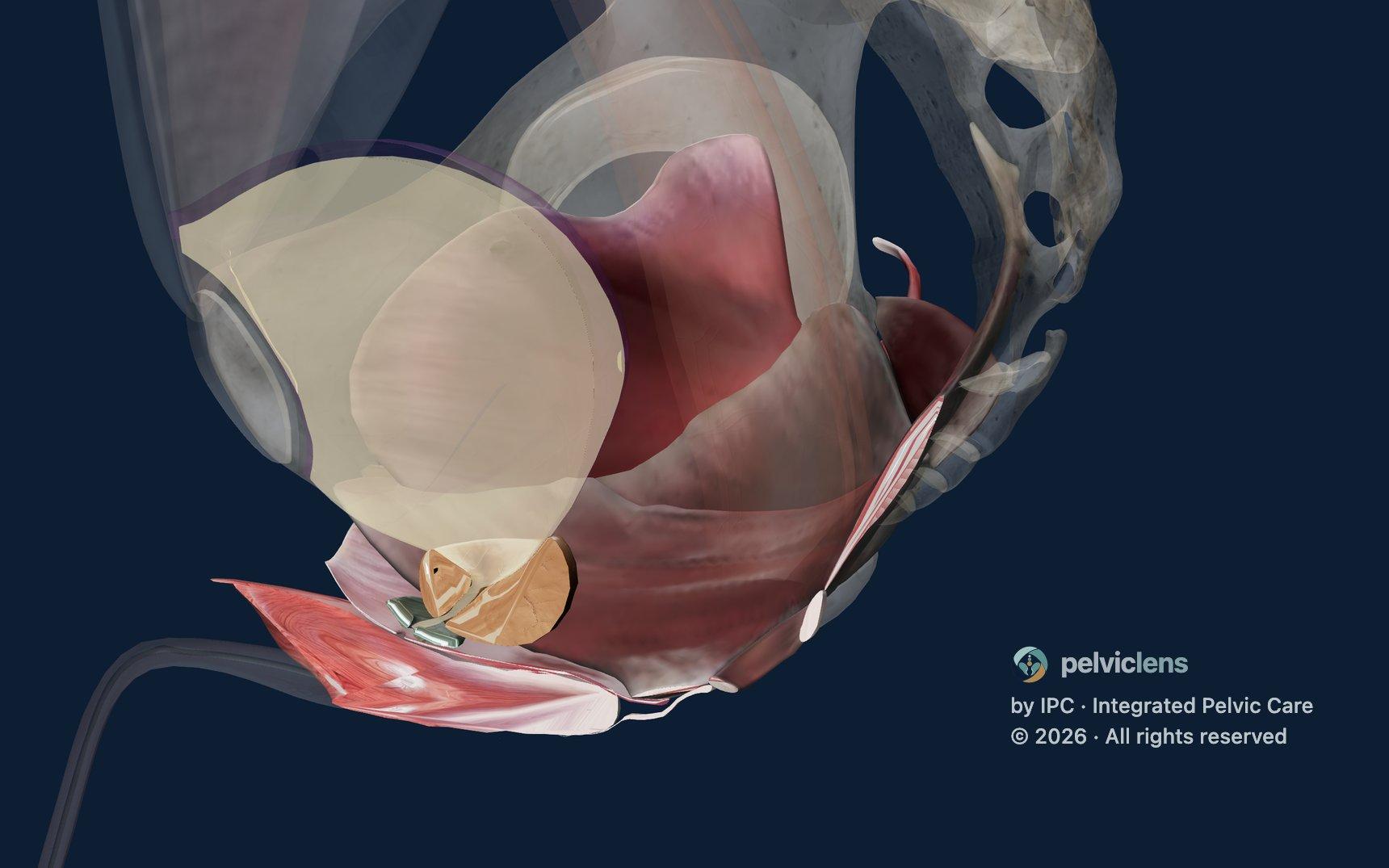 Men’s healthPelvic floor downtraining in menHypertonic pelvic floor in men is a label, not a finding: pelvic floor downtraining is down-regulation for the Guarding pattern the exam finds.17 min read
 Men’s healthPudendal neuralgia: criteria and testsPudendal neuralgia in men: the Nantes criteria, the P slump test and the pudendal nerve tests, from EMG to the CT-guided block, read by Four Horsemen.10 min read
Read this article in Français · Español · Português · Deutsch
This article is education for health professionals. It is not medical advice, not a diagnosis and not a treatment plan for any person. Clinical decisions rest on your own assessment of the patient in front of you. If you are a patient reading this, talk it through with your own health professional. Evidence changes: the review date above tells you when this article was last checked.