
Cystometrogram
Cystometrogram for the pelvic health clinician: the filling curve read as pressure, Pves = Pabd + Pdet, and what to tell your patient.

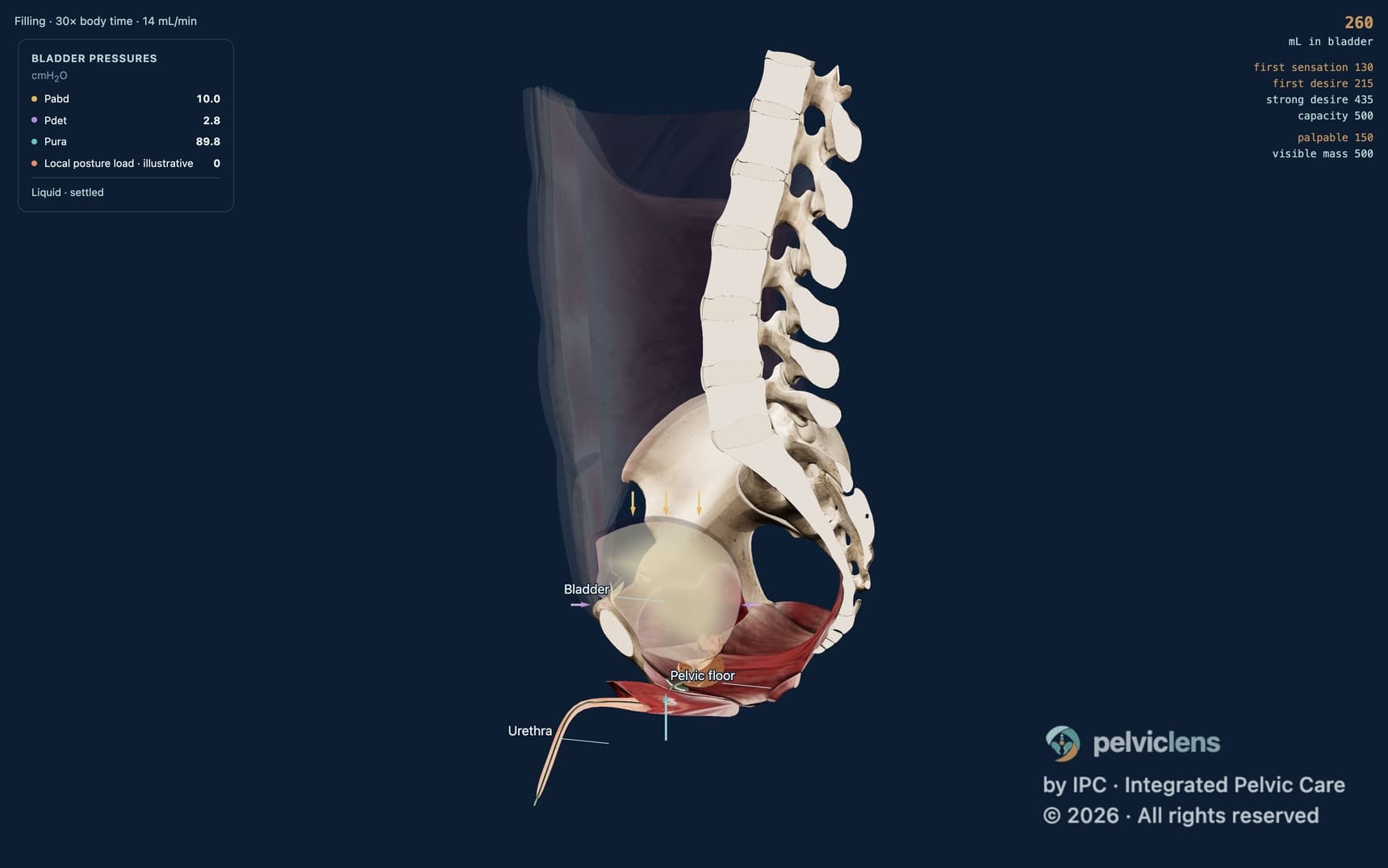
The short answer. A cystometrogram is the pressure record of the bladder as it fills: vesical pressure measured in the bladder, abdominal pressure in the rectum, and detrusor pressure calculated as their difference, all plotted against the volume infused [1]. Storage holds while vesical pressure stays below urethral pressure, so the trace shows which pressure the clinician can change.
Key takeaways
- The detrusor line on a cystometrogram is never measured. It is vesical pressure minus abdominal pressure, so it can read below zero. The regular cough spikes check both lines.
- Normal volumes come from healthy volunteers. In twenty men, first sensation came at about 130 mL, first desire at 215, strong desire at 435 and capacity at 500. Yet 71 percent of that study's healthy volunteers showed at least one pathological finding, so a finding is not a diagnosis.
- Position and fill rate change the trace: supine filling misses much of the detrusor overactivity, and a fast fill can manufacture low compliance.
- In two randomised trials, of women with uncomplicated stress incontinence and of men considering prostate surgery, adding urodynamics did not improve the outcome. The test earns its place when its answer will change the plan.
The referral arrives with a urodynamics report folded behind it: four traces, a column of numbers and one line of conclusion, "no detrusor overactivity; normal compliance; VLPP 68 cmH2O". Your patient leaks every time she lifts her grandson, and that line reads like good news. The cystometrogram behind it is one equation drawn against time. Read as pressure, it shows what pushed urine past her outlet and which of those pressures your next session can change.
Filling cystometry: the trace as pressure
The line on the report that looks most like the bladder, the detrusor line, is the one nobody measured. Vesical pressure, Pves, is recorded through a thin double-lumen catheter in the bladder. Abdominal pressure, Pabd, is recorded through a fluid-filled balloon catheter in the rectum, or in the vagina when the rectum cannot be used. Both are zeroed to atmospheric pressure and referenced to the level of the upper edge of the pubic symphysis, so numbers from two laboratories mean the same thing [2]. Detrusor pressure, Pdet, is calculated as Pves minus Pabd, so it can sit at zero or dip below it with nothing wrong with the bladder.
The teaching frames storage with that equation, rearranged: Pves = Pabd + Pdet. Detrusor pressure has a passive component, the stretch of a filling wall, and an active one, the contraction that empties it. Storage holds while vesical pressure stays below urethral pressure, Pura. A storage treatment therefore lowers abdominal pressure, keeps detrusor pressure low as capacity grows, or raises urethral pressure. A voiding strategy does the reverse, raising vesical pressure and lowering urethral pressure. In the teaching's four Mechanical Zones, Zone II, the Abdominal Zone, generates abdominal pressure. Zone III, the Pelvic Zone, adds the pelvic floor's share of urethral pressure, and Zone IV, the Bladder, generates detrusor pressure. Zone I, the Spinal Zone, changes all three through posture and the nerves that leave the spine.
The storage reflexes and the wall's own compliance are why the detrusor line on a healthy trace barely moves while the bladder fills. Sympathetic hypogastric outflow inhibits detrusor contraction and contracts the smooth muscle of the bladder outlet. Pudendal outflow from Onuf's nucleus to the striated urethral sphincter rises as the bladder fills, which is the guarding reflex [3]. A detrusor line that climbs during filling therefore means low compliance, an involuntary contraction, or a load that reached one line and not the other.
A change of position is a load both lines see. Vesical and abdominal pressure rise together from lying to sitting to standing, and the detrusor line stays near zero [4]. The teaching adds the spine: a slouch loads the bladder and sitting tall takes the load off. The pressure model shows that direction with an illustrative load. On the model a slouch's local load on the bladder dome never reaches the rectal line, so the equation holds but the displayed detrusor line carries it; in the laboratory a slouch raises the rectal line too.
In the film the detrusor line climbs in the slouch and reads below zero with the spine tall. Yet the model's own detrusor pressure holds at 2.8 cmH2O. So before a detrusor rise on a real trace is called a bladder finding, check that the abdominal line moved with the bladder line [2].
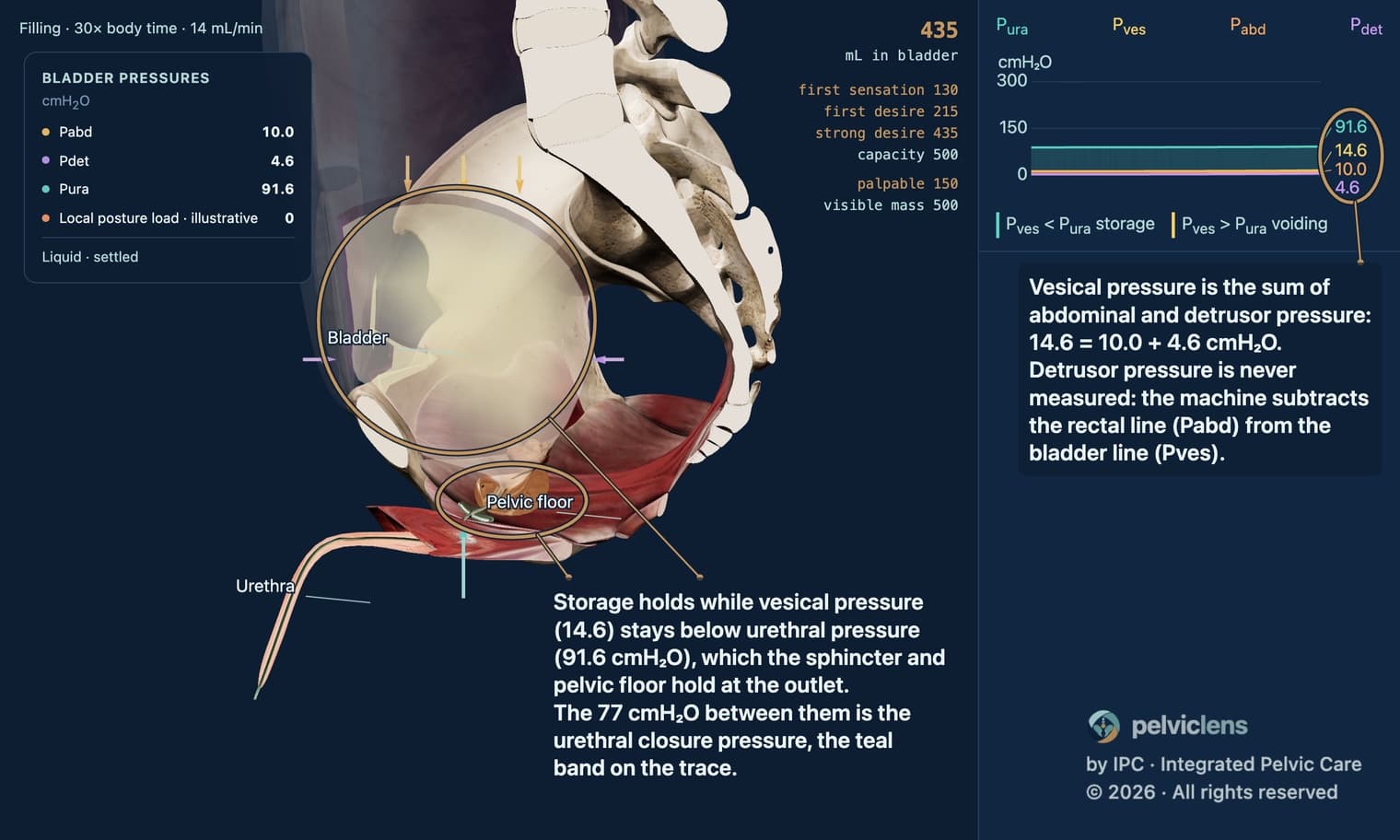
This still shows the Pelvic Lens pressure model supine, because its clinician page runs supine, so the abdominal readout is 10.0 cmH2O. That is the supine row of the model's position table, 10 supine, 25 sitting and 32 standing, inside the ICS typical resting ranges [4]. The filling course is held at 435 mL, the strong-desire marker from the healthy men in Leitner 2016 [5]. The circled readouts on the trace are abdominal 10.0, detrusor 4.6, vesical 14.6 and urethral 91.6 cmH2O, so the closure margin is 77 cmH2O. The full animation plays on pelviclens.com.
How to read a cystometrogram, line by line
The spikes that recur along the trace are not findings. They are line checks: coughs the technician asks for about every minute or every 50 mL during filling, and immediately before and after voiding. A good cough raises vesical and abdominal pressure equally, leaving the detrusor line flat or with a biphasic spike, a common artefact the lab can accept [4]. A weak or absent response on one line means a blocked, kinked or displaced catheter, which the lab flushes or repositions before repeating the cough. A dead abdominal line turns every cough into a false detrusor spike.
A report prints vesical pressure, abdominal pressure, the calculated detrusor pressure and the volume infused, with flow and pelvic floor EMG where the lab recorded them. The event marks note what your patient reported and did: first sensation, first desire, strong desire, capacity, permission to void, and each cough, strain or change of position.
The first centimetre of the trace is its own check. Resting vesical and abdominal pressure sit around 5 to 20 cmH2O lying down, 15 to 40 sitting and 30 to 50 standing. The initial detrusor pressure is zero or close to it: 0 to 6 cmH2O in 80 percent of cases, and rarely up to 10 [4]. A rectal contraction shows as a positive wave on the abdominal line mirrored by a negative wave on the detrusor line. An expelled catheter shows as a sudden drop [2]. Neither artefact is a finding about the bladder.
Cystometrogram normal results: sensation and capacity
Normal cystometrogram results are usually summarised as variable, which is of little use with a report in your hand. The ICS names four landmarks, and the technician marks each one as your patient reports it:
- First sensation of filling is the first awareness that the bladder is filling [6].
- First desire to void is the point at which she would void at the next convenient moment, though she can wait [6].
- Strong desire to void is a persistent desire to void without fear of leaking [6].
- Maximum cystometric capacity, in a patient with normal sensation, is the volume at which she feels she can no longer delay voiding [6].
In twenty healthy men in Zürich, first sensation came at about 130 mL, first desire at 215, strong desire at 435 and capacity at 500, each with a wide spread. Yet 71 percent of that study's 42 healthy volunteers, with normal diaries, examinations and flow rates, showed at least one pathological finding when filled twice in one session [5]. A trace describes a bladder on one day; it does not diagnose one.
In the teaching's clinical experience, the detrusor contracts best when your patient voids between about 260 and 350 mL. A bladder held to 500 or 600 mL again and again is overstretched smooth muscle on the road to retention. The bladder diary records that working capacity without a catheter. The normal capacity of the bladder it shows is functional capacity, not the maximum cystometric capacity a lab fills to.
Bladder compliance and the detrusor leak point pressure
Low compliance on a report is a question before it is a finding. Compliance is the volume the bladder accepts for each centimetre of water that detrusor pressure rises, in mL/cmH2O, calculated across filling with contractions left out. The ICS terminology report for men gives low compliance as below 10 mL/cmH2O in a neurogenic bladder and below 30 in a non-neurogenic one. Those cut-offs were defined in women, and the report states that values for men are not well defined [1]. The ICI-RS think tank on the measurement found a wide range in healthy volunteers. It concluded that poor compliance still needs a better definition [7].
The common artefact comes from the filling pump. The viscoelastic wall needs time to relax around new volume, so a fast fill can manufacture low compliance [7]. A careful laboratory stops the pump, or repeats the fill more slowly, and watches whether detrusor pressure settles back [1]. On your patient's report, "normal compliance" means her detrusor pressure stayed low while the lab filled her.
Compliance matters because of what storage pressure does upstream. In 42 people with myelodysplasia followed for a mean of seven years, none of the 20 who leaked at an intravesical pressure of 40 cmH2O or less had vesicoureteral reflux. Of the 22 who leaked above it, 68 percent had reflux [8]. That measurement became the detrusor leak point pressure, with 40 cmH2O as its traditional line. The ICS teaching module warns that the measurement lacks standardisation. It adds that end-filling pressure or the leak pressure of neurogenic detrusor overactivity is often reported under its name. No cut-off, 40 included, reliably separates the upper tracts at risk, so the number is never read alone [9].
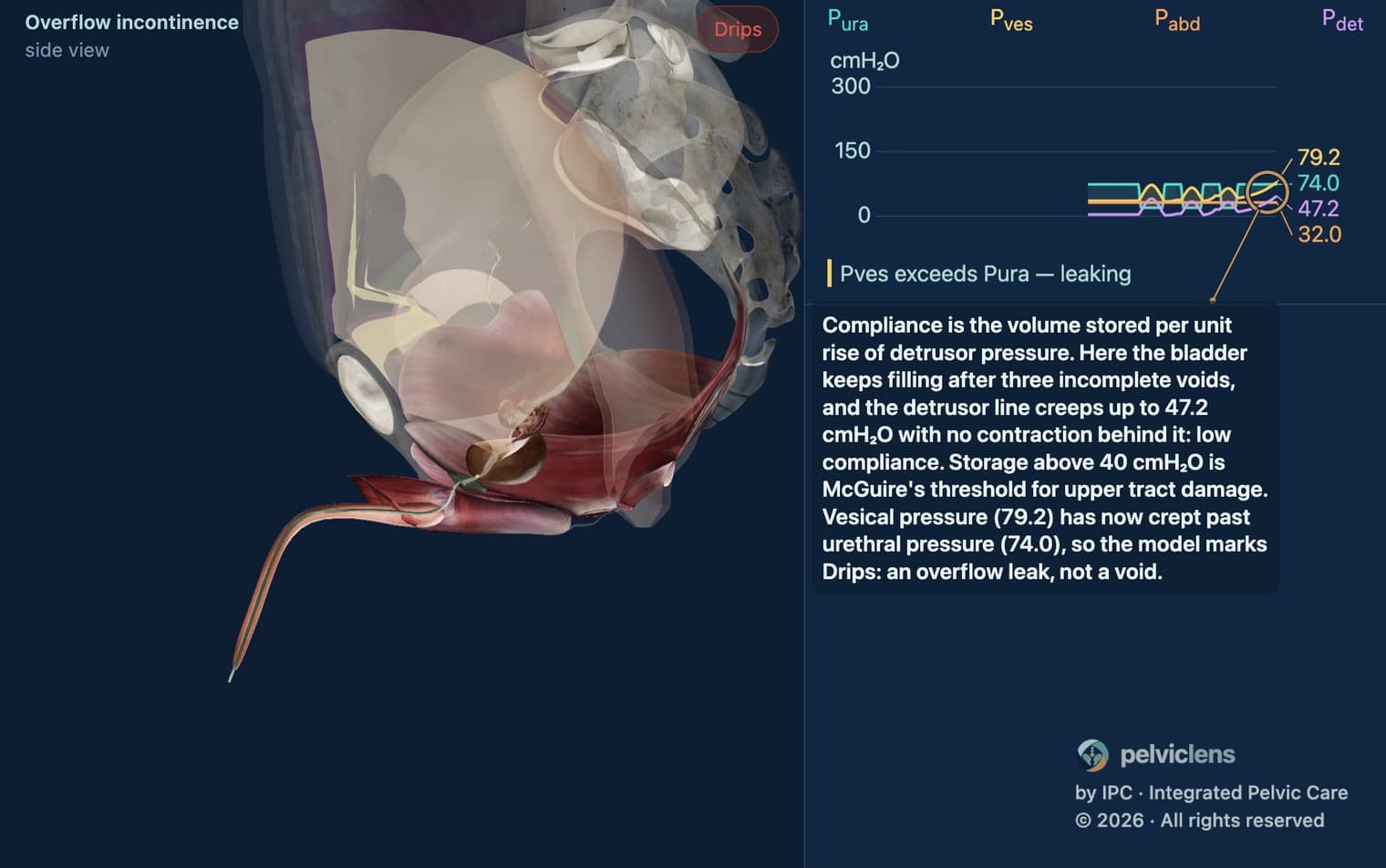
This still shows the overflow chapter of the Pelvic Lens incontinence model after three incomplete voids, with the model's bladder near 900 mL. Detrusor pressure has crept to 47.2 cmH2O with no contraction behind it. Vesical pressure, 79.2, is now past urethral pressure, 74.0, so the model marks drips, an overflow leak. The model's pressure curve above 500 mL is calibrated shape, not overdistension data. The full animation plays on pelviclens.com.
For the pelvic health clinician, high storage pressure changes the plan first. A high-pressure bladder is not trained toward a bigger capacity, because more volume at that pressure threatens the upper tracts. The plan is made with the urologist.
Detrusor overactivity on the trace, and what it is not
"No detrusor overactivity" on a report means the detrusor stayed quiet during one fill, at one rate, in one position. Detrusor overactivity is a urodynamic observation: involuntary detrusor contractions during filling cystometry, spontaneous or provoked, with no lower limit on their amplitude. Phasic detrusor overactivity is a characteristic wave, with or without leakage. Terminal detrusor overactivity is a single involuntary contraction at cystometric capacity that cannot be suppressed and results in incontinence, usually emptying the bladder [6]. On the trace the vesical and detrusor lines rise while the abdominal line stays flat. Without that trace the diagnosis is not made in the clinic.
The symptom predicts the trace unevenly. With urgency incontinence, detrusor overactivity appeared in 90 percent of men but 58 percent of women in one tertiary unit. The authors attributed the gap to the women's coexisting stress incontinence [10]. Filling position matters too. A review of sixteen studies found that supine filling would have missed between 33 and 100 percent of detrusor overactivity diagnoses. It recommended filling sitting or standing unless a disability prevents it [11]. So the first question about a quiet trace is how your patient was filled, at what rate, and whether the lab tried her triggers, such as running water [1].
The opposite error is real too. In the Zürich study, 14 percent of the healthy women and 30 percent of the healthy men showed detrusor overactivity, so a wave without the matching symptom is not a diagnosis either [5]. In the 4Is, the teaching's assessment frame, detrusor overactivity belongs to Storage Impairment. The clinic's evidence for it is the bladder diary's urgency, frequency and small voided volumes.
What a cough shows: leak point pressure and the outlet
The same cough appears twice on a report and means two different things. Through the fill it is the line check. At a stated volume, a cough or a Valsalva strain becomes the provocation test for stress leakage. The lowest vesical pressure at which urine leaks with no detrusor contraction is the abdominal leak point pressure, written VLPP after a strain and CLPP after a cough.
The conventional reading of the abdominal leak point pressure comes from case series in women. A pressure below 60 cmH2O points to intrinsic sphincter deficiency, a urethral closure mechanism that has lost its reserve. That line, and the bands that read 60 to 90 as equivocal and above 90 as urethral hypermobility, are conventions carried over to men after prostatectomy without validation there.
What sits in the urethra changes the number. In 53 women tested at 150 mL, the Valsalva leak point pressure read a median of 76 cmH2O with the urethral pressure sensor in place and 69 without it. Sixteen percent of them leaked only once the sensor was out [12]. So the 68 cmH2O on your patient's report, measured with a catheter in her urethra and inside the equivocal band, points to a mechanism to examine, not a grade for her leak.
Cough pressure transmission, the urethral pressure rise as a share of the abdominal rise, measures how the outlet answers a cough. In men with no previous pelvic surgery, the reflex response to a cough raised urethral pressure by about two and a half times the rectal rise. Every neurologically normal man showed that reflex, and 80 percent of men with lower motor neuron signs did not [13]. After radical prostatectomy, transmission measured as peak urethral over peak abdominal pressure was 77 percent at six weeks in the men who were dry and 37 percent in those who leaked [14].
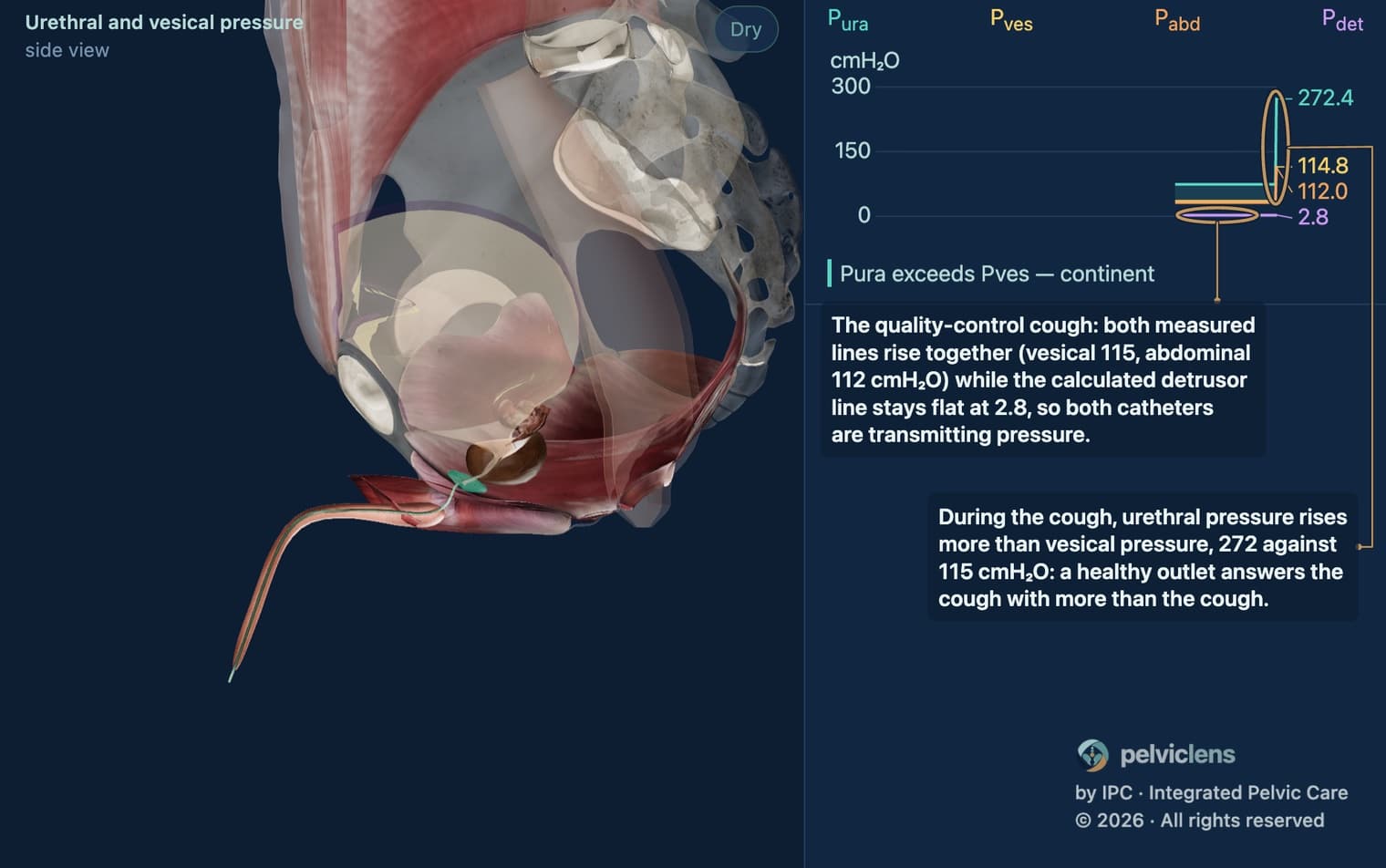
This still from the Pelvic Lens incontinence model shows its intact outlet at the peak of a cough. Urethral pressure reaches 272.4 cmH2O against vesical pressure at 114.8, so the outlet holds. Abdominal pressure reads 112.0 and the detrusor line stays flat at 2.8. The cough transmission is modelled on Robain 1999 and John 2000 [13] [14]. The full animation plays on pelviclens.com.
The same trace carries the teaching's lesson on the pelvic floor. A maximal contraction raises urethral pressure but recruits the abdominal wall, so vesical pressure rises with it and the closure margin barely widens. A submaximal contraction raises urethral pressure and leaves vesical pressure alone. That is Continence Control in the teaching's terms: a gentle squeeze with a breath out, timed right before the cough or the lift. For your patient, the first trigger to practise it on is lifting her grandson.
When to order a cystometrogram, and when not to
Two large trials asked whether the test changes what happens next, and for two common referrals the answer was no. In 630 women with uncomplicated, demonstrable stress incontinence, office evaluation alone was non-inferior to evaluation plus urodynamics before surgery, with success at a year in 77.2 against 76.9 percent. Urodynamics changed diagnoses, not the treatment chosen or the outcome [15]. In 820 men with bothersome lower urinary tract symptoms considering prostate surgery, adding urodynamics left the International Prostate Symptom Score at 18 months no worse, 12.6 against 13.1. It did not reduce surgery either, 38 against 36 percent [16].
The teaching reaches the same conclusion from the clinic. The test is invasive, fills the bladder retrogradely through a urethral catheter and does not always reproduce the symptom, so it is not where a workup starts. It earns its place when a neurological condition is suspected, when symptoms worsen despite treatment, before a second operation, and before any treatment that changes the structure of the lower urinary tract. The AUA/SUFU guideline on adult urodynamics, built on 393 studies, puts the test in the same place: after the evaluation and the characterisation of the symptoms [17].
In the clinic, the teaching's rule is that the pelvic health assessment is functional, not diagnostic. The 4Is set its order: Fluid Imbalance first, from the diary's 24-hour voided volume and nocturnal polyuria index, then Storage Impairment, from the maximum and average voided volumes. Voiding Impairment follows, from the flow curve and the post-void residual. In the teaching's experience a residual below about 300 mL is usually managed conservatively. Only the pressure-flow study, the voiding half of urodynamics, separates a blocked outlet from an underactive detrusor. Incontinence comes last, with the IPC stress cup test. A cystometrogram is ordered when a question inside one of those four has an answer that will change the plan.
Is a cystometrogram painful?
Your patient's question is about the catheter more than the pain. Your answer changes how the test goes, because her sensations are part of the measurement. A thin double-lumen catheter passes through the urethra into the bladder. A second line sits in the rectum, or in the vagina only when the rectum cannot be used [2]. The urethral catheter goes in with lubricating gel, usually with no other anaesthetic. She is filled sitting or standing whenever she can be [2]. She reports each sensation as the bladder fills, and she coughs or strains near capacity. The discomfort is usually pressure and urgency rather than pain.
A urinalysis to screen for infection or blood in the urine is completed before the test [2]. The test is postponed during a urinary infection, and the lab asks about pregnancy. A patient with a high spinal cord injury is watched for autonomic dysreflexia. The lab usually asks for a three-day bladder diary first, and bladder medication is stopped only on its instruction [2]. Afterwards, passing urine can sting, and the lab asks her to drink more that day to lower the small risk of infection.
Explain two things to her in advance. The repeated coughs check the lines and are not tests she can fail. If her usual urge or leak does not appear, she says so and the lab can try her trigger.
What to say to your patient
- When the referral arrives with a report: "Your test measured pressure, not only leaks. That tells us what to train."
- When the report says no overactivity but her diary shows urgency: "The test did not catch your urge. Your diary did. We treat what your diary shows."
- When the leak point pressure is low: "The door that holds urine in opens at a low push. We start with a small squeeze before you cough or lift."
- When the test is booked: "Two thin tubes go in, and you stay awake. Tell them every feeling. What you feel is part of the test."
Frequently asked questions
What is the difference between urodynamics and cystometrogram?
A cystometrogram is one part of urodynamics: the record of bladder pressure and volume while the bladder is filled through a catheter. Urodynamics is the whole study, which adds a free flow rate, a post-void residual, the pressure-flow study after permission to void, and often pelvic floor EMG or X-ray video. Storage problems such as detrusor overactivity, low compliance and stress leakage show in that filling phase.
What are the downsides of a cystoscopy?
A cystoscopy's downsides are brief discomfort as the scope passes, stinging on passing urine for a day or two, occasional blood in the urine and a small risk of urinary infection. It is a different test from a cystometrogram. A cystoscopy looks at the lining of the urethra and bladder through a camera and measures no pressure, so it cannot show compliance, detrusor overactivity or a leak point pressure.
Do they put you to sleep for a cystoscopy?
Usually not: a flexible cystoscopy is done awake, with anaesthetic gel in the urethra, and takes a few minutes. A rigid cystoscopy, used for some procedures, is done under general or spinal anaesthesia. A cystometrogram is done awake, because the sensations reported during filling are part of the measurement.
References
- The International Continence Society (ICS) report on the terminology for adult male lower urinary tract and pelvic floor symptoms and dysfunction. Neurourology and Urodynamics, 2019.
- International Continence Society Good Urodynamic Practices and Terms 2016: Urodynamics, uroflowmetry, cystometry, and pressure-flow study. Neurourology and Urodynamics, 2017.
- Neural control of the lower urinary tract. Comprehensive Physiology, 2015.
- Good urodynamic practices: uroflowmetry, filling cystometry, and pressure-flow studies. Neurourology and Urodynamics, 2002.
- Urodynamic Investigation: A Valid Tool to Define Normal Lower Urinary Tract Function?. PLOS ONE, 2016.
- The standardisation of terminology of lower urinary tract function: report from the Standardisation Sub-committee of the International Continence Society. Neurourology and Urodynamics, 2002.
- Bladder compliance what does it represent: can we measure it, and is it clinically relevant?. Neurourology and Urodynamics, 2011.
- Prognostic value of urodynamic testing in myelodysplastic patients. The Journal of Urology, 1981.
- ICS teaching module: Detrusor leak point pressures in patients with relevant neurological abnormalities. Neurourology and Urodynamics, 2017.
- Is the bladder a reliable witness for predicting detrusor overactivity?. The Journal of Urology, 2006.
- Does the patient's position influence the detection of detrusor overactivity?. Neurourology and Urodynamics, 2008.
- Influence of the urethral pressure transducer in measuring Valsalva leak point pressure in women undergoing multichannel urodynamic testing. Neurourology and Urodynamics, 2020.
- Urethral pressure response to cough and voluntary perineal contraction in men without previous pelvic surgery. Neurourology and Urodynamics, 1999.
- Effect of radical prostatectomy on sensory threshold and pressure transmission. The Journal of Urology, 2000.
- A randomized trial of urodynamic testing before stress-incontinence surgery. The New England Journal of Medicine, 2012.
- Diagnostic Assessment of Lower Urinary Tract Symptoms in Men Considering Prostate Surgery: A Noninferiority Randomised Controlled Trial of Urodynamics in 26 Hospitals. European Urology, 2020.
- Urodynamic studies in adults: AUA/SUFU guideline. The Journal of Urology, 2012.
Related articles
 Intrinsic sphincter deficiencyIntrinsic sphincter deficiency for the pelvic health clinician: why one valve is left after prostatectomy, and what to train first.16 min read
 External urethral sphincter: functionThe external urethral sphincter for the pelvic health clinician: what it closes, how a cough moves it, and how to train it.12 min read
Read this article in Français · Español · Português
This article is education for health professionals. It is not medical advice, not a diagnosis and not a treatment plan for any person. Clinical decisions rest on your own assessment of the patient in front of you. If you are a patient reading this, talk it through with your own health professional. Evidence changes: the review date above tells you when this article was last checked.