
Intrinsic sphincter deficiency
Intrinsic sphincter deficiency for the pelvic health clinician: why one valve is left after prostatectomy, and what to train first.

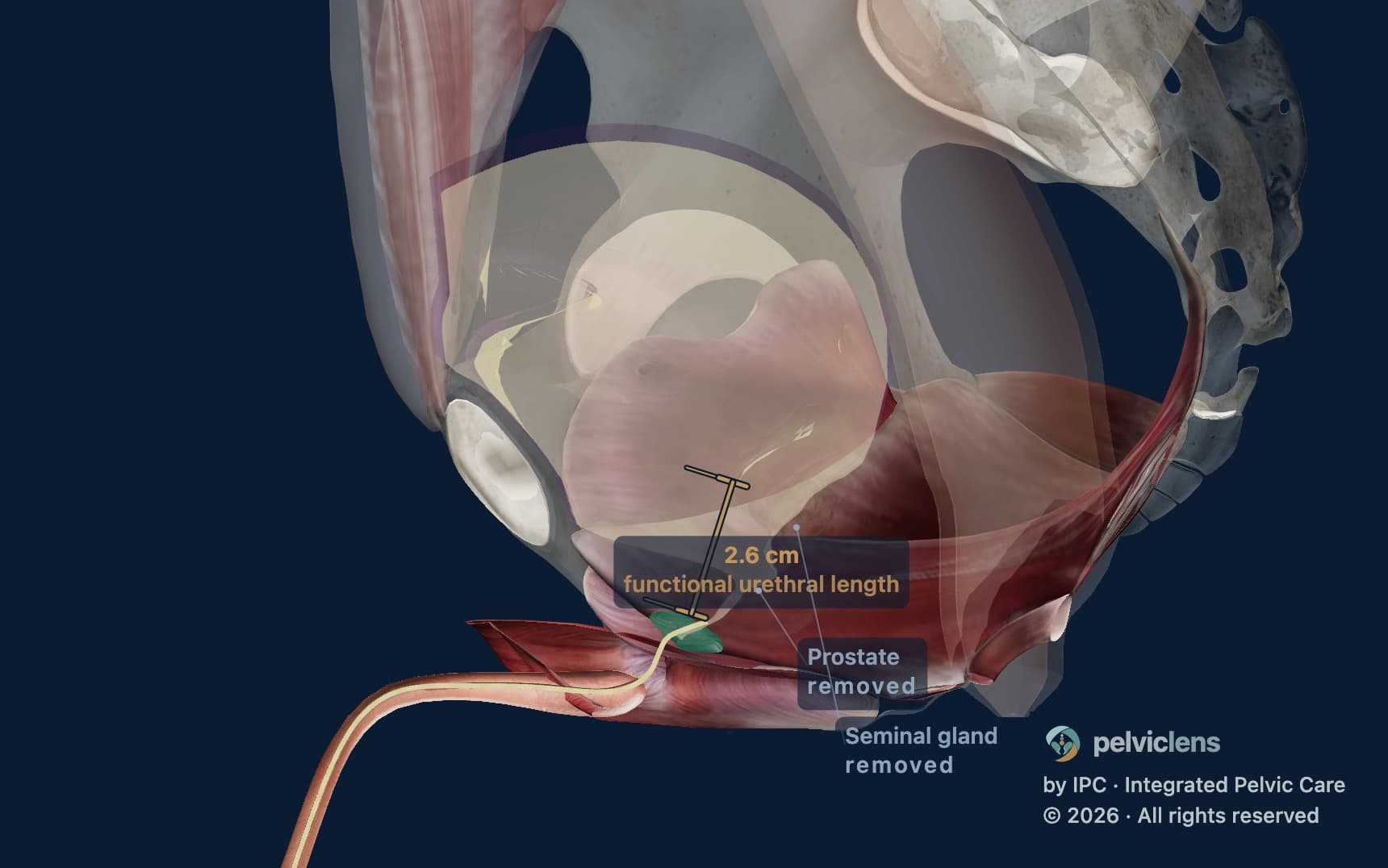
The short answer. Intrinsic sphincter deficiency is stress incontinence in which the urethral closure mechanism itself fails, so urine escapes at low abdominal pressure even with a well-supported urethra. It is the usual mechanism after radical prostatectomy: the bladder neck and internal sphincter are resected with the prostate, the striated sphincter is the only closure left, and pelvic floor training comes first [1].
Key takeaways
- The sphincter fails, not the support: urine crosses a urethra that sits in a normal position, at an abdominal pressure that an intact outlet would hold.
- After radical prostatectomy the internal sphincter and the bladder neck are resected with the gland, so the striated sphincter and the levator ani are the only closure left. That is the case a pelvic health clinic sees most.
- The 20 cmH2O closure pressure and 60 cmH2O leak point cut-offs were derived in women and agree with each other in about two thirds of them. They identify which mechanism is leaking; they do not grade how severe the leak is, and they do not decide the first treatment.
- The first treatment is a gentle pelvic floor contraction timed to land before the cough, the lift or the stand, taught and re-tested in the clinic room, started before surgery where the pathway allows it, and never performed while a catheter is in the urethra.
Your patient is six weeks past his prostatectomy, with a pad in his pocket and the ward's exercise sheet folded inside it. He has done the exercises, hard, every day, and he still leaks when he stands up from the chair. Intrinsic sphincter deficiency, ISD for short, is why. The term says where the problem sits: the urethra is not dropping out of position under load; the mechanism that closes it has lost its reserve, so an ordinary cough crosses it, and squeezing harder adds abdominal pressure to the cough. That changes the first instruction a clinician gives: a submaximal contraction timed before the cough, not a maximal squeeze. The sections below show why on the anatomy, what to measure, and what to train before anyone talks about a procedure. The same mechanism explains the woman whose sling lifted the urethra and changed nothing.
Post-prostatectomy incontinence: one valve left
Before surgery your patient has more closure than he will ever use, and never has to think about it. The internal sphincter at the bladder neck is smooth muscle under sympathetic control, closed throughout storage. Below it the urethra runs through the prostate, and below that the striated urethral sphincter, the omega-shaped loop of the middle pelvic floor layer, adds the voluntary part. The fascia, the ligaments and the vascular bundles around the urethra give that column its support and its seal. Urethral closure pressure is the sum of all of them, and storage holds for as long as that sum stays above bladder pressure, whatever a cough or a lift adds to it.
A radical prostatectomy resects the prostatic urethra with the gland. The bladder neck and the internal sphincter are resected in the same specimen, or divided and reconstructed where the surgeon preserves the neck, and the bladder is anastomosed to the membranous urethra. The periurethral fascia, the puboprostatic ligaments and, depending on the nerve-sparing plan, the neurovascular bundles are divided or disturbed, and part of what heals is fibrosis that fixes the urethra in place. So the striated sphincter, with the levator ani behind it, is the one closure left. Before the operation several structures controlled urethral pressure between them; after it, one structure does the whole job, and that structure is the pelvic floor.
The urodynamic series of men after radical prostatectomy measure what that costs. The functional urethral length, the segment whose closure pressure exceeds bladder pressure, falls from about five centimetres to under three. Cough pressure transmission, the urethral rise as a fraction of the abdominal rise, is about a third in the men who leak against three quarters in the men who stay dry [2]. In one series, maximum urethral closure pressure went from 84 cmH2O before surgery to 33 immediately after [3]. The abdominal leak point pressure test showed sphincter deficiency in 53 of 63 men who had none before [3]. At least six months on, in the video-urodynamic series that sorted the causes, sphincter deficiency alone explained the leak in two thirds of the men and was present in nine of ten [4].
This is easier to show than to describe. The post-prostatectomy chapter of the Pelvic Lens incontinence model plays the resection, shortens the functional urethral length along the urethra, and then coughs. Your patient watches the same cough that an intact outlet held cross the one sphincter he has left. The still below is the moment it crosses.
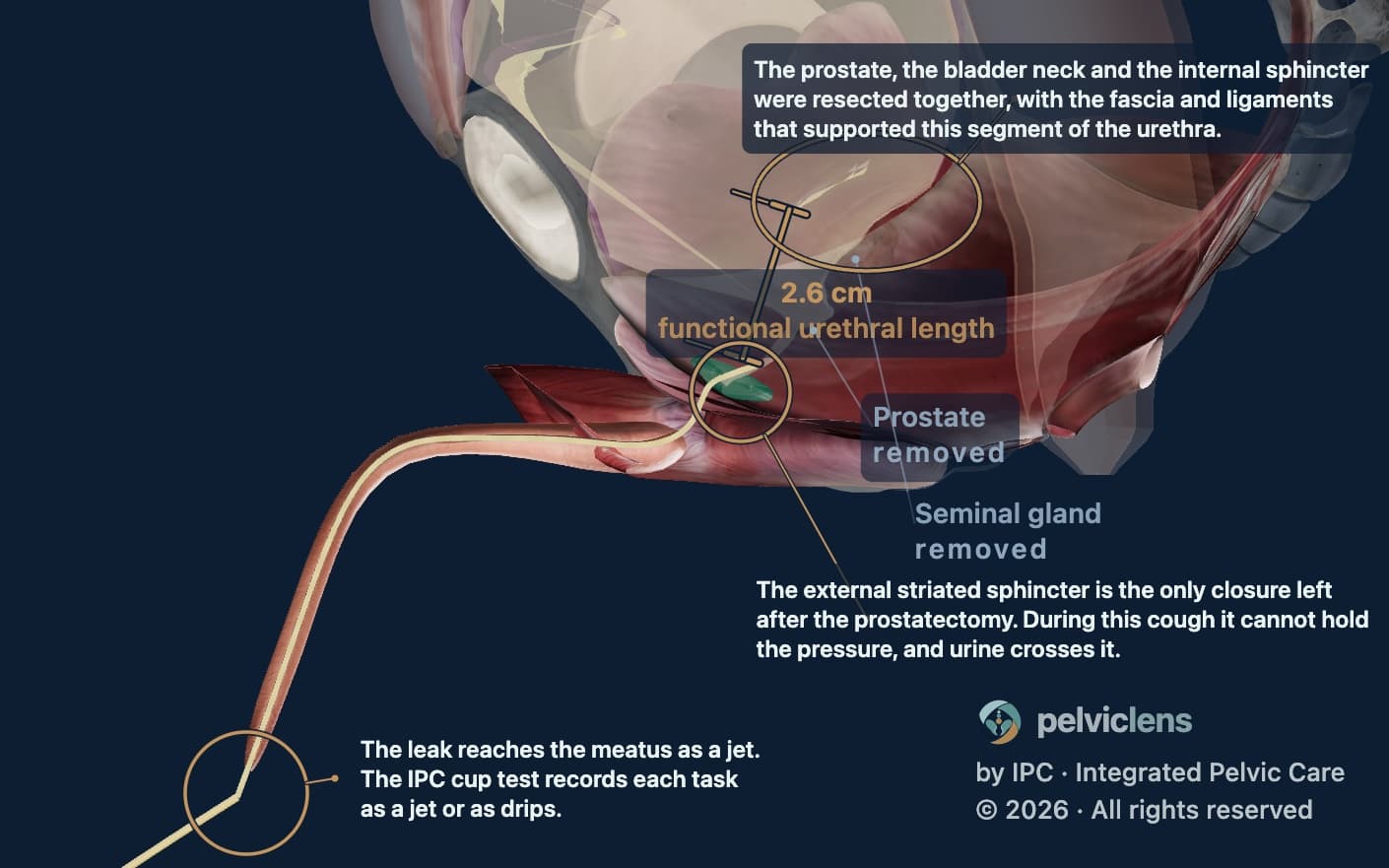
A still from the Pelvic Lens incontinence model, post-prostatectomy chapter, labels on: the prostate and the seminal vesicles resected (the model's label reads seminal gland), the functional urethral length at 2.6 cm, and a cough that raises abdominal pressure by 80 cmH2O crossing the striated sphincter as a jet. The full animation plays on pelviclens.com. The lengths and pressures on screen come from the urodynamic series of men after radical prostatectomy [2] [3].
The picture carries a second lesson for your patient, who was dry before surgery. His pelvic floor is not weak. It is doing a job it never had to do alone, on a shorter urethra, against the same cough.
Intrinsic sphincter deficiency vs urethral hypermobility
Stress incontinence has two mechanisms, and your patient usually has some of each. In urethral hypermobility the closure mechanism is intact but its support has gone: the bladder neck and the proximal urethra descend and rotate under load, the urethra loses the backboard it compresses against, and the leak follows the drop. In intrinsic sphincter deficiency the urethra can sit in a normal position and still leak, because the closing pressure it generates has fallen below what a cough delivers. The ICS glossary calls it a very weakened urethral closure mechanism, and older papers call it type III stress incontinence. ICD-10 keeps the two apart: N36.41 for hypermobility of the urethra, N36.42 for intrinsic sphincter deficiency, N36.43 for both together.
The urodynamic working definition is a maximum urethral closure pressure of 20 cmH2O or less, or a leak point pressure of 60 cmH2O or less. Both numbers were derived in women. The series that set the 20 cmH2O benchmark studied 159 women with pure stress incontinence. A low closure pressure and a low leak point pressure agreed in 64 percent of them and disagreed in 21 percent, and the authors asked for a composite diagnosis rather than either number on its own [5]. In your patient after prostatectomy both thresholds are transferred from that literature and not validated in men, and the incontinence model badges them that way on screen.
So the numbers identify the mechanism behind the leak. They do not grade how severe it is, and they do not decide the first treatment, which is training in either case. What they change is the surgical conversation later, because the operation that suits a mobile urethra does not suit a fixed one. A mid-urethral sling restores support. In the series that followed it for a year, it cured about half of the women with sphincter deficiency against nearly nine in ten of the rest, and a fixed urethra with a low closure pressure predicted the failures [6]. That finding is the sentence to put in the referral letter, because it changes which operation the surgeon considers. In the clinic you read the mechanism from the history, from the cup test below, and from the bladder diary that opens any stress urinary incontinence workup.
ISD incontinence is rarely pure stress after surgery
The sphincter is the headline after prostatectomy, and the bladder is the part that gets missed. Many men come out of the operation with detrusor overactivity, and some with detrusor underactivity. In the video-urodynamic series above, bladder dysfunction was present in 45 percent of the men and was the cause of the leak in 27 percent, alongside the sphincter or instead of it [4]. Bladder compliance falls as well: in the series that measured it at each stage, it fell from 28 to 16 mL/cmH2O immediately after surgery and was back near 27 at a year [3].
That is why the teaching runs every post-prostatectomy case through the same frame as any other lower urinary tract complaint: Fluid Imbalance, Storage Impairment, Voiding Impairment and Incontinence, in that order. Fluid first, because the patient who follows the ward's advice to drink three litres a day leaks more, and the one who stops drinking to stay dry hands you a false improvement at the next visit. Storage second, because urgency and a bladder that holds 80 mL undo any continence strategy before it starts. Only then the leak itself, with the strategy that follows.
Measure the leak the same way at every visit. The IPC stress cup test asks for five coughs at about 80 percent effort, supine to standing, ten sit-to-stands and marching on the spot, and records each task as drips or jets. It tells you which trigger leaks and how much, and once the strategy below has been taught it tells you which part of the strategy held. A 24-hour pad weight tells you how much leaked in a day, and neither which trigger caused it nor which strategy held.
A gentle squeeze before the trigger
Everything above points to one strategy, and it is the opposite of the instruction most men bring home from the ward. Urethral pressure after surgery is made by the striated sphincter and the levator ani. In the teaching's observation, a maximal contraction recruits them and recruits the abdominal wall with them, so bladder pressure rises at the same moment and the margin you were trying to widen closes again. That is the patient who squeezes as hard as he can during a cough and still leaks, and who leaks during his exercises. The maximal effort raises his bladder pressure as much as his urethral pressure. The teaching's name for the alternative is continence control: a submaximal pelvic floor contraction, applied right before the cough, the lift or the stand, and held through it. In the room it is a light grip, well under full effort, combined with a posture that lowers abdominal pressure and a breath out as the trigger arrives. Closure pressure rises while bladder pressure does not.
The effect is immediate, and it is not a strength effect. In the trial that first measured it, older women learned the timed contraction and one week later leaked 98 percent less with a medium cough and 73 percent less with a deep one [7]. The reduction had no relationship to how strong their pelvic floor tested [7]. Your patient who tests five out of five on a digital exam and leaks on the way to the car is the same lesson from the other side: the muscle is strong enough, but it is not contracting at the moment the pressure arrives.
Three rules follow, and each has a reason. Teach it in the room and re-test it with the cup test the same visit. Your patient, who leaked on the cough and then stayed dry with the gentle squeeze, keeps the lesson. A written sheet can teach a contraction; it cannot teach the timing, which is the part that holds the cough. Start before surgery where the pathway allows it: in the pooled trials, men who trained before the operation were more often continent at three months, with the gain fading by six [8]. And never while the catheter is in place. The teaching's rule is firm and its reasoning is mechanical. A catheter cannot be compressed, so a sphincter squeezed against it for two weeks learns a closure that does not meet. Your patient who exercised hardest on the ward is the one whose urethra will not close when the tube comes out. The exercises stop the day the catheter goes in and start the day it comes out.
How long recovery takes, and what does not change it
Tell your patient the shape of the curve before he asks for it. In the series that measured closure pressure at each stage, the 33 cmH2O of the first days had climbed back to 63 at a year, against 84 before surgery [3]. The leak point pressure test still showed sphincter deficiency in 7 of the 63 men at twelve months [3]. The bladder's storage function went back to where it had been; the sphincter did not [3]. Continence follows that curve: most men recover their closure within the year, and about one in nine still shows the deficiency on the leak point pressure test beyond it.
The surgical horizon is written into the guideline: your patient still incontinent at one year, or with severe incontinence at six months, may elect surgery, such as an artificial urinary sphincter [1]. The sling is the lighter operation and the artificial sphincter the heavier one, and the choice between them is made on the severity of the leak and on whether he has had radiation. Two leak patterns earn that surgical conversation earlier than the one-year mark. Continuous leakage, your patient standing still and dripping with no trigger, is not a mechanical problem a strategy can meet; it is the pattern the artificial urinary sphincter exists to treat, and a penile clamp contains the leak until that decision is made. Insensible leakage, the pad that is wet without a cough or an urge he noticed, fits the finding that the sensation of the posterior urethra is impaired after prostatectomy and recovers alongside continence [2]. Both are reasons to keep the urologist in the room early, and the patient guide to post-prostatectomy recovery is the one to send him home with.
When a woman has intrinsic sphincter deficiency
She had a mid-urethral sling two years ago. It restored the support under her urethra and changed nothing about the leak, and she still leaks on the third cough in the chair. In women the mechanism is the same and the causes are different: a previous anti-incontinence operation, pelvic radiation, a neurological lesion anywhere from the cortex to the pelvic nerves, and age with its loss of striated urethral muscle. Each takes closure pressure away while leaving the urethra where it is. The presentation is the fixed urethra that leaks on a cough in the chair, often at a low bladder volume.
That history is why the mechanism decides the operation. A mid-urethral sling restores support, which is the thing that is not missing, and the cure rate falls to about half in the women with sphincter deficiency [6]. Where a sling is still chosen, the route matters. In the randomised trial of women with urodynamic sphincter deficiency, repeat surgery within three years was 1.4 percent after a retropubic tape and 20 percent after a transobturator one [9]. Urethral bulking is the least invasive option and the one most often repeated; the autologous fascial sling is the choice for severe deficiency or after failed surgery; the artificial sphincter is the last step.
Training comes first here as well. The timed-contraction trials were done in women, and the gentle squeeze works on a low-pressure urethra for the same reason it works after prostatectomy: it adds closure at the instant the cough arrives without adding abdominal pressure. Teach it, re-test it with the cup test, and let the result decide whether the referral letter asks for bulking, a sling or an artificial sphincter.
How is intrinsic sphincter deficiency treated?
The order is measure first, train first, and only then choose a procedure by the mechanism and the severity of the leak. The measuring is the frame above: fluid, storage, voiding, then the leak itself with the cup test, so that urgency and a small bladder are treated as what they are. The training is continence control: a gentle pelvic floor contraction timed before each trigger, taught in the room, re-tested the same day, started before surgery where it can be and never with a catheter in. The procedures replace or bypass the closure the body lost, because an internal sphincter is not repaired: bulking agents narrow the lumen, a sling compresses or supports it, and an artificial urinary sphincter closes it with a cuff. For a man that choice opens at one year, or at six months when the leak is severe. For a woman with a fixed urethra, the operation that only restores support is the one to avoid.
What to say to your patient
- At the first visit after surgery, with the model open: "The surgery took one of your two doors. We train the one that is left."
- When you teach the trigger: "Squeeze gently, about a quarter of your strength. Then cough."
- On the day the catheter goes in: "No pelvic floor exercises while the catheter is in. Start the day it comes out."
- When the leak worries him: "Leaking is annoying, not dangerous. As long as it comes out, you are safe."
Frequently asked questions
What are the symptoms of intrinsic sphincter deficiency?
Leakage with a cough, a sneeze, a lift or standing up, at a low effort and often as a jet rather than a few drops. The urethra can sit in a normal position and still leak. After prostatectomy the leak can be continuous for the first weeks, and some people leak without feeling any trigger at all, which is called insensible leakage.
What are the causes of intrinsic sphincter deficiency?
Anything that takes closure pressure away from the urethra itself. In men it is nearly always radical prostatectomy, which removes the internal sphincter and the bladder neck with the prostate. In women the usual causes are a previous anti-incontinence operation, pelvic radiation, a neurological condition and age, with its loss of striated urethral muscle. Pelvic radiation can add to it in either sex.
Can an internal sphincter be repaired?
No. An internal sphincter removed at surgery, or scarred by radiation, is not repaired; the treatments work around it. Pelvic floor training strengthens and times the striated sphincter that remains, bulking agents narrow the urethra, a sling compresses or supports it, and an artificial urinary sphincter closes it with an inflatable cuff.
Does urinary incontinence ever go away?
After prostatectomy it does for most men, over the first year, and a pelvic floor programme shortens that time. A smaller group is still leaking at twelve months, and for them the leak is unlikely to settle on its own, which is when the surgical options are discussed. In women with a fixed, low-pressure urethra the leak does not settle without treatment.
What does ISD stand for in medical terms?
ISD stands for intrinsic sphincter deficiency, a form of stress urinary incontinence in which the urethral closure mechanism itself is weak. Its ICD-10 code is N36.42. The same letters mean isosorbide dinitrate in cardiology, so a continence note spells the term out the first time it appears.
References
- Incontinence after Prostate Treatment: AUA/SUFU Guideline. Journal of Urology, 2019.
- Effect of radical prostatectomy on sensory threshold and pressure transmission. Journal of Urology, 2000.
- Chronological Urodynamic Evaluation of Changing Bladder and Urethral Functions After Robot-assisted Radical Prostatectomy. Urology, 2015.
- The etiology of post-radical prostatectomy incontinence and correlation of symptoms with urodynamic findings. Journal of Urology, 1998.
- Diagnosing intrinsic sphincteric deficiency: comparing urethral closure pressure, urethral axis, and Valsalva leak point pressures. American Journal of Obstetrics and Gynecology, 1997.
- Impact of intrinsic sphincter deficiency on mid-urethral sling outcomes. International Urogynecology Journal, 2022.
- A pelvic muscle precontraction can reduce cough-related urine loss in selected women with mild SUI. Journal of the American Geriatrics Society, 1998.
- Preoperative Pelvic Floor Muscle Exercise and Postprostatectomy Incontinence: A Systematic Review and Meta-analysis. European Urology, 2016.
- Three-year follow-up of tension-free vaginal tape compared with transobturator tape in women with stress urinary incontinence and intrinsic sphincter deficiency. Obstetrics and Gynecology, 2012.
Read this article in Français · Español · Português
This article is education for health professionals. It is not medical advice, not a diagnosis and not a treatment plan for any person. Clinical decisions rest on your own assessment of the patient in front of you. If you are a patient reading this, talk it through with your own health professional. Evidence changes: the review date above tells you when this article was last checked.