
Pudendal neuralgia: criteria and tests
Pudendal neuralgia in men: the Nantes criteria, the P slump test and the pudendal nerve tests, from EMG to the CT-guided block, read by Four Horsemen.

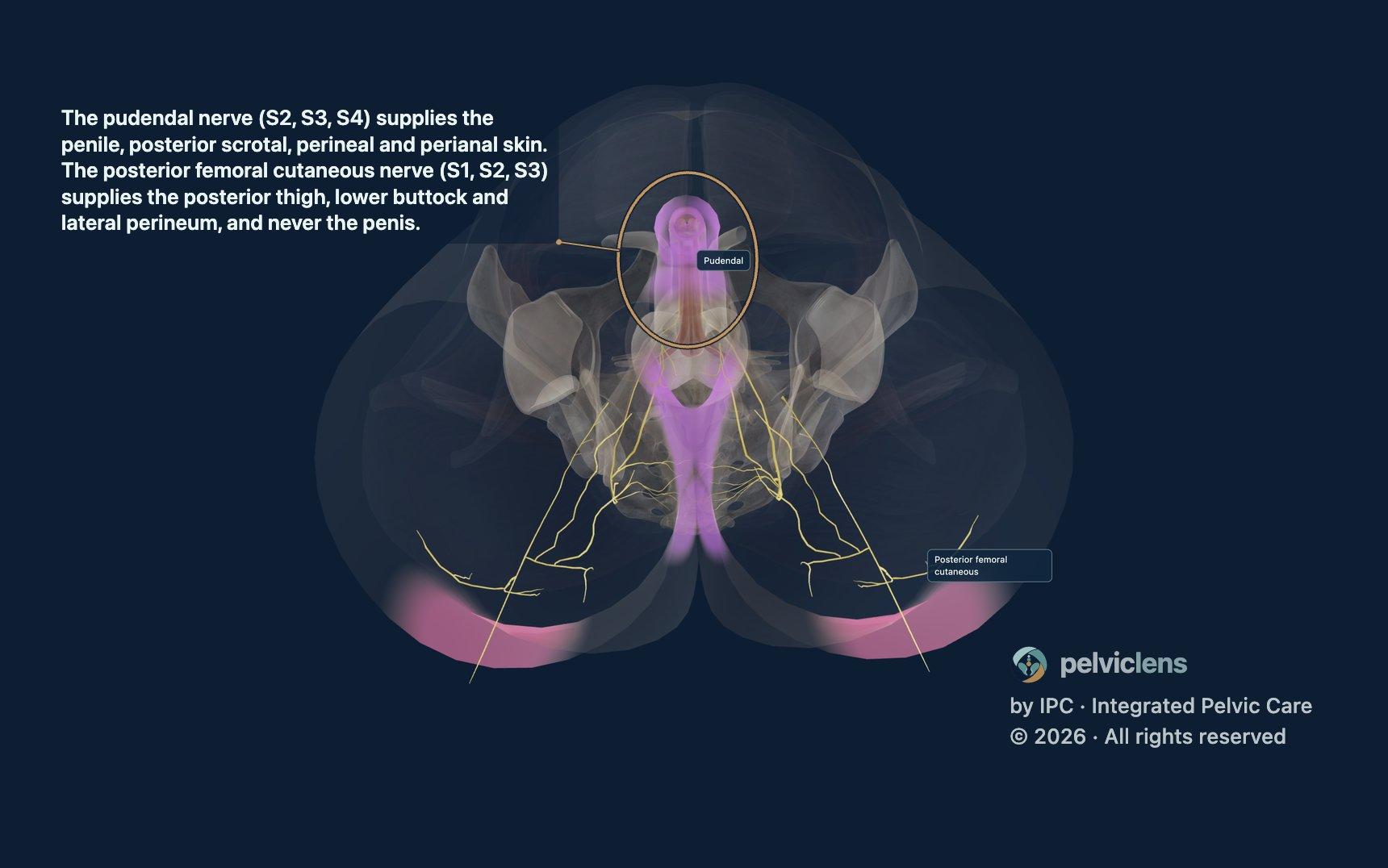
The short answer. Pudendal neuralgia is pain in the anatomical territory of the pudendal nerve, worsened by sitting, and diagnosed clinically on the five Nantes criteria [1]. A positive anaesthetic block confirms the nerve's role [2]. The pain is still classified by the Four Horsemen. Only a response that neither spinal loading nor a pelvic floor contraction changes is the Neuro horseman.
Key takeaways
- The diagnosis is clinical, made on five Nantes criteria; no sign or test is pathognomonic.
- The spine, an obturator internus tender point and the posterior cutaneous nerve of the thigh (PCNT) can each mimic it, so each is tested before the Neuro horseman is named.
- Perineal EMG adds clues but cannot tell entrapment from other nerve lesions; a block that cuts sitting pain by more than half confirms the nerve's role.
Your patient's referral reads pudendal neuralgia, and he lowers himself onto one buttock to take the chair. The name probably gets the territory right: the pain runs from the anus to the penis and builds as he sits. The letter is silent on the mechanism, and the mechanism is what your first session treats.
Integrated Pelvic Care's masterclass, the teaching Pelvic Lens is built on, sorts that mechanism with the Four Horsemen: the Spinal, Pelvic, Neuro and Tissue horsemen, types 1 to 4. Each names a dominant mechanism of male pelvic pain, and a diagnosis on the letter does not skip them.
The pudendal nerve: entrapment sites and Alcock's canal
The pudendal nerve does not run through the pelvic floor: it leaves the pelvis and comes back around it. It arises from the S2 to S4 roots and exits through the greater sciatic foramen, below piriformis. It passes over the sacrospinous ligament and under the sacrotuberous ligament, wrapping around the ischial spine. Then it runs forward over the obturator internus in Alcock's canal. Its branches are the inferior rectal nerve, the perineal nerve and the dorsal nerve of the penis.
Cadaver dissection defined three possible conflict sites: between the two ligaments, in Alcock's canal, and where the nerve straddles the falciform process of the sacrotuberous ligament [3]. The EAU guideline places the canal within the fascia of the obturator internus [4], a pelvic wall muscle rather than a pelvic floor muscle per se.
When the nerve loses its mobility along its gluteal or pelvic course, sitting compresses it against the falciform process [2]. These structures also exist in people without symptoms, so anatomy alone cannot make the diagnosis [2].
Because sitting provokes the pain, a referral like your patient's may ask for pelvic floor downtraining before anyone has tested whether his pelvic floor drives it.
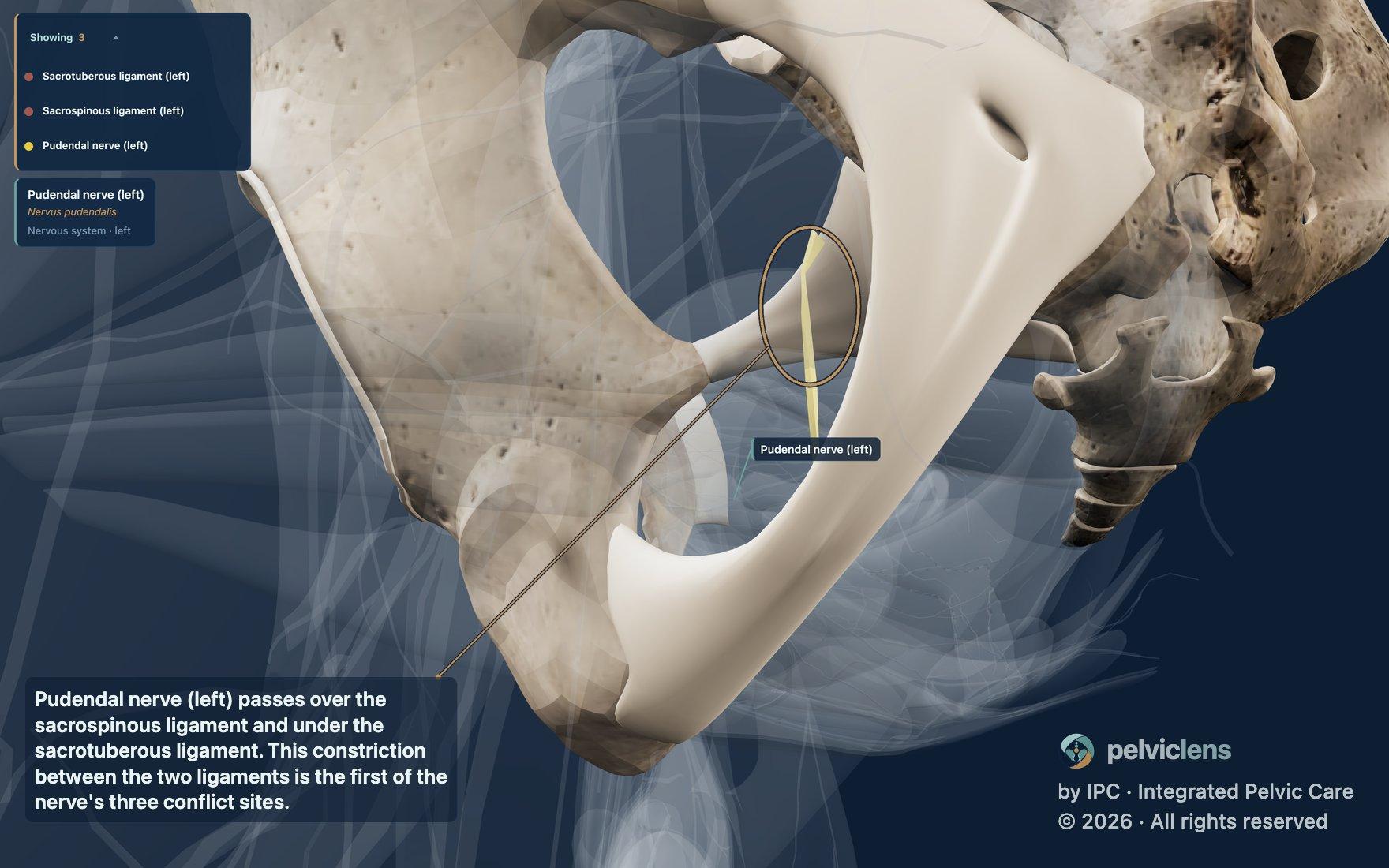
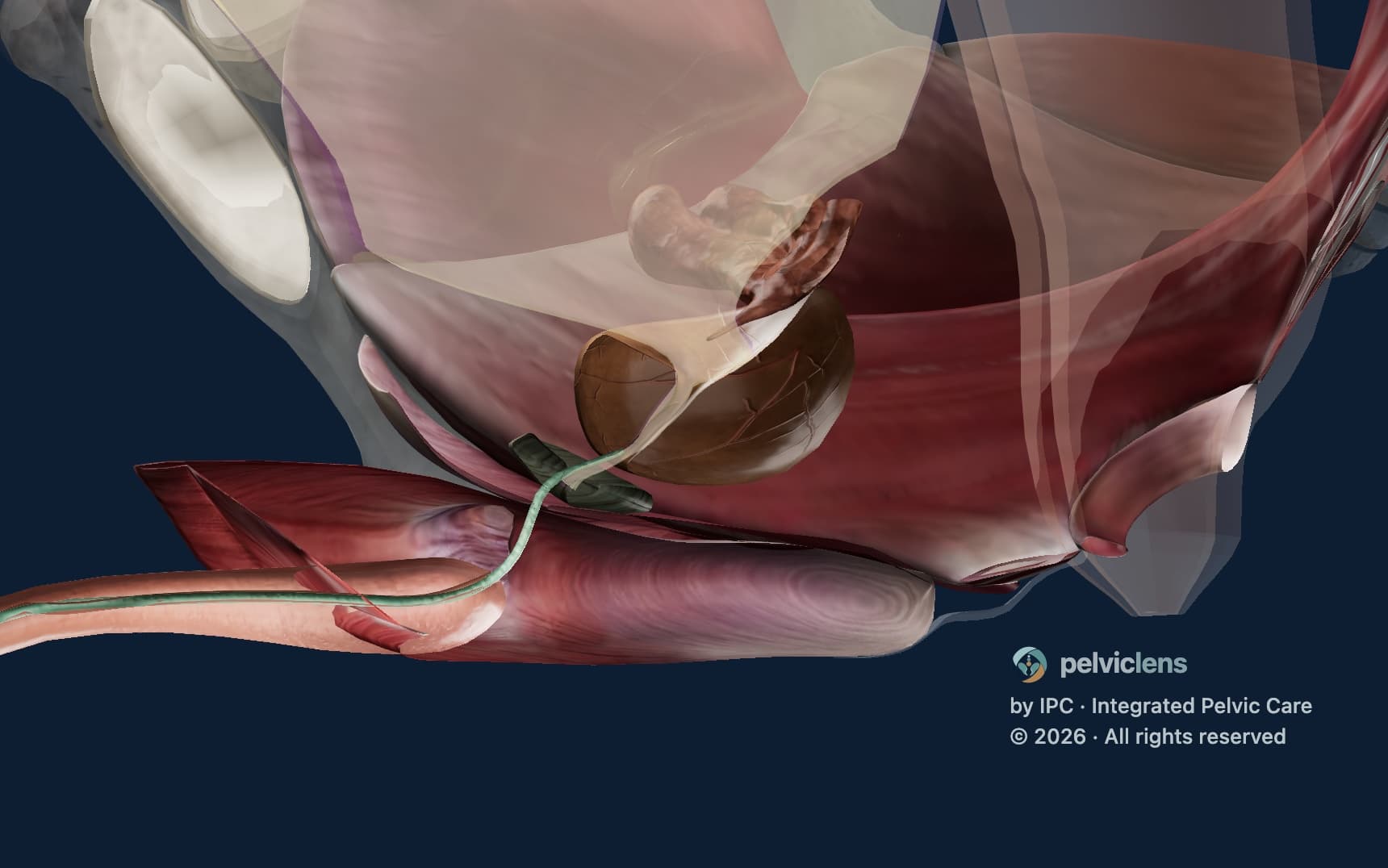
The pudendal nerve passes over the sacrospinous ligament and under the sacrotuberous ligament, an entrapment site in pudendal neuralgia, on the Pelvic Lens Base Anatomy model.
Testing the pudendal nerve: provocation and P slump
The referral names a territory, and your hands can test the nerve that serves it. Two provocations load it: pressure between the ligaments in the piriformis position, and pressure at Alcock's canal with your patient supine. Each is positive when it brings on pain in the perineum.
The guideline agrees that tenderness at the ischial spine or Alcock's canal may aid the diagnosis, though there is often little to find [4]. The ICS names both kinds of test: pudendal nerve neurodynamics and the pudendal nerve provocation test [5].
The P slump test is the pudendal neurodynamic test. Your patient sits upright, and the penis is held and drawn down to tension the pudendal nerve. You read his baseline, and then he slouches slowly. A slouch that reproduces and increases his pain is a positive test, a sign of nerve tension. It says the nervous system is sensitised, not which nerve is the lesion: each test is a functional baseline, not a diagnosis.
Your patient is sure his nerve is trapped and that only surgery will free it. The Neuro Horseman model runs the same test.
The Nantes criteria for pudendal neuralgia, on the exam
Five lines decide the diagnosis, and two are met only when something is missing. Labat and colleagues list the five essential criteria [1]:
| Nantes criterion | On your exam |
|---|---|
| 1. Pain in the anatomical territory of the pudendal nerve. | From the anus to the penis [2] |
| 2. Worsened by sitting. | Compression at the falciform process |
| 3. The patient is not woken at night by the pain. | Night waking is a red flag that reopens the diagnosis |
| 4. No objective sensory loss on clinical examination. | Sensory loss is a red flag that calls for imaging |
| 5. Positive anesthetic pudendal nerve block. | Read in the block section |
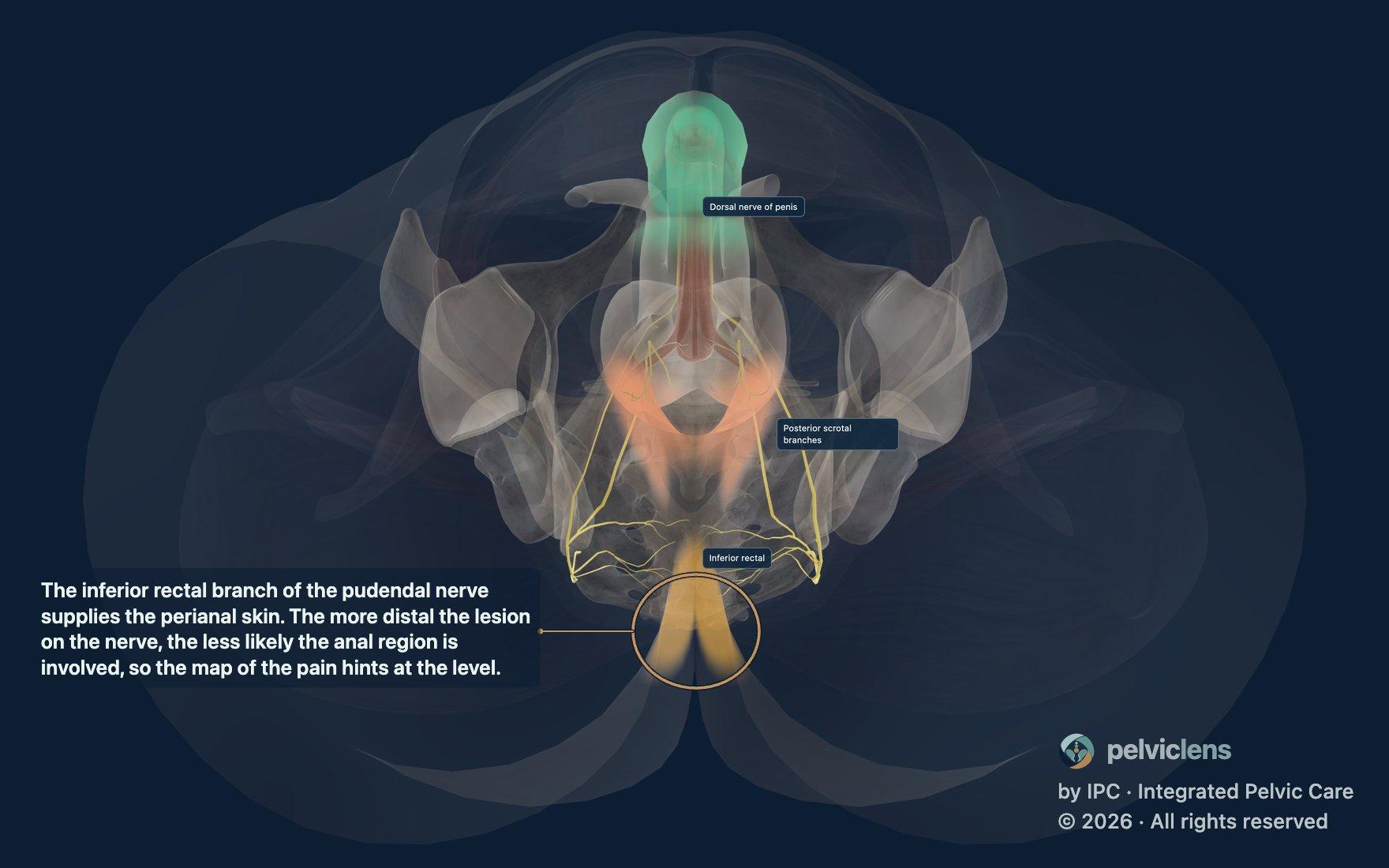
The pudendal territory splits by branch on the Pelvic Lens pain map: the dorsal nerve of the penis, the posterior scrotal branches and the inferior rectal nerve, all within Nantes criterion 1.
Labat and colleagues also propose exclusion criteria: "purely coccygeal, gluteal, or hypogastric pain, exclusively paroxysmal pain, exclusive pruritus, presence of imaging abnormalities able to explain the symptoms" [1]. The Nantes paper calls the diagnosis "essentially clinical", with "no pathognomonic criteria" [1]. A working party validated the criteria, which makes them a consensus, not a measure of diagnostic accuracy [1].
Pudendal nerve or obturator internus: rule out first
Your patient can meet every clinical Nantes criterion and his pain is still classified, because the criteria name the territory and the classification names the mechanism.
The Spinal horseman, type 1, comes first: load the spine and re-test his P slump baseline. For pelvic nerve pain, the guideline's first diagnostic step is to rule out confusable diseases, spinal pathology among them [4].
The Pelvic horseman, type 2, comes next: if the spine leaves the baseline unchanged, your patient contracts his pelvic floor and you re-test. An obturator internus tender point whose palpation reproduces his familiar pain meets the Myofascial pain pattern's major criterion, as the obturator internus trigger point article sets out.
Muscle can reproduce pain in the pudendal territory, even at the penis. In men with chronic prostatitis/chronic pelvic pain syndrome (CP/CPPS), puborectalis, pubococcygeus and rectus abdominis tender points reproduced penile pain more than 75% of the time [6]. The chronic pelvic pain syndrome in men article sorts that diagnosis by the Four Horsemen first.
Only a baseline that neither spinal loading nor a pelvic floor contraction changes is the Neuro horseman, type 3: neuropathic or nociplastic pelvic pain. Entrapment is one peripheral driver within it.
Two neighbours can mimic pudendal neuralgia. The PCNT, from S1 to S3, and its inferior cluneal branch reach the perineum but never the penis, which is pudendal territory alone. Deep gluteal syndrome, nerve entrapment in the subgluteal space, can involve the pudendal nerve. Purely gluteal pain, though, is a Nantes exclusion [1].
Pudendal nerve tests: EMG and the CT-guided block
Test results add weight to a clinical diagnosis without settling it. A 2026 systematic review counts imaging and nerve tests as support for the diagnosis, not proof of it [7]. It lists supplementary Nantes features, among them burning, shooting or stabbing pain, numbness, pain triggered by defecation and exquisite tenderness over the ischial spine [7].
Perineal electroneuromyography (ENMG) combines needle EMG with sacral reflexes and nerve motor latencies [8]. The review counts the pudendal nerve terminal motor latency among its supplementary tools [7]. ENMG reflects structural damage to the nerve's motor supply, demyelination or axonal loss, not the mechanism of the pain [8]. It cannot tell entrapment from other causes of pudendal nerve damage, such as stretch during surgery or chronic constipation, and its sensitivity and specificity for entrapment are limited [8]. Its main value is an objective record of the nerve's motor supply when decompression is considered [8].
In the Nantes group's trial, the block was image-guided: every infiltration was placed under CT guidance, with contrast medium, at the sacrospinous ligament and in Alcock's canal on the painful side [2].
How long does it take a pudendal nerve block to work?
A diagnostic pudendal nerve block is read straight away, with your patient sitting. A greater than 50% reduction in sitting pain immediately after the infiltration confirms the role of the pudendal nerve [2]. A positive block does not prove entrapment or name the site; a differential block helps localise where the nerve may be trapped [4].
In the Nantes group's randomised, double-blind trial, a corticosteroid added nothing to the block. At three months, 14.3% were responders with it and 11.8% without, a difference that was not significant [2]. The block stays a test of the nerve's role.
Pudendal neuralgia treatment: the Neuro horseman
Once the Neuro horseman is named, desensitise first and load second. The first stage desensitises peripherally and centrally, with autonomic regulation alongside.
Loading then rebuilds sitting, exercise and sexual activity step by step, paced by irritability, recovery time and tolerance, not by pain elimination alone. In a double-blind randomised trial in 52 men, TENS added to the same exercise program lowered pain more than sham TENS [9].
In the Neuro horseman, the pelvic floor is treated for secondary dysfunction or pain-spasm-pain cycling. The work aims at the Guarding, Restriction and Myofascial pain patterns that maintain sensitisation.
The guideline strongly recommends standard approaches to managing neuropathic pain [4]. The Nantes group recommends decompression surgery after medical treatment has failed [2]. In its randomised trial in people whose blocks gave only temporary relief, 50 percent of 16 improved at three months after decompression, against 6.2 percent of 16 without surgery [10]. The guideline adds that surgery is not the answer for every patient [4].
What to say to your patient
- With a P slump test running on the model: "Watch this nerve tighten as the slouch comes in. Slumped sitting does the same."
- When a P slump test reproduces his pain: "That is your pain. The test stretched the nerve you sit on."
- When treatment starts: "First we calm your nerve. Then we build up your sitting, bit by bit. A sensitive nerve can settle."
Frequently asked questions
What are the symptoms of pudendal nerve irritation?
Pudendal nerve irritation typically causes burning, shooting or stabbing pain, tingling or numbness between the anus and the penis, worse when your patient sits. Pain that wakes him at night, or objective sensory loss, is a red flag that reopens the diagnosis and calls for imaging.
Can men get pudendal neuralgia?
Yes, men get pudendal neuralgia: the Nantes group observes it in both men and women, with a female predominance of about 60 percent. The group notes that no published study has measured how common it is. In men the territory runs from the anus to the penis, and a randomised trial of TENS enrolled 52 men aged 30 to 50 with the diagnosis.
What stretches are good for pudendal neuralgia?
No stretch has been shown in a trial to treat pudendal neuralgia. The teaching starts below the level that flares the pain, then grades sitting and exercise by irritability, recovery time and tolerance. The randomised physiotherapy trial in men tested TENS added to exercise: it shows that TENS adds to exercise, not that exercise works alone.
Can pudendal neuralgia cause constipation?
The link in the literature runs the other way: chronic constipation is named among the causes of a stretch lesion of the pudendal nerve. Defecation can also bring on the pain, one of the supplementary features of the diagnosis. Your patient's bowel habit therefore belongs in the history and the plan.
What is the ICD-10 code for pudendal neuralgia?
ICD-10-CM, the US code set, has no code or index entry that names pudendal neuralgia [11]. Its index sends neuralgia of a specified nerve not listed elsewhere to G58.8, other specified mononeuropathies, a code WHO ICD-10 shares [11][12]. Neuralgia of the perineum is indexed to R10.20, pelvic and perineal pain, a code WHO ICD-10 keeps as R10.2 with no fifth character [11][12].
References
- Diagnostic criteria for pudendal neuralgia by pudendal nerve entrapment (Nantes criteria). Neurourology and Urodynamics, 2008.
- Adding corticosteroids to the pudendal nerve block for pudendal neuralgia: a randomised, double-blind, controlled trial. BJOG: An International Journal of Obstetrics and Gynaecology, 2017.
- Anatomic basis of chronic perineal pain: role of the pudendal nerve. Surgical and Radiologic Anatomy, 1998.
- EAU Guidelines on Chronic Pelvic Pain. European Association of Urology, 2026.
- An International Continence Society (ICS) report on the terminology for pelvic floor muscle assessment. Neurourology and Urodynamics, 2021.
- Painful myofascial trigger points and pain sites in men with chronic prostatitis/chronic pelvic pain syndrome. The Journal of Urology, 2009.
- The Diagnosis and Management of Pudendal Neuralgia. Pain and Therapy, 2026.
- What is the place of electroneuromyographic studies in the diagnosis and management of pudendal neuralgia related to entrapment syndrome?. Neurophysiologie Clinique, 2007.
- Effectiveness of transcutaneous electrical nerve stimulation as an adjunct to selected physical therapy exercise program on male patients with pudendal neuralgia: A randomized controlled trial. Clinical Rehabilitation, 2021.
- Decompression and transposition of the pudendal nerve in pudendal neuralgia: a randomized controlled trial and long-term evaluation. European Urology, 2005.
- ICD-10-CM Tabular List of Diseases and Injuries and Alphabetic Index, FY2027. Centers for Disease Control and Prevention, National Center for Health Statistics, 2026.
- International Statistical Classification of Diseases and Related Health Problems, 10th Revision (ICD-10), Version 2019. World Health Organization, 2019.
Related articles
 Men’s healthPelvic floor courses for physiotherapistsPelvic floor courses for physiotherapists: what to check before booking, what a 3D model adds, and where to learn male pelvic health.16 min read
 External urethral sphincter: functionThe external urethral sphincter for the pelvic health clinician: how it differs from the internal sphincter, how a cough moves it, and how to train it.10 min read
 Men’s healthAnorectal angle: normal range in menNormal anorectal angle: about 85 to 96° at rest, sharper on a squeeze, wider on straining, and the exam cue that splits Guarding from Restriction.18 min read
Read this article in Français · Español · Português · Deutsch
This article is education for health professionals. It is not medical advice, not a diagnosis and not a treatment plan for any person. Clinical decisions rest on your own assessment of the patient in front of you. If you are a patient reading this, talk it through with your own health professional. Evidence changes: the review date above tells you when this article was last checked.