
Pelvic floor courses for physiotherapists
Pelvic floor courses for physiotherapists: what to check before booking, what a 3D model adds, and where to learn male pelvic health.

The short answer. Pelvic floor courses for physiotherapists teach how to examine and treat the pelvic floor, and their palpation labs assume you know its anatomy in three dimensions. A 3D model lets you study it before the lab and show it to your patient after. For male pelvic health, the author teaches and recommends the four masterclasses of Integrated Pelvic Care (IPC).
Key takeaways
- Course pages lead with hours, points and price. Check as well what the lab teaches on, whether the male pelvic floor is a chapter or a bullet, and which language the course is taught in.
- A two-day lab assumes the anatomy it cannot teach. A 3D model holds that anatomy before the lab, maps what your finger found after it, and shows it to your patient.
- Each IPC masterclass teaches its own frameworks, from the six IPC Male Pelvic Floor Patterns to the Four Mechanical Zones. The three live ones pair a 4-hour online pre-course with a two-day live course and its palpation lab on real male models, carry US continuing education units and run in the US or Canada.
It is the lab afternoon of a pelvic floor course for physiotherapists, and a live model lies on the plinth. Your glove is on, and the instructor asks you to find the perineal body, then follow the levator ani back to the hiatus. The morning's slide showed one slice through the pelvis, and what sits under your finger does not line up with it. Pelvic floor courses for physiotherapists are compared on hours, points and price, the three numbers most course pages print first. None of the three decides how much of that afternoon you take home. What decides it is whether you arrived with the anatomy already in three dimensions.
A disclosure before the advice: the author of this article teaches the IPC masterclasses recommended below. Pelvic Lens is IPC's model, so read what follows as a colleague's recommendation with that interest declared.
What to check before you book a pelvic floor course
The course page answers the wrong questions first. Hours, points and price sit at the top. The answers that decide what you learn sit lower down or are missing. Check six things before you book, in any country:
| Check | What to look for |
|---|---|
| Format | Whether the hands-on part is taught live in a lab or only shown on video. |
| Hours and points in your market | The local units the page states: UE and Fortbildungspunkte (FP) in Germany, DPC or FIFPL funding in France, CPE or CEUs elsewhere, from a body your registration recognises. |
| Prerequisites and who attends | Whether the course asks for prior training in internal examination, and whether it admits trainers or midwives beside physiotherapists. |
| What the lab teaches on | Live lab models, wet specimens, a modelled pelvis or video; only a live model contracts, relaxes and responds to your cue. |
| Male content | Whether the male pelvic floor has its own chapter and lab time or is a bullet inside a women's module. |
| Teaching language | The language stated on the page, because the cues in a palpation lab come quickly. |
The line no brochure prints is that two days cannot teach the anatomy the lab assumes. Peter Pan and the Lost Boys, IPC's male pelvic health foundation masterclass, maps that anatomy in its Chapter 3, the Nine Triangles of Male Pelvic Anatomy. Its course page describes the map as "Complex three-dimensional anatomy, redrawn as nine clear two-dimensional regions. A navigation tool to guide palpation, map symptoms, and document findings, so you always know where you are and what sits beneath your hands." The muscles under those regions are set out in the pillar on the anatomy of the male pelvic floor.
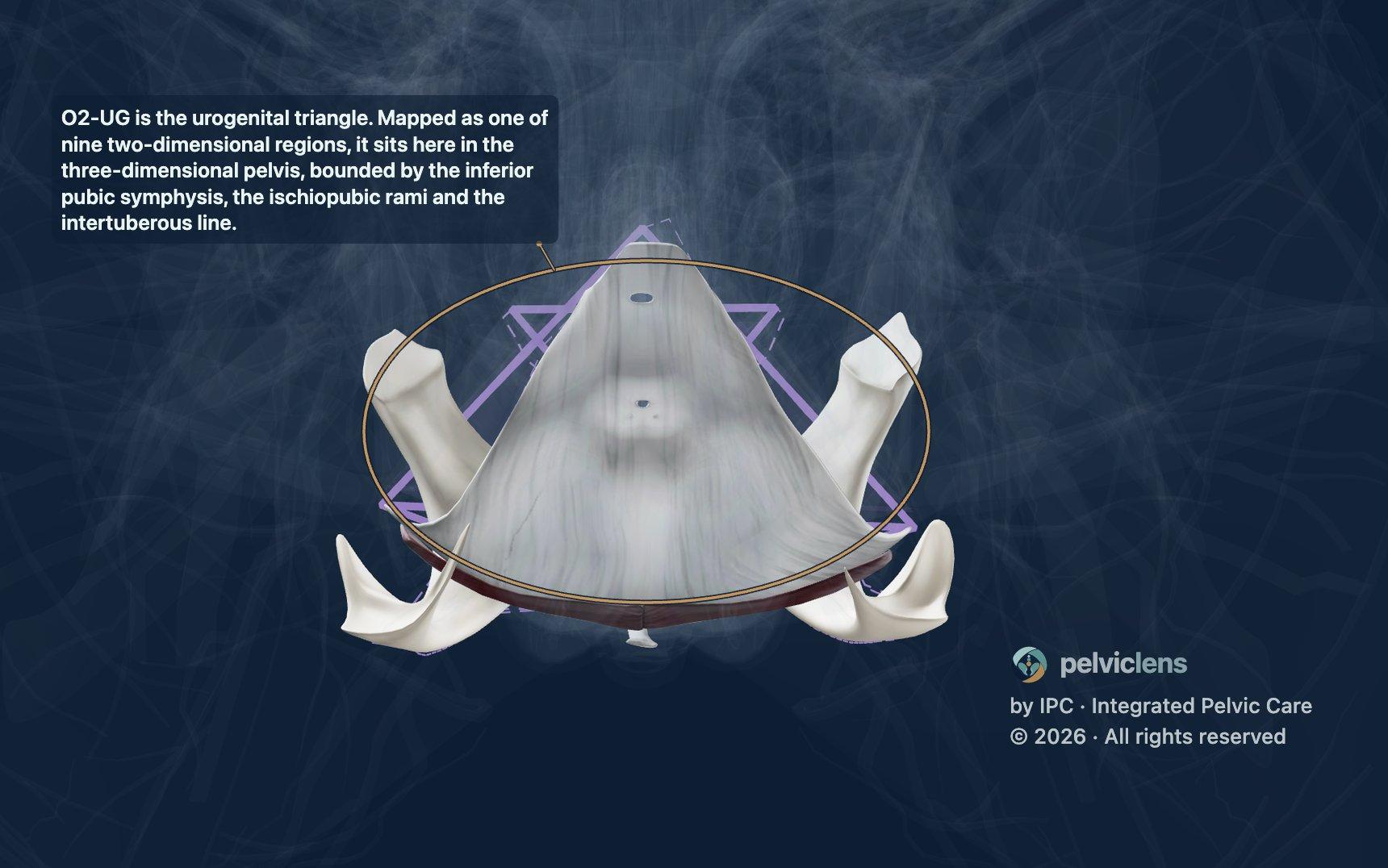
The Nine Triangles model draws that map over the male perineum.
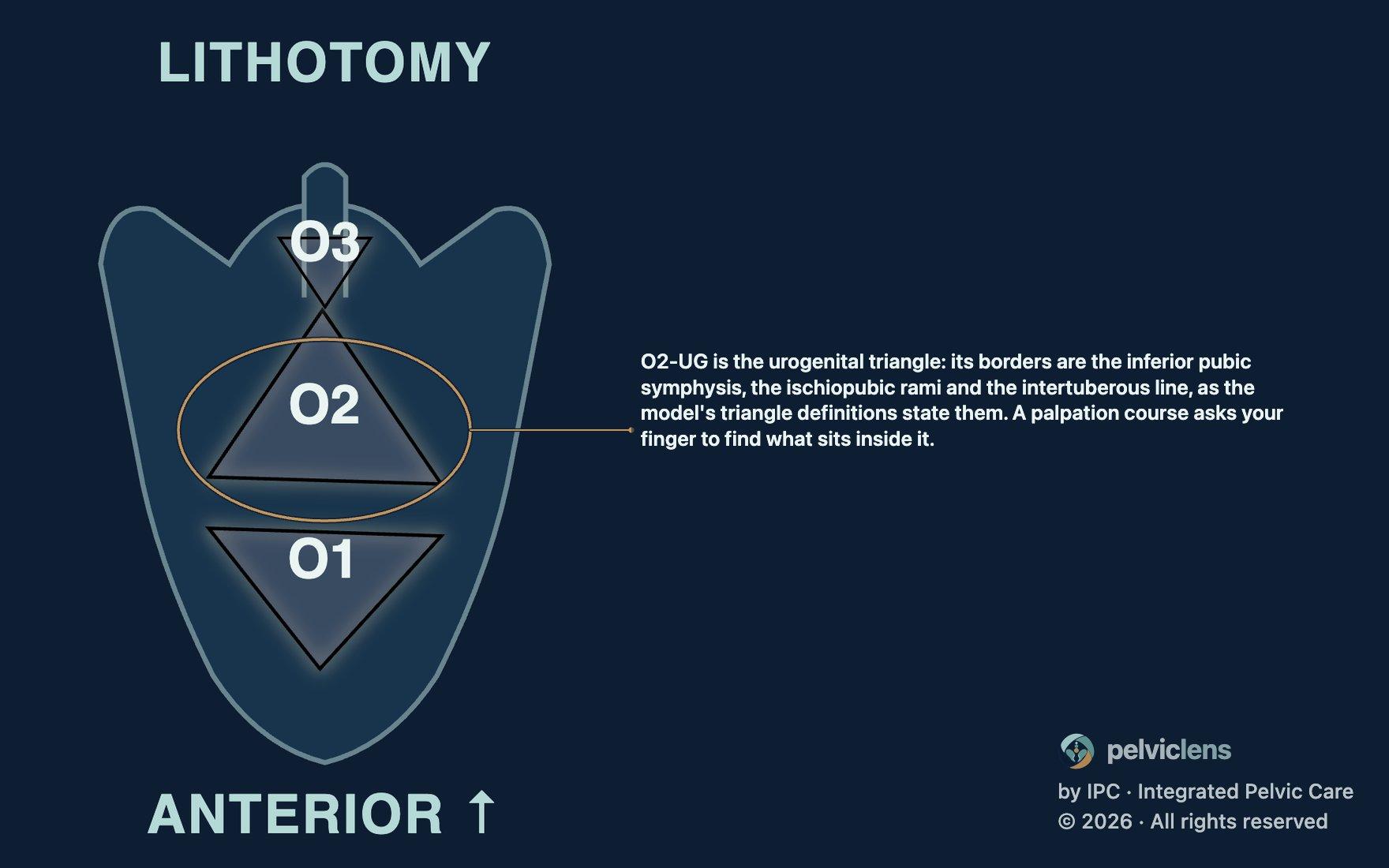
The urogenital triangle, O2-UG, frames what your finger finds between the ischiopubic rami on the Pelvic Lens Nine Triangles map of the male perineum, drawn in lithotomy.
After the course, the same map answers your patient, who is sure the internal exam is a prostate check because no one has shown him the muscles in between.
What a 3D model adds to any pelvic floor course
A slide is one slice and a fingertip is one point, and the structure under both is neither. A 3D model holds the whole structure in one view, and it earns its place at three moments of a course:
- Before the course, you work through the pre-course anatomy on the model, layer by layer, so the perineal body, the levator ani and the hiatus already have their positions when the lab begins.
- During the course, you map what your finger found onto the same model that evening, while the instructor's cues are still fresh.
- After the course, you open the model in front of your patient and turn it to show him what you examined and why the plan follows from it.
Research from neighbouring settings points the same way. In a meta-analysis of studies of anatomy teaching, 3D visualisation tools gave learners better spatial knowledge of anatomy than the teaching methods they were compared with [1]. Even an imaging exam of the male floor is examiner-dependent: on transperineal ultrasound in men, two assessors agreed closely on the floor's resting position but not on its craniocaudal displacement [2]. Both measured anatomy learners and ultrasound images, not pelvic floor courses, so they support the direction of this argument without testing it.
Male pelvic health: the module most courses skip
Read the programmes on the first page of a German or British search for pelvic floor courses, and the male pelvic floor is a bullet inside a module, where it appears at all. In a survey of Canadian entry-to-practice physiotherapy programmes, fewer than a third taught students to perform internal pelvic floor techniques, and those that did taught them only in elective courses [3]. Where a programme teaches internal techniques only in an elective, a physiotherapist can qualify without ever being taught the internal exam of the male floor.
Male referrals reach pelvic health clinics anyway. The AUA and SUFU guideline on incontinence after prostate treatment expects incontinence after most radical prostatectomies and states that pelvic floor muscle exercises can hasten continence recovery [4]. The 2025 AUA guideline treats chronic prostatitis/chronic pelvic pain syndrome (CP/CPPS) with a multimodal, multidisciplinary approach that includes allied health professionals [5]. Both guidelines send these referrals to clinics whose training was built on the female pelvic floor.
The IPC masterclasses ask for no women's health experience, only male pelvic health within your scope of practice. Most attendees are physical therapists, with occupational therapists, nurses, urologists and chiropractors also attending. For male pelvic health, these are the courses this article recommends, and IPC's free courses, listed at the end, are the place to sample the teaching.
The dribble model shows a male complaint that a course built on the female pelvic floor has no reason to teach, because only the male urethra has a bulbar segment.
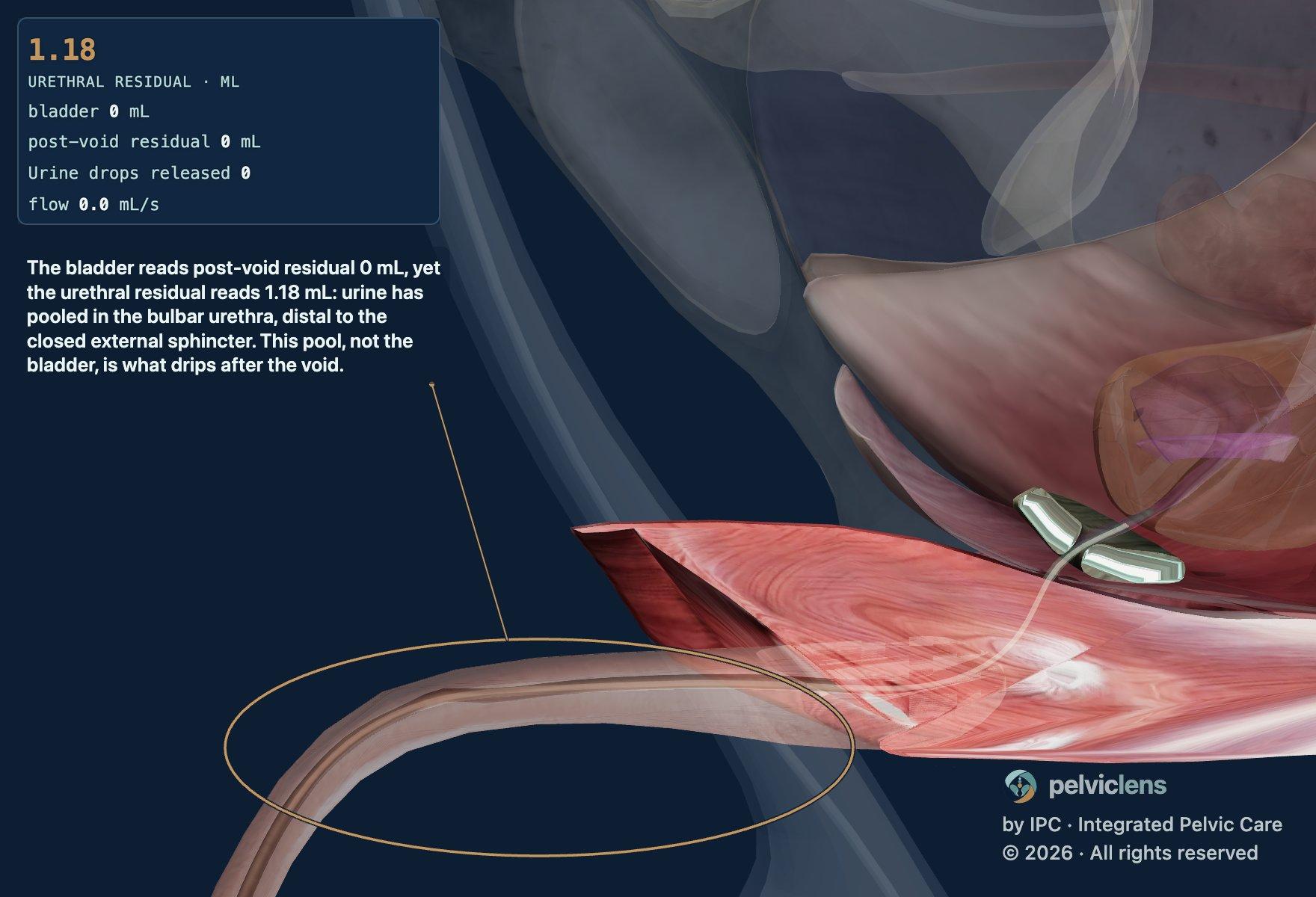
The bulbar urethra holds pooled urine distal to the closed external sphincter after a complete void on the Pelvic Lens dribble model: the mechanism of post-micturition dribble.
Peter Pan: the six IPC Male Pelvic Floor Patterns
The course page for Peter Pan and the Lost Boys opens on the line "Male pelvic floors don't come in two settings, weak and tight." The Chapter 6 slides of the masterclass set the old labels aside: "The traditional hypotonic / hypertonic classification is terminology-problematic, and clinically insufficient for male pelvic floor rehabilitation."
In their place, Chapter 6 teaches the IPC Male Pelvic Floor Patterns: "Clinical groupings of physical examination findings that reflect the primary pelvic floor capacity affected." There are six, each named with its capacity and given a Lost Boy:
| Pattern | Capacity affected | Lost Boy |
|---|---|---|
| Restriction pattern | mobility deficit | Slightly |
| Underactivation A | voluntary recruitment deficit | the Twins |
| Underactivation B | involuntary/reflexive timing deficit | the Twins |
| Guarding pattern | regulation deficit | Curly |
| Myofascial pain pattern | tolerance deficit | Tootles |
| Normal pattern | none, once the other patterns are ruled out | Nibs |
The order matters. It reflects the clinical assessment sequence: observation, then external assessment, then internal examination. The Pattern Classification Rule reads: "A pelvic floor pattern is suggested when there is either: 1 major criterion or 3 minor criteria. And it becomes clinically meaningful only when it connects to: Symptoms and impaired capacities." A Normal pattern requires ruling out the other patterns first.
The patterns give the exam a treatment direction. Guarding is treated with down-regulation, the work of pelvic floor downtraining in men, and Restriction with mobility work. Cueing separates the two on the exam. "Acute/restricted puborectalis or anorectal position that is non-modifiable" is a Restriction minor criterion, and "Acute puborectalis position that is modifiable" is a Guarding one. The same split applies when you read the anorectal angle, because the puborectalis sling sets that bend.
The pelvic floor model runs two of the six patterns through the same cough, side by side.
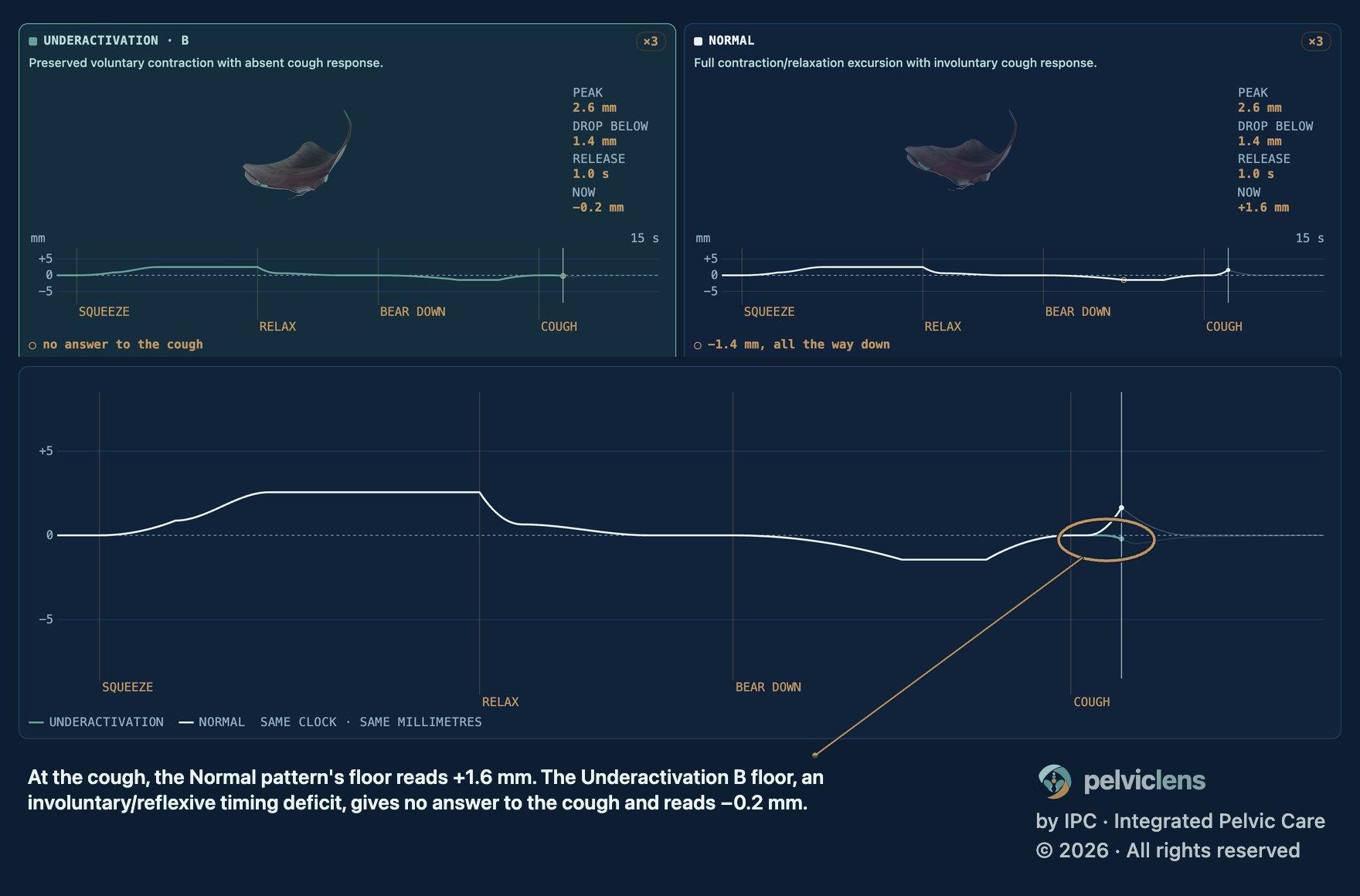
The pelvic floor in the Normal pattern answers the cough with a reflexive response on the Pelvic Lens pelvic floor model, while the floor in Underactivation B, an involuntary/reflexive timing deficit, gives none.
Wizard of LUTS: the Four Mechanical Zones
The male LUTS list runs long, from leakage after prostatectomy to BPH, overactive bladder, underactive bladder, retention and nocturia. The zones behind it are four. The Wizard of LUTS frames them in one sentence of its slides. "Depending on the origin and type of force, we've identified four Mechanical Zones in the body to analyze factors affecting the LUT." The four are MZ I: The Spinal Zone, MZ II: The Abdominal Zone, MZ III: The Pelvic Zone and MZ IV: The Bladder. The course pairs them, in that order, with the Tin Man, the Scarecrow, the Cowardly Lion and Toto.
The zones meet in the bladder's pressure equation, Pves = Pabd + Pdet. Storage holds while vesical pressure stays below urethral pressure, Pves < Pura, and voiding happens when Pves > Pura. Vesical, abdominal and detrusor pressure are the three lines a cystometrogram traces, with detrusor pressure calculated from the other two. A model that moves adds what neither a slide nor a finger can hold: a pressure that changes as the body changes position.
The functional diagnosis runs through the 4Is in a fixed order: fluid imbalance, storage impairment, voiding impairment, then incontinence. Treatment keeps that order: fluid management, storage, voiding, and then Continence Control. Continence Control is the masterclass's name for storage strategies used "immediately before and during movements, actions, or activities that are likely to trigger urinary leakage". After radical prostatectomy the striated external urethral sphincter is the main closure left, the setting of intrinsic sphincter deficiency. For your patient after the operation, Continence Control combines posture, breathing and a gentle submaximal squeeze timed right before the cough.
Emptying has four strategies of its own: Bladder Strategies for effective emptying, Abdominal Strategies that increase Pabd, Pelvic Strategies of PFM relaxation or contraction, and Spinal Strategies that adjust posture.
The incontinence model times that squeeze against the cough after prostatectomy.
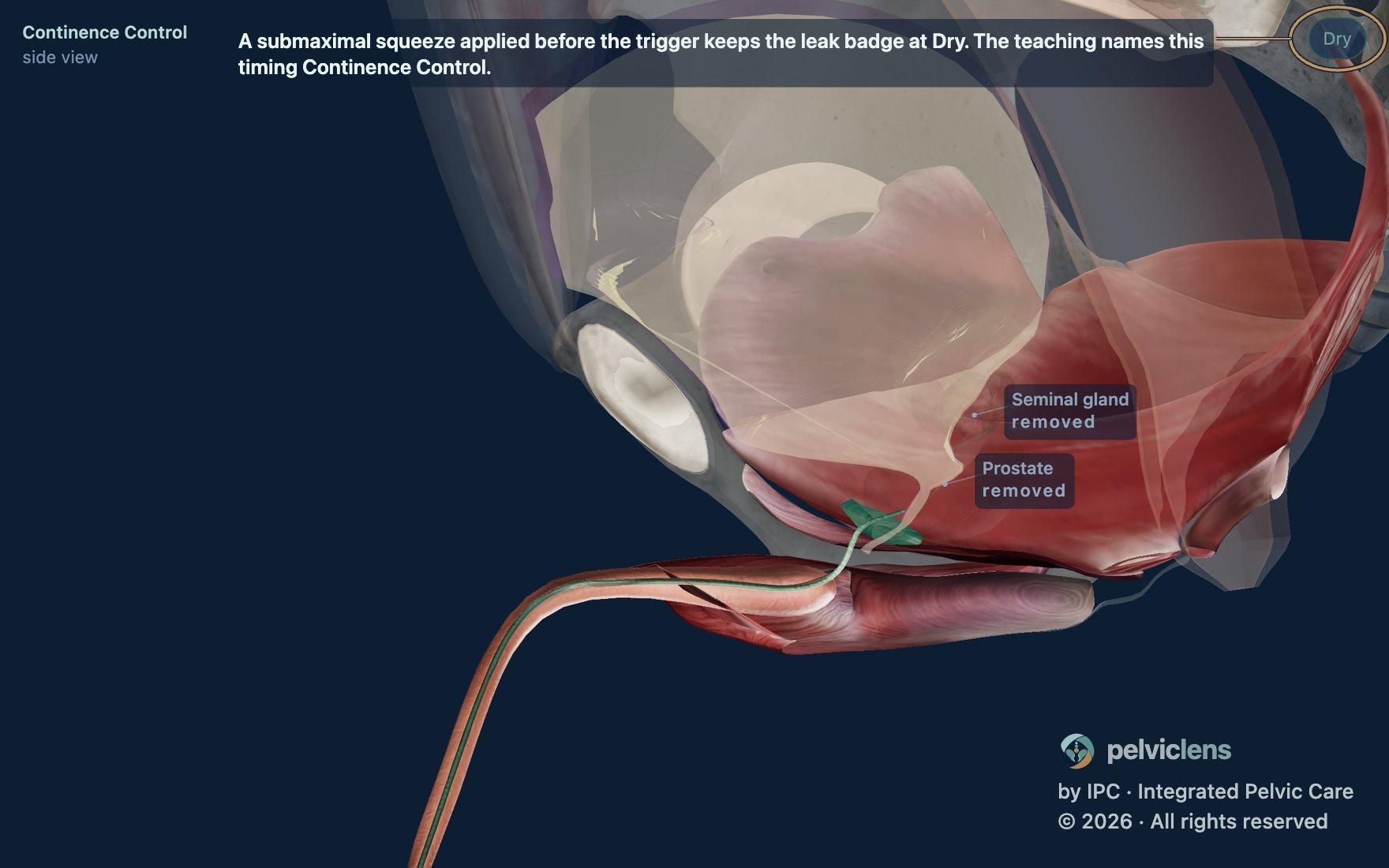
The outlet stays dry when a submaximal squeeze is timed before the cough on the Pelvic Lens incontinence model, the strategy the Wizard of LUTS teaches as Continence Control.
Four Horsemen: pelvic pain by its dominant mechanism
Pain location does not establish its cause. Groin or testicular pain can start at the spine, in the pelvic floor, in a nerve or in a local tissue such as a repair site. The place your patient feels it does not say which. The Four Horsemen of Male Pelvic Pain sorts it by the driver instead. The Four Horsemen are the four pain patterns, IPC's classification by the dominant mechanism:
- Spinal, type 1: Primary Mechanical Spinal Source of Pelvic Pain.
- Pelvic, type 2: Mechanical Nociceptive Pelvic Pain.
- Neuro, type 3: Neuropathic/Nociplastic Pelvic Pain.
- Tissue, type 4: Tissue-Related Nociceptive Pelvic Pain.
In the Pelvic horseman, the pain comes from non-neural pelvic tissues, including pelvic floor muscle and connective tissue. A tender point is a better chart entry than a trigger point, and a tender point is not diagnostic. That rule decides how an obturator internus trigger point is charted and read. The Neuro horseman is examined with the Mechanical Nerve Provocation Test. Steven Tijerina, who reviewed this article, co-teaches the Four Horsemen and the Wizard of LUTS.
The Neuro Horseman model runs the re-test that separates a nerve source from a spinal or pelvic floor one.
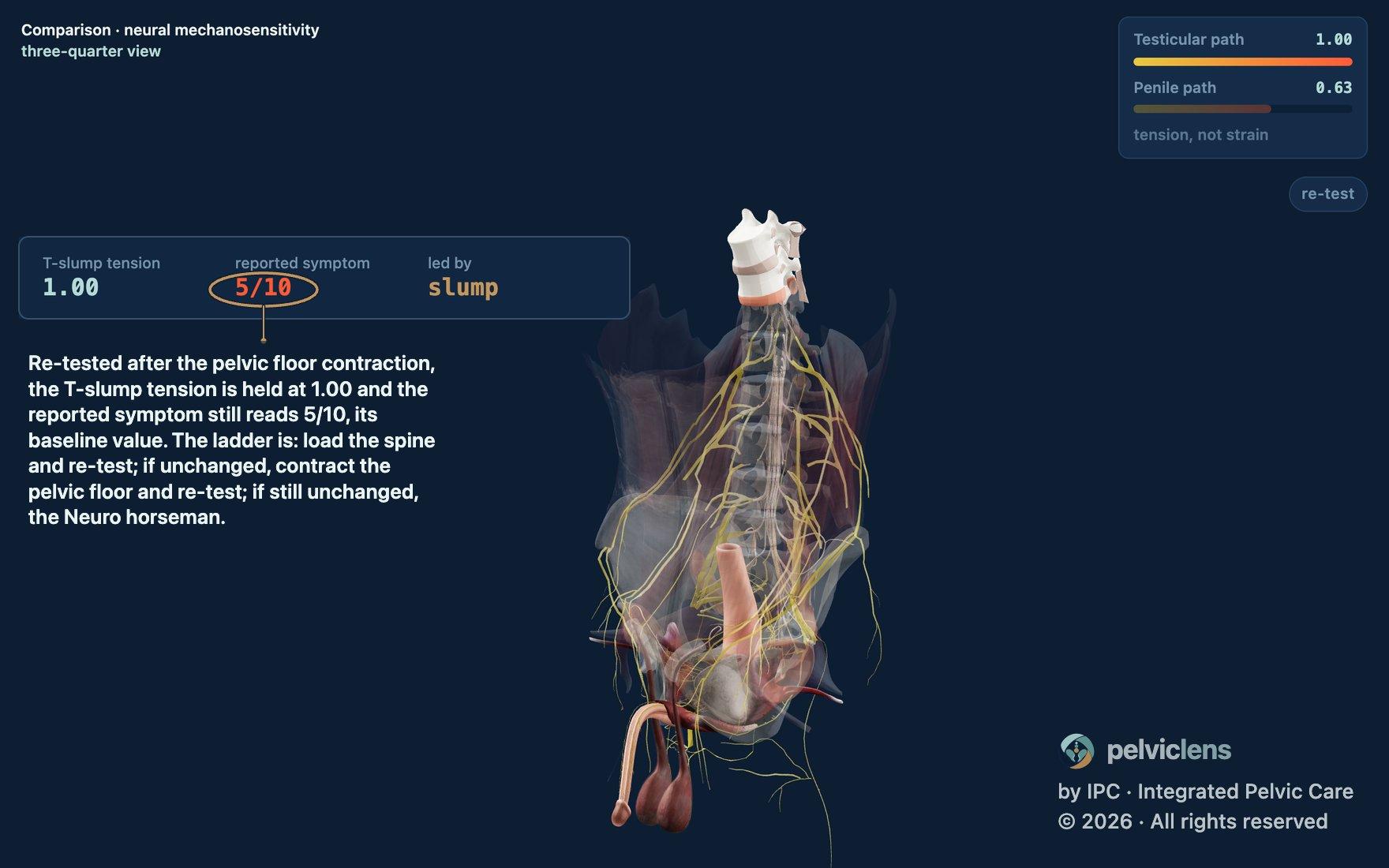
The nerve under slump tension keeps the symptom score at 5/10 when the test is re-run after a pelvic floor contraction, on the Pelvic Lens Neuro Horseman model: the Neuro horseman, type 3.
Rhythms of ED: three types of erection
The erectile dysfunction exam starts with a question about wiring: which erection pathway still works. Rhythms of ED is the bundle that teaches that exam, in two self-paced online parts with 4 hours of content each. The author teaches both parts.
Rhythms of ED teaches three types of erection: psychogenic, reflexogenic and nocturnal. In standard neurophysiology, a psychogenic erection starts in the brain, from thought, sight or sound, and its signal descends through the spinal cord. A reflexogenic erection starts with genital touch and runs through a spinal reflex arc in the sacral cord at S2 to S4. A nocturnal erection comes during sleep. Which type is preserved points to the pathway that still works, so the history starts the neurological exam.
The course assesses and prescribes with the Sex Range of Motion tool, which has four zones: warm for getting it up, hot for staying up, fire for ejaculation and explosive for orgasm. Treatment falls into four families named Prevention, Augmentation, Adaptation and Substitution. The ED courses are fully online and self-paced, and IPC's FAQ says it does not apply for continuing education units for online courses.
The nerve model lights the reflexogenic pathway with the spinal cord intact.
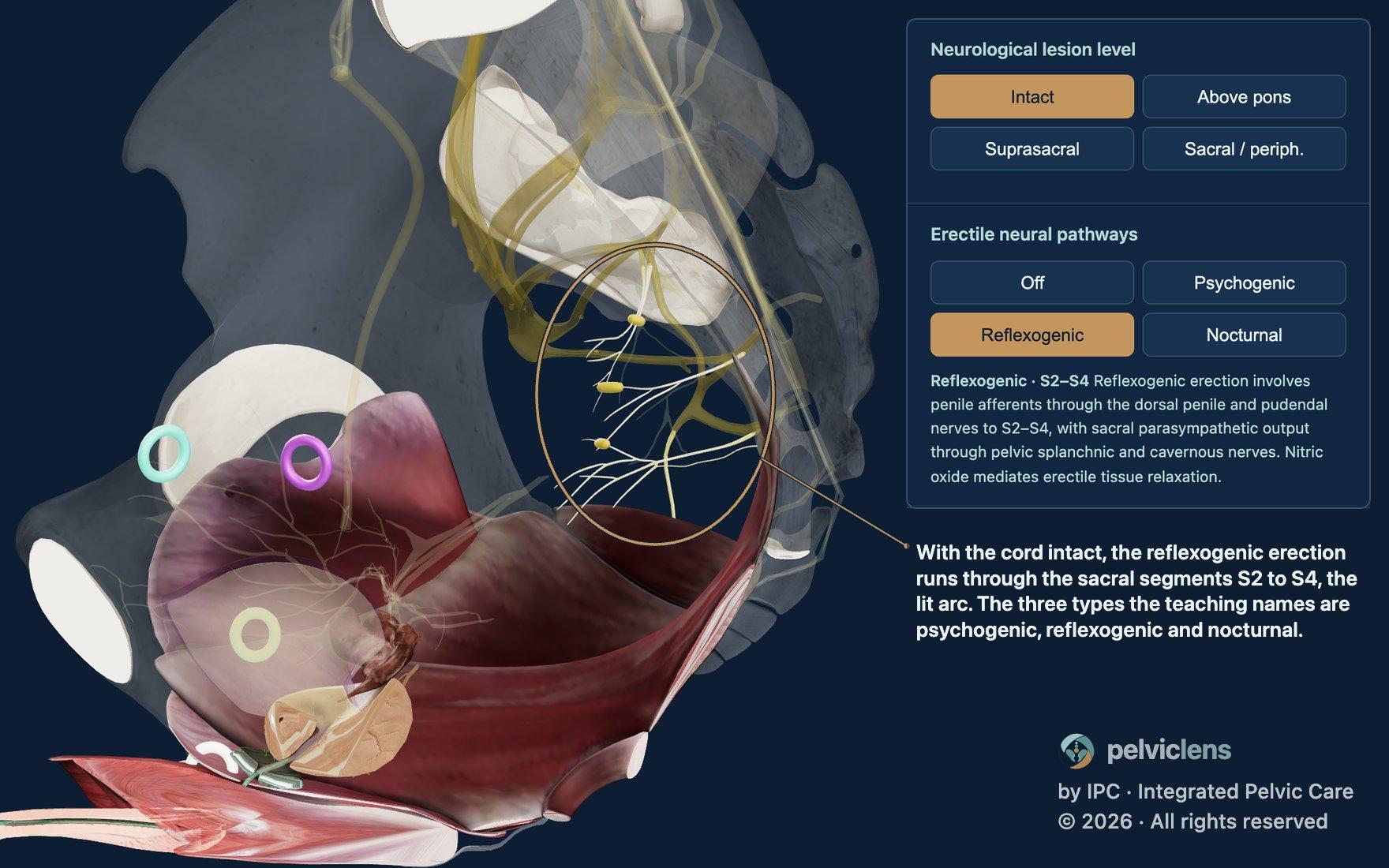
The S2 to S4 sacral reflex arc lights with the spinal cord intact on the Pelvic Lens nerve model, the pathway of a reflexogenic erection, one of the three types Rhythms of ED teaches.
Which pelvic floor course comes first?
Start with what costs nothing, because IPC's free courses show the teaching before you commit two days and the travel to a masterclass. Each course is listed under the name on its IPC card:
- Opening the hood of male anatomy teaches male anatomy and physiology facts that are clinically relevant.
- The Flow walks through the IPC evaluation form for a male pelvic pain evaluation; it is not about urine flow.
- Hard-flaccid is a mini-course about hard flaccid for pelvic clinicians.
- PURE bliss teaches the Sex Range of Motion tool for understanding and treating premature ejaculation.
- Pain during sex shows how to deconstruct cases of pain during sex.
IPC's free resources page lists all five and also offers microlearnings by email.
Then choose by caseload:
- Peter Pan and the Lost Boys dates: the fundamentals course, where to start when male pelvic health is new to your clinic.
- Four Horsemen of Male Pelvic Pain dates: the course for a caseload heavy with pelvic, groin and testicular pain.
- Wizard of LUTS dates: the course for LUTS and BPH, from leakage after prostatectomy to retention.
- The Rhythms of ED bundle: the course for erectile dysfunction, and the one masterclass you take without travelling.
The three live masterclasses share one format: an online pre-course of 4 hours, then a two-day live course with a palpation lab on real male models, 20 hours in all. Rhythms of ED is two self-paced online parts of 4 hours each.
Every live date on the IPC pages is in the US or Canada, and no live masterclass is offered online. The continuing education approvals the pages name are American. For the Wizard of LUTS, they are the California and Illinois physical therapy associations. For the Four Horsemen, one page names the Illinois and California associations and the Minnesota Board of Physical Therapy, and other pages name the host clinic, a New York approved provider. The Peter Pan page states 20 CEUs and names no approving body. Every masterclass is taught in English.
The pages name no German or other European continuing education approval, so a physiotherapist in Europe takes the masterclasses in English and without local continuing education points. IPC's FAQ adds that a certificate follows successful completion of each course.
What to say to your patient
- As you turn the Nine Triangles model toward him: "Watch this triangle. It is the part of your pelvic floor I checked."
- When he watches the floor let go on the model: "See how it lets go after the squeeze. We will train yours to do that."
- When he asks why you are treating his back for groin pain: "Some of this pain is coming from your back. A nerve carries it to your groin."
- When he asks if he can see it again at home: "I will send you a short video about pain from the back. Watch it at home."
Frequently asked questions
Are online pelvic floor courses worth it?
Online pelvic floor courses are worth it for theory, frameworks and clinical reasoning, and they cannot teach palpation. Palpation is learned in a lab, on a live lab model, with an instructor checking where your finger is. A good online course prepares you for that lab, and a 3D model of the pelvis keeps the lab's anatomy in three dimensions after you leave it.
Do I need women's health experience before a male pelvic health course?
No, women's health experience is not a prerequisite for learning the male pelvic floor, and the IPC masterclasses do not ask for it. The two floors differ enough that learning the male one is like learning the violin when you already play the piano: some of the music carries over, and the instrument is new. IPC asks only that male pelvic health is within your scope of practice.
Do IPC courses carry continuing education points?
The live IPC masterclasses carry US continuing education units, and IPC's FAQ says it does not apply for CEUs for online courses. The Wizard of LUTS and Four Horsemen pages name state physical therapy bodies or a New York approved provider. The Peter Pan page states 20 CEUs without naming a body. Every approving body the pages name is in the US. The masterclasses are taught in English, and the pages name no German or other European approval.
Can I use Pelvic Lens to teach my patients?
Yes, Pelvic Lens is built for the explanation in the clinic as well as for study. You open the model of the region you are treating and turn it while your patient watches. Two patient videos, the male and the female referred pain films, carry your practice's name, logo, phone number and booking link, so the explanation of referred pain goes home with your patient.
References
- A meta-analysis of the educational effectiveness of three-dimensional visualization technologies in teaching anatomy. Anatomical Sciences Education, 2015.
- The repeatability of measurements of male pelvic floor anatomy and function made from transperineal ultrasound images of healthy men and those before and after prostatectomy. Neurourology and Urodynamics, 2021.
- Pelvic Health Content in Canadian Entry-To-Practice Physiotherapy Programs: An Online Survey. Physiotherapy Canada, 2024.
- Incontinence after Prostate Treatment: AUA/SUFU Guideline. The Journal of Urology, 2019.
- Male Chronic Pelvic Pain: AUA Guideline: Part II Treatment of Chronic Prostatitis/Chronic Pelvic Pain Syndrome. The Journal of Urology, 2025.
Related articles
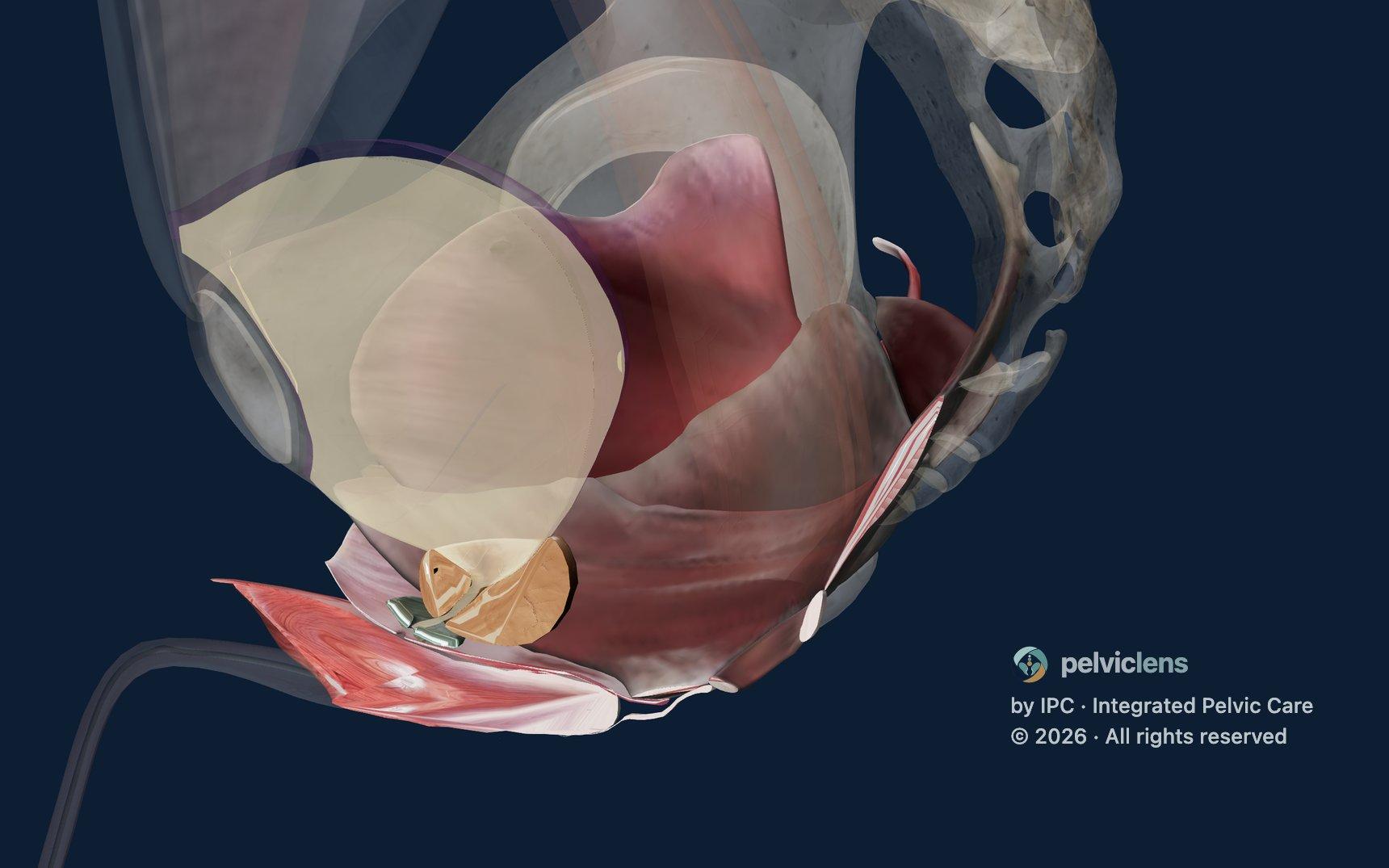 Men’s healthPelvic floor downtraining in menHypertonic pelvic floor in men is a label, not a finding: pelvic floor downtraining is down-regulation for the Guarding pattern the exam finds.17 min read
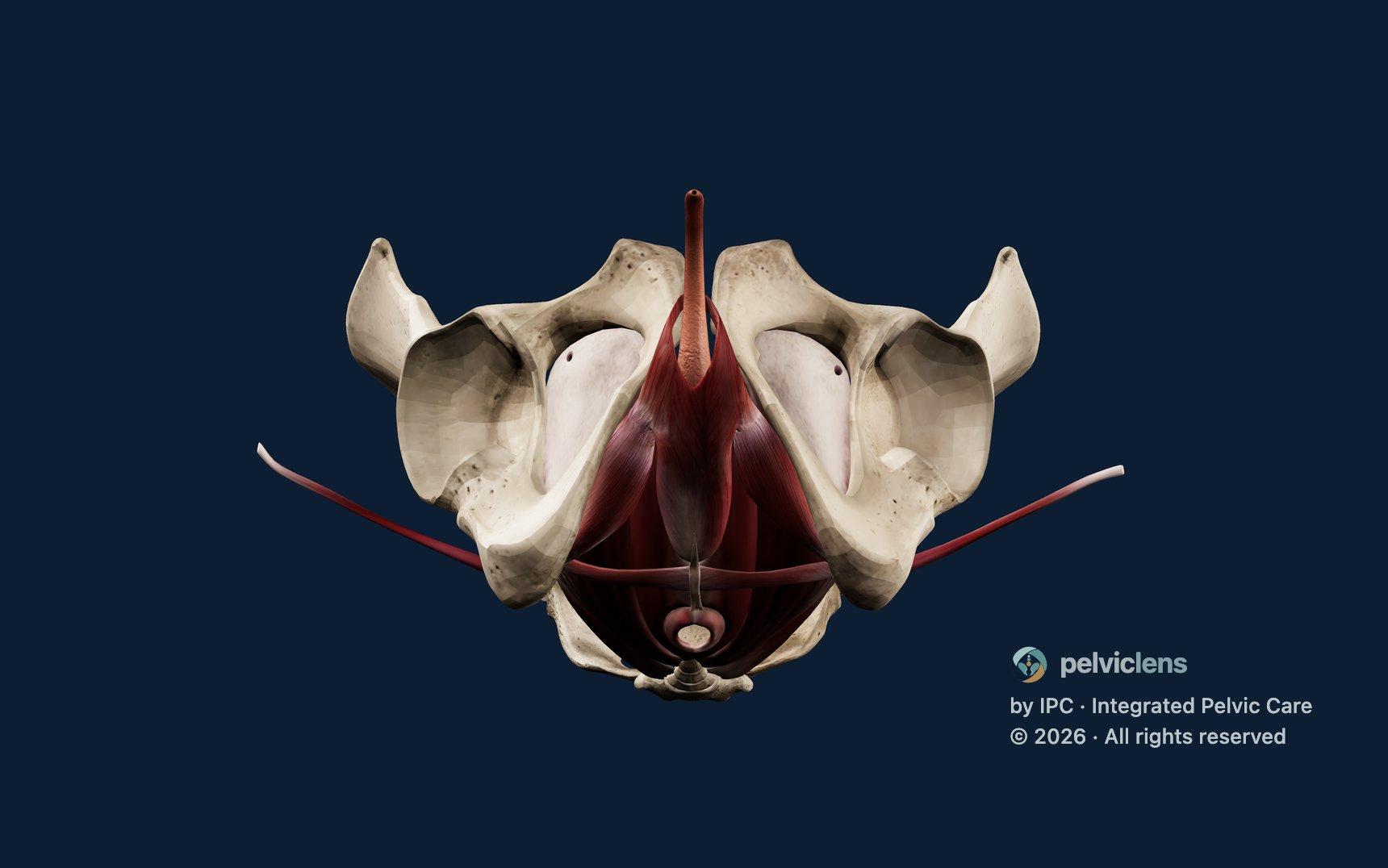 Men’s healthMale pelvic floor anatomy: the three layersMale pelvic floor anatomy for clinicians: three muscle layers, the two sphincters, the pelvic wall and the pudendal supply, in exam order.17 min read
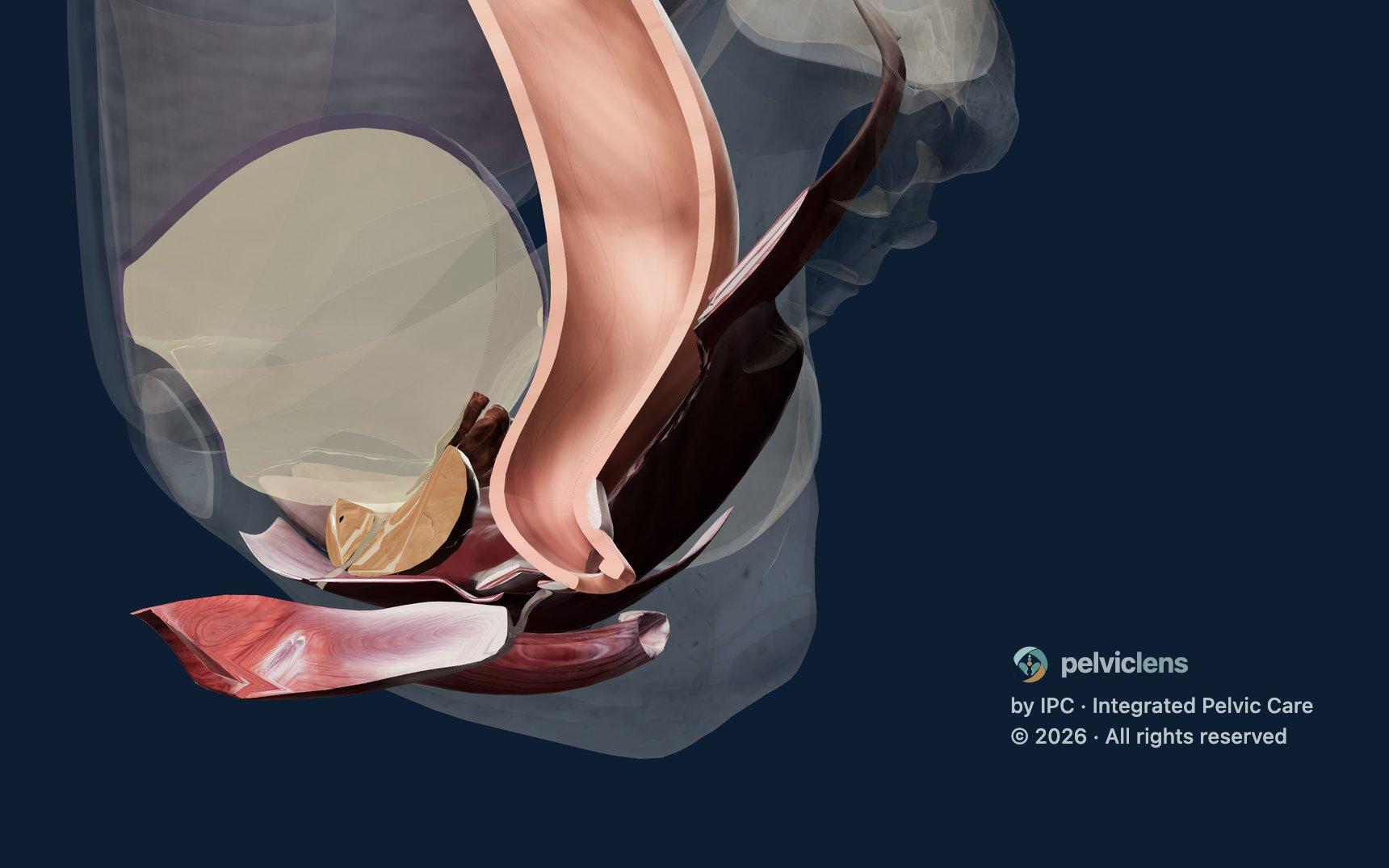 Men’s healthAnorectal angle: normal range in menNormal anorectal angle: about 85 to 96° at rest, sharper on a squeeze, wider on straining, and the exam cue that splits Guarding from Restriction.18 min read
Read this article in Français · Español · Português · Deutsch
This article is education for health professionals. It is not medical advice, not a diagnosis and not a treatment plan for any person. Clinical decisions rest on your own assessment of the patient in front of you. If you are a patient reading this, talk it through with your own health professional. Evidence changes: the review date above tells you when this article was last checked.