
Obturator internus trigger point
Obturator internus trigger point, charted as a tender point: the pelvic wall muscle, the finding that counts and the work it needs.

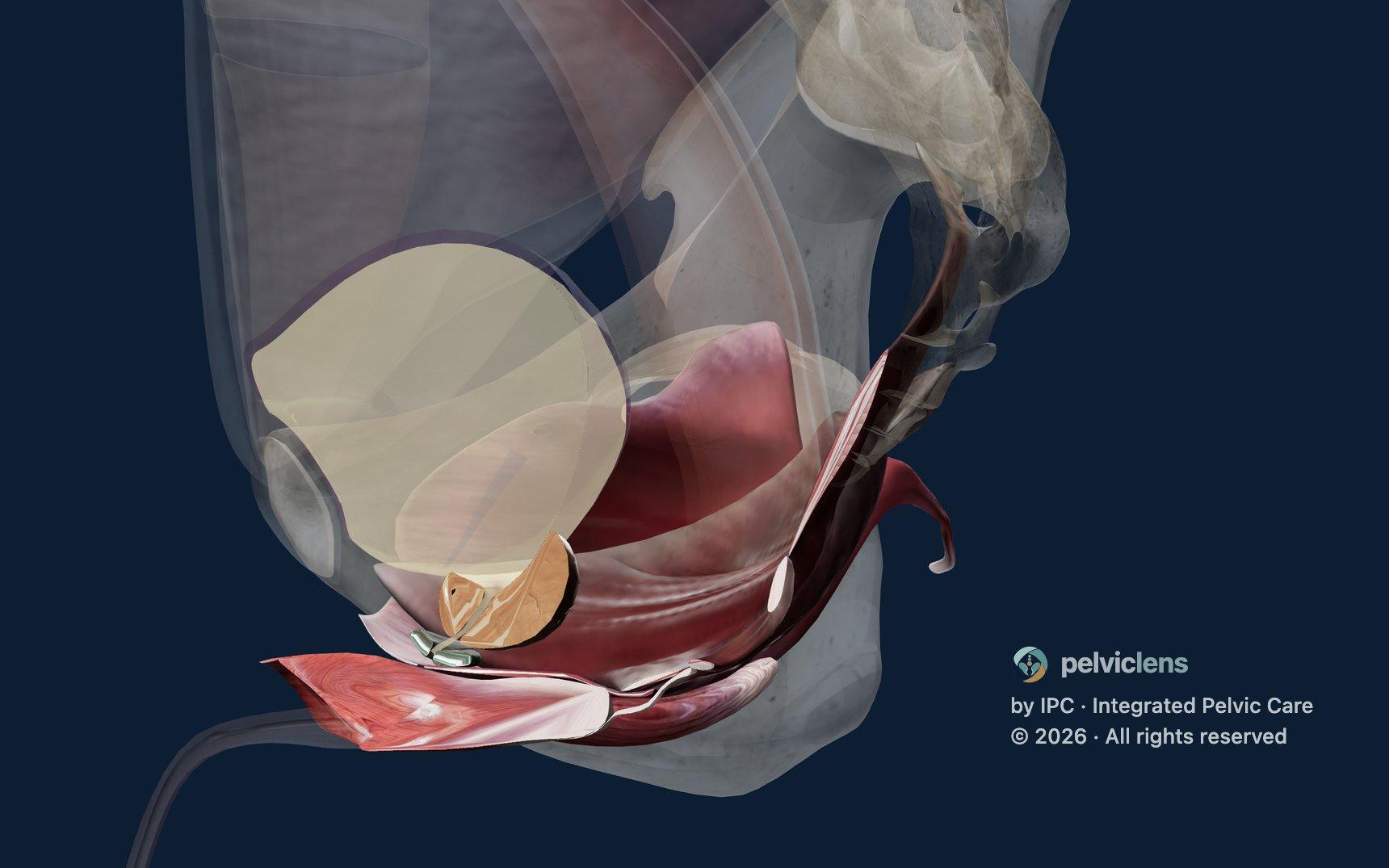
The short answer. An obturator internus trigger point is better charted as a tender point: tenderness on the muscle lining the pelvic side wall, a finding rather than a diagnosis [1]. It becomes the finding that counts when pressing it reproduces your patient's familiar pain: the major criterion of the Myofascial pain pattern, a tolerance deficit treated by desensitization, then graded tolerance.
Key takeaways
- The obturator internus is a pelvic wall muscle, not a pelvic floor muscle per se, and a tender point on it is charted as a finding, not a diagnosis.
- Only familiar pain reproduced on pressing meets the major criterion of the Myofascial pain pattern.
- The work restores tolerance: desensitization while the pain is constant, graded tolerance once it is intermittent.
Your patient can no longer sit through a meeting, and he arrives sure that an obturator internus trigger point needs releasing. On your exam, his floor lifts, lets go and descends through its full range. Then one point on the right side wall, pressed through the rectal wall, brings back his ache and sends it toward the penis. What you chart that point as decides what you treat next.
Obturator internus tender point: a tolerance deficit
The floor in front of you moves normally, and that is the tell: only touch provokes the pain. Integrated Pelvic Care's masterclass, the teaching Pelvic Lens is built on, calls this the Myofascial pain pattern, a tolerance deficit.
It defines the pattern as "a male PFM pattern characterized by impaired mechanical tolerance of PFM or related tissues, demonstrated by tenderness, tender points, familiar symptom reproduction, pain with stretch, pain with contraction, or pressure sensitivity". PFM is pelvic floor muscle, and the obturator internus is one of those related tissues. The major criterion reads: "Palpation of a PFM tender point reproduces the patient's familiar/recognized pain, with or without a familiar referral pattern". The seven minor criteria each show at a step of the exam (IAP is intra-abdominal pressure):
| Minor criterion | Where it shows |
|---|---|
| Local PFM tenderness without clear familiar symptom reproduction | Palpation |
| Pain with contraction or resistance | Voluntary contraction |
| Pain with stretch/bearing down | Bearing down |
| Pain with cough or increased IAP | Cough |
| Pain with anal contact or insertion | Insertion |
| Reduced pressure tolerance | Sustained pressure |
| Post-examination symptom flare | The days after the exam |
Under the Pattern Classification Rule, 1 major criterion or 3 minor criteria suggest the pattern, and it becomes clinically meaningful only when it connects to his symptoms and impaired capacities. The criteria were written for the male pelvic floor.
Nobody can diagnose a trigger point on palpation, so the word your patient arrived with is the first thing to correct. A tender point is neutral: it records what you find. The ICS terminology defines it as an area of localized tenderness in muscle, muscle-tendon junction, bursa or fat pad [1]. Because what a trigger point is remains uncertain, the report charts palpation findings as tender points, apart from tone [1].
Examiners palpating for trigger points also agree poorly. A meta-analysis of six studies and 363 people, which excluded palpation through a body cavity and so any internal pelvic examination, put their agreement at a kappa of 0.452 [2]. The criteria examiners agreed on best, localized tenderness and pain recognition, are the two that the major criterion already asks for.
Relaxing your patient's floor further is not the treatment. In pelvic floor downtraining, down-regulation belongs to the Guarding pattern, and a tender point that reproduces the familiar pain marks a tolerance deficit.
Your patient is sure a knot deep in his pelvic floor needs releasing, and that pressing harder will release it.
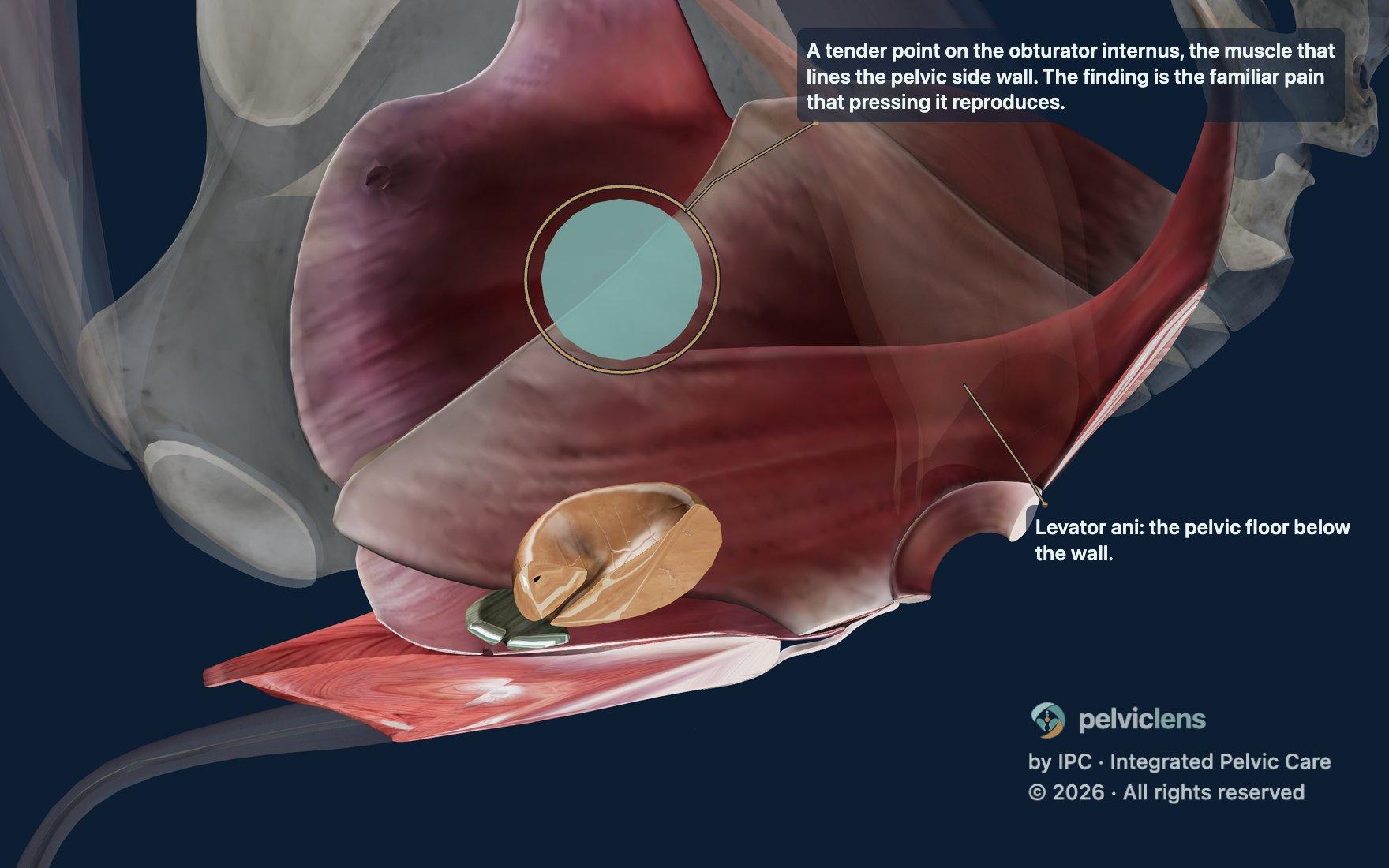
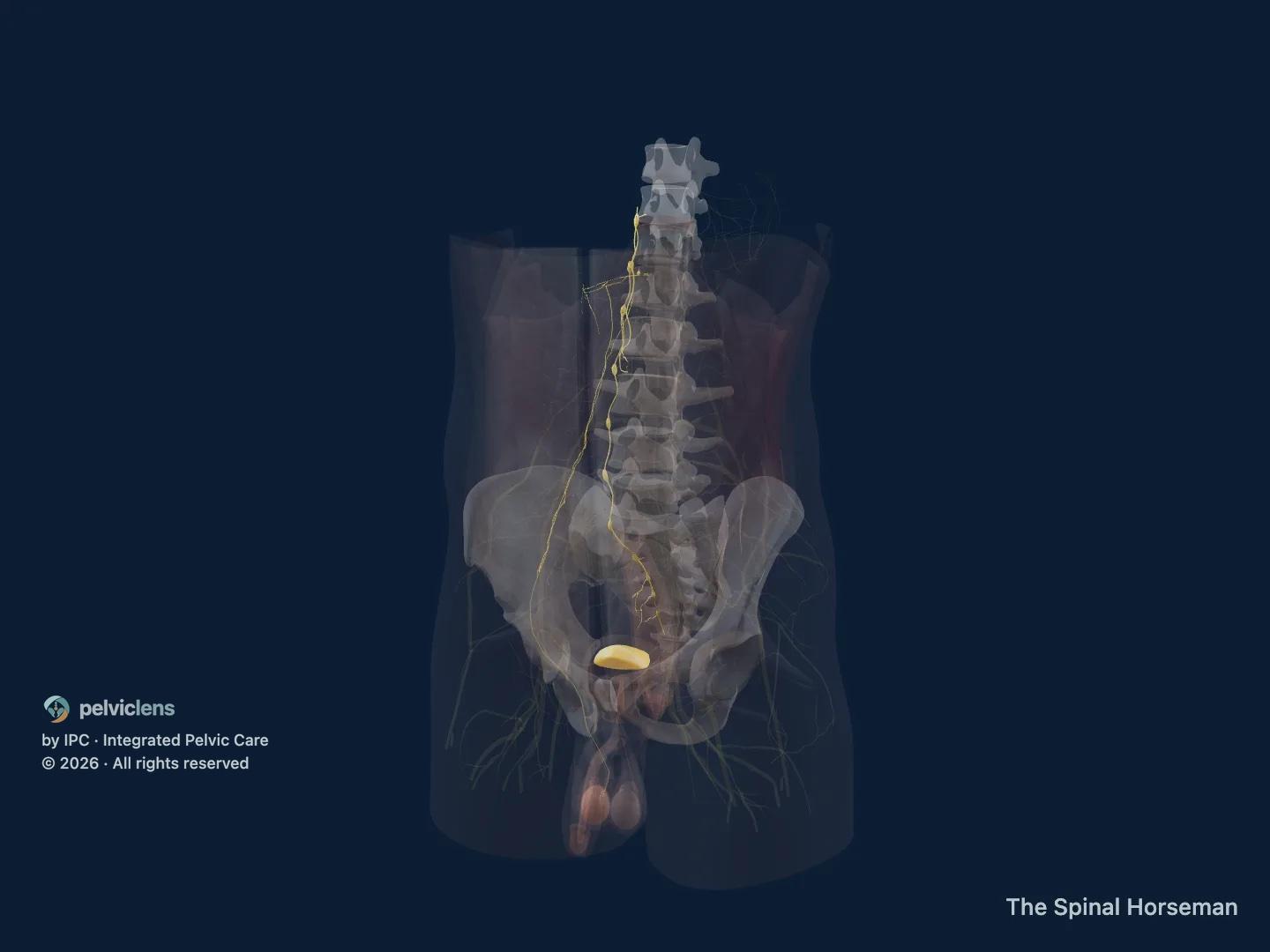
The obturator internus, the muscle lining the pelvic side wall above the levator ani, has its palpation site lit on the Pelvic Lens pelvic floor model, shown with the bladder hidden.
Obturator internus anatomy: a pelvic wall muscle
Most pages file this muscle under the pelvic floor, and it belongs to the wall. The obturator internus is a pelvic wall muscle, not a pelvic floor muscle per se, and it reinforces the side wall for hip stabilization and load transfer. It arises inside the pelvis from the obturator membrane and the bony margin of the obturator foramen, and it covers most of the lateral pelvic wall. It leaves through the lesser sciatic foramen, where its tendon bends at a right angle over the ischium. Outside the pelvis the tendon joins the gemelli as the obturator internus gemelli complex, external rotators of the hip that insert on the medial aspect of the greater trochanter. The male pelvic floor anatomy pillar sets this wall beside the three layers of the floor.
Its fascia matters as much as its fibers. The pudendal nerve wraps around the ischial spine and enters Alcock's canal, within the obturator internus fascia [3]. The fat of the ischioanal fossa, between the levator ani and the canal, protects the nerve. That fascia makes the muscle popular for manual therapy, and it turns a tender point here into a pudendal question too. The same nerve carries the motor supply to the external urethral sphincter.
How to palpate an obturator internus?
The question at the side wall is not whether the point is tender but whether pressing it brings back your patient's pain. In men the route is the rectum: in the MAPP extended examination, the obturator muscles were palpated anteriorly and laterally, and the levator posteriorly [4]. From outside, your finger reaches mostly the tendon part of the muscle.
Discomfort on palpation is acceptable; the familiar pain is the finding. A referral toward the penis makes it more significant, and the pattern does not require one. The same criterion holds on the bulbospongiosus or on the puborectalis at the anorectal angle. In men treated for chronic prostatitis/chronic pelvic pain syndrome, palpating designated points inside and outside the pelvic floor could reproduce the pain at each of the seven sites they reported, five of them at least half the time [5].
Tenderness without the familiar pain proves less. In the MAPP cohort of men and women, obturator tenderness turned up in 40.4 percent of people with urologic chronic pelvic pain syndrome, in 9.8 percent of controls with chronic fatigue syndrome and in none of the healthy controls [4]. Tenderness that does not bring back his pain is a minor criterion, so you do not treat every tender spot.
Chart the tender point with its location and referral [1]. The patterns are a clinical classification, not a validated instrument.
Pudendal nerve, hip or tender point: rule out first
Before you chart any tender point, ask whether the pelvic floor is relevant at all: groin pain after an inguinal hernia repair, or pain that travels down the leg, may belong elsewhere.
The pudendal nerve comes next, since it runs in this muscle's fascia. The ICS terminology gives pudendal nerve neurodynamics and a pudendal nerve provocation test terms of their own, apart from the tender point [1]. In the P slump test, your patient sits upright, the penis is held and drawn down to tension the pudendal nerve, and then he slumps. Pain that the test reproduces and increases points to nerve tension, not a tender point. The Nantes criteria and the re-test sequence that follows a positive P slump test are set out in the pudendal neuralgia article.
Then comes the hip, because the obturator internus is a hip external rotator. Run the load transfer and pressure control tests, see which one fails, and treat outside the pelvis as well as inside.
Desensitization first, then tolerance
Your patient asks for a release, and the pattern asks for tolerance: reduce the pain first, then raise what the tissue can take. In desensitization you hold your finger on the point and wait as the pain eases, from eight to seven, then to six. In tolerance you hold a set pain, around four, and push a little further each time it eases, a graded exposure that usually belongs to the later stage of recovery.
Tolerance starts when the pain becomes intermittent, so a constant seven gets desensitization first. A pelvic wand on the tender point also serves desensitization. In an open-label pilot of an internal pelvic wand within a multimodal protocol, median pain sensitivity fell from 7.5 to 4 at six months. Nearly all who completed it were men [6].
At home, your patient sits on a golf ball placed behind the ischium until his pain comes, at no more than four out of ten, then stands and sits again. The dose matches the task: if he cannot sit through ten minutes of a meeting, he starts at five or six.
The work is not totally pain-free. Without a Guarding pattern the floor has nothing to protect, so the aim is to reproduce his pain and leave him no worse afterwards. Irritability in this pattern is usually moderate to high. Monitor a ten to fifteen minute targeted trial: mild soreness for 24 to 48 hours is acceptable, and improvement within four or five days supports the pattern.
When Guarding comes with the tender point
A floor that braces before your finger arrives changes what comes first. Treat first the pattern that best explains the main symptom: in a flare-prone case, guarding before myofascial pain, because you cannot work on a point you cannot touch. With little guarding, the pain comes first.
Slight tenderness that does not reproduce your patient's symptoms, with a lot of involuntary contraction, points to the Guarding pattern first. Delayed relaxation with a lot of pain reproduced points to the Myofascial pain pattern first. Chronic pain rarely carries one pattern, so expect a mobility deficit or an Underactivation pattern underneath as well. Where that chronic pain carries the label chronic prostatitis, the chronic pelvic pain syndrome in men article sorts it by the Four Horsemen before the floor is treated.
What to say to your patient
- With the obturator internus lit on the model, after pressing reproduces his pain: "This is the spot I pressed. It is a muscle on your pelvic wall."
- When you explain the plan: "First we calm the pain. Then we help the muscle handle more pressure."
- At the end of the first session: "Soreness for a day or two is fine. Tell me how the next few days go."
Frequently asked questions
Where do you feel obturator internus pain?
Your patient typically feels it as a sitting pain, often worse on one side, and sometimes referred toward the penis. The location does not make the finding. Palpation that brings back that familiar pain does, with or without the referral. Pain that starts in the back or travels down the leg is ruled out first.
What is the origin and insertion of the obturator internus?
The obturator internus arises inside the pelvis from the obturator membrane and the margin of the obturator foramen, and inserts with the gemelli on the medial aspect of the greater trochanter. It covers most of the lateral pelvic wall and leaves through the lesser sciatic foramen, which makes it a pelvic wall muscle and hip external rotator, not a pelvic floor muscle per se.
What nerve controls the obturator internus muscle?
The nerve to obturator internus, a branch of the sacral plexus, supplies the muscle. Despite the shared name, the obturator nerve supplies the obturator externus instead. The pudendal nerve is separate and runs in Alcock's canal within the muscle's fascia, so a tender point on the pelvic side wall is examined beside a pudendal neurodynamic test.
How do you release the obturator internus?
In the Myofascial pain pattern, release means desensitization: sustained finger pressure on the tender point, internally or on the external tendon part, held until the pain eases. Once the pain becomes intermittent, graded tolerance follows, such as sitting on a ball at no more than four out of ten. The aim is to reproduce your patient's familiar pain and leave him no worse afterwards.
References
- An International Continence Society (ICS) report on the terminology for pelvic floor muscle assessment. Neurourology and Urodynamics, 2021.
- Interrater Agreement of Manual Palpation for Identification of Myofascial Trigger Points: A Systematic Review and Meta-Analysis. The Clinical Journal of Pain, 2017.
- Benjamin Alcock and the pudendal canal. Journal of Reconstructive Microsurgery, 2011.
- Physical Examination for Men and Women With Urologic Chronic Pelvic Pain Syndrome: A MAPP (Multidisciplinary Approach to the Study of Chronic Pelvic Pain) Network Study. Urology, 2018.
- Painful myofascial trigger points and pain sites in men with chronic prostatitis/chronic pelvic pain syndrome. The Journal of Urology, 2009.
- Safety and effectiveness of an internal pelvic myofascial trigger point wand for urologic chronic pelvic pain syndrome. The Clinical Journal of Pain, 2011.
Related articles
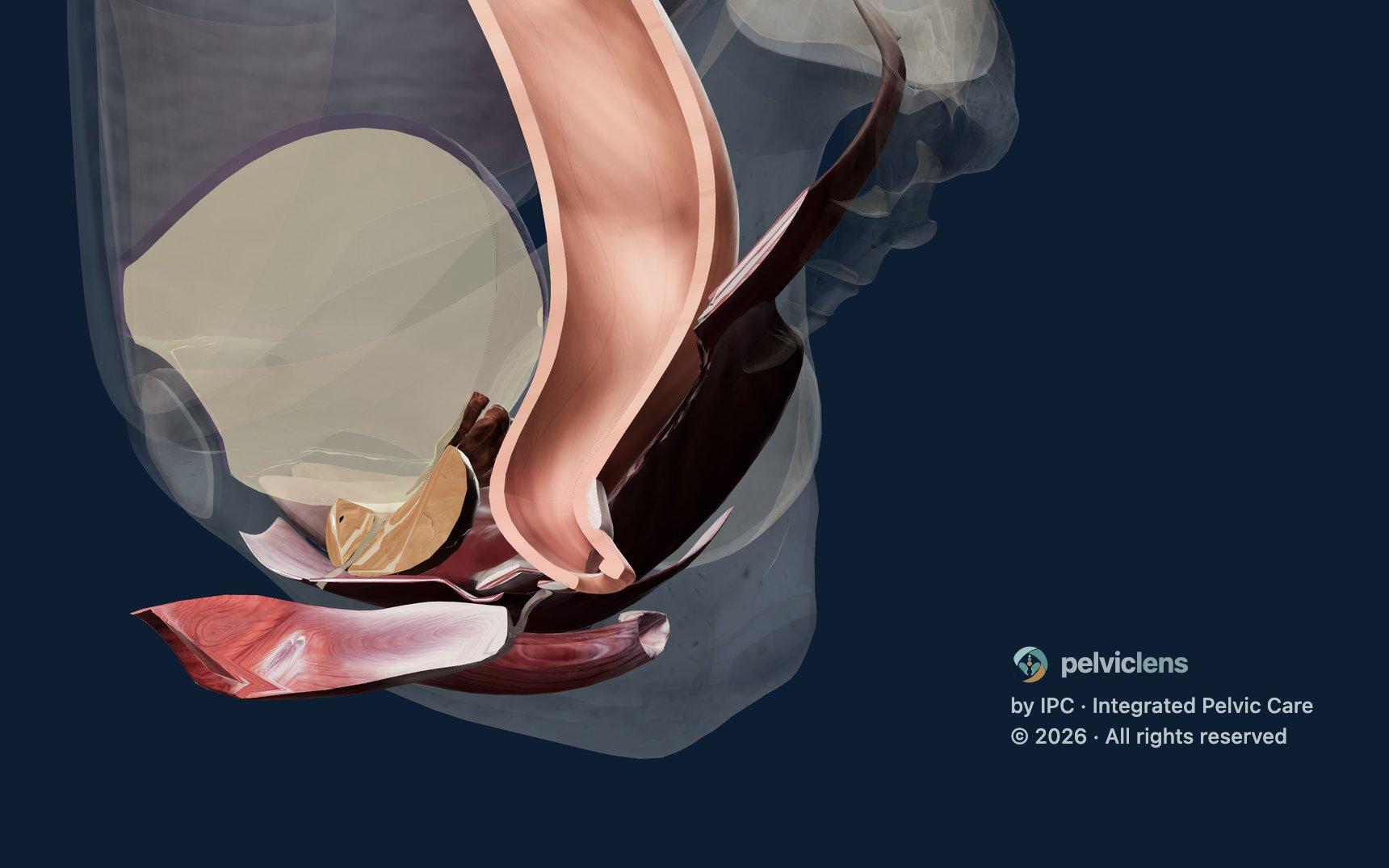 Men’s healthAnorectal angle: normal range in menNormal anorectal angle: about 85 to 96° at rest, sharper on a squeeze, wider on straining, and the exam cue that splits Guarding from Restriction.18 min read
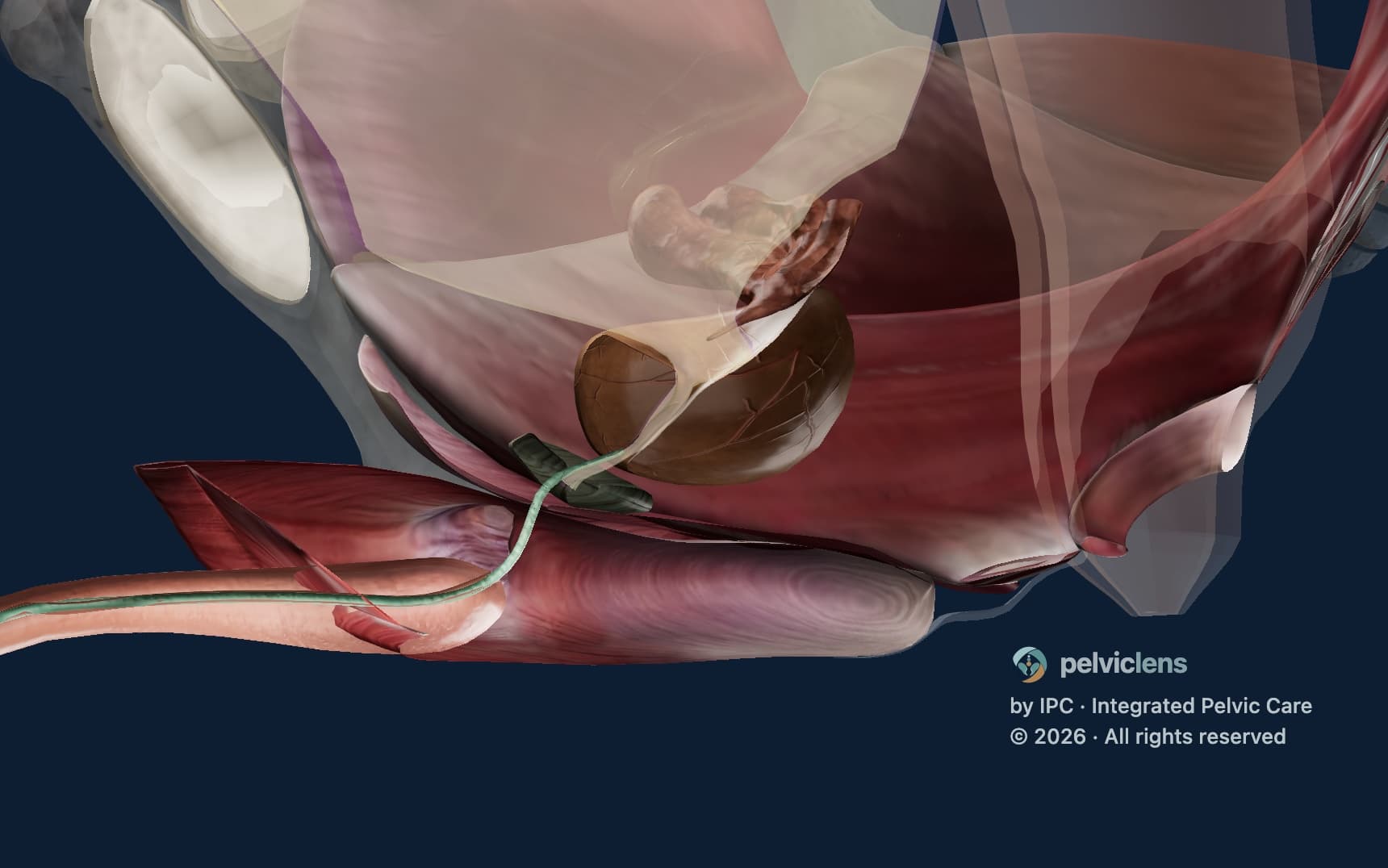 External urethral sphincter: functionThe external urethral sphincter for the pelvic health clinician: how it differs from the internal sphincter, how a cough moves it, and how to train it.10 min read
 Coccydynia: causes, tests and treatmentCoccydynia for clinicians: dynamic sitting X-rays, the pelvic floor muscles on the coccyx, and the evidence from cushions to coccygectomy.10 min read
Read this article in Français · Español · Português · Deutsch
This article is education for health professionals. It is not medical advice, not a diagnosis and not a treatment plan for any person. Clinical decisions rest on your own assessment of the patient in front of you. If you are a patient reading this, talk it through with your own health professional. Evidence changes: the review date above tells you when this article was last checked.