
Chronic pelvic pain syndrome in men
Chronic pelvic pain syndrome in men, long called chronic prostatitis: sort it by the Four Horsemen, then by the pelvic floor pattern.

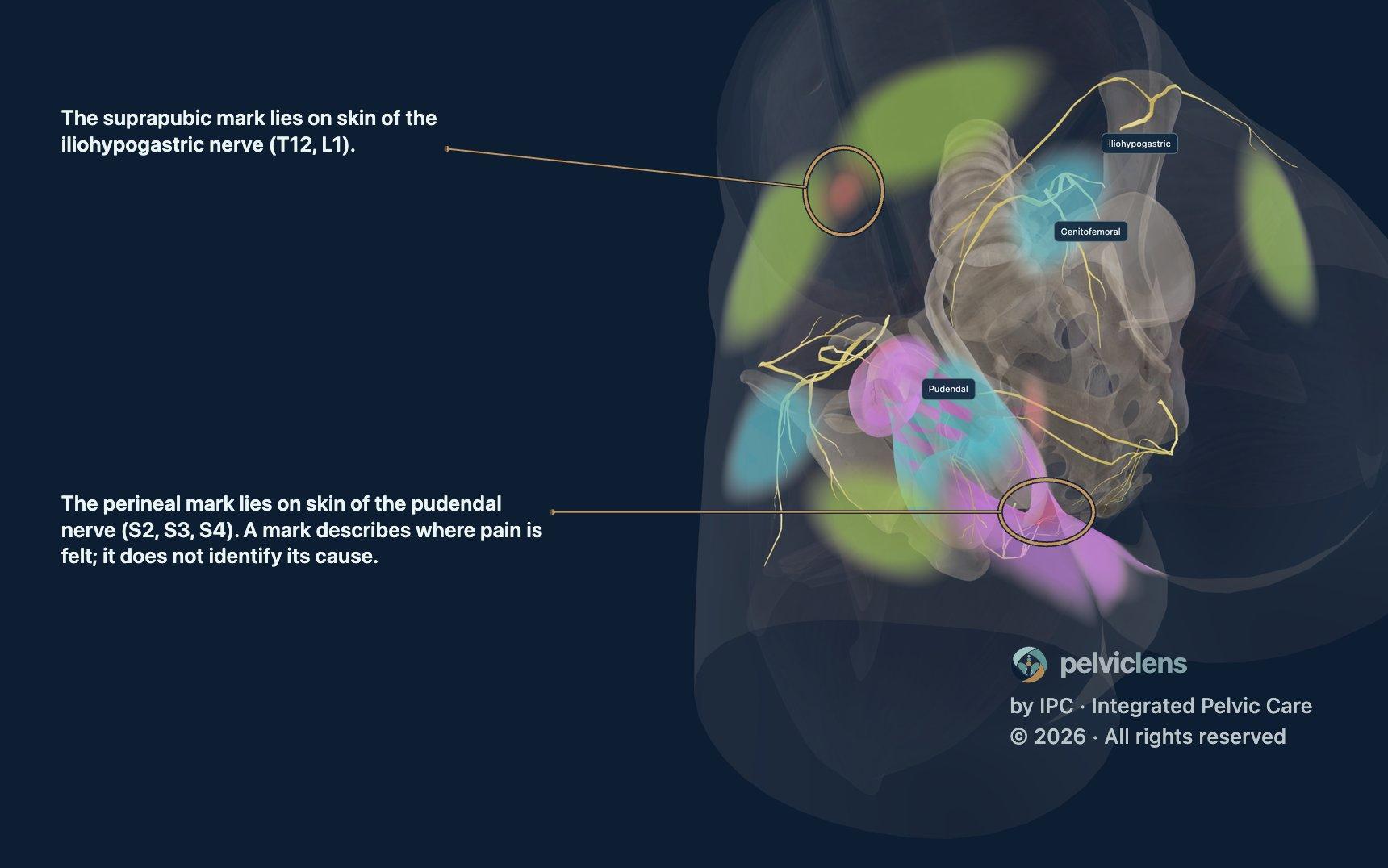
The short answer. Chronic pelvic pain syndrome in men is pelvic pain or discomfort for at least three of the past six months, in the absence of other causes [1]. The label names a time course, not a mechanism. The Four Horsemen sort the pain by its dominant mechanism; on the pelvic floor, the Guarding and Myofascial pain patterns need different first treatments.
Key takeaways
- Categories IIIA and IIIB show no clinically significant differences, so the microscopy finding that splits them does not choose the physiotherapy [1].
- The Four Horsemen sort the pain first. On the floor, the Guarding pattern gets down-regulation, and the Myofascial pain pattern gets desensitization, then tolerance.
- In the 21 men with CP/CPPS in one feasibility trial, myofascial physical therapy and massage did not differ significantly: 64 versus 40 percent responded (p = 0.39) [2].
Your patient calls his pain prostatitis: he has had repeated courses of antibiotics, his culture came back negative, and he points to his perineum and his left testicle. The diagnosis behind his word is chronic pelvic pain syndrome in men, written as chronic prostatitis/chronic pelvic pain syndrome (CP/CPPS, or CPPS), with no infection found. A prostatitis in your patient's past was most likely not a prostatitis at all, but a pelvic pain case.
So you sort the pain by its mechanism first. Integrated Pelvic Care's masterclass, the teaching Pelvic Lens is built on, uses the Four Horsemen: the Spinal, Pelvic, Neuro and Tissue horsemen, types 1 to 4. Each is a dominant mechanism of male pelvic pain. Examination findings and the response over time name the dominant one, not the site of the pain. Within the Pelvic horseman, the IPC Male Pelvic Floor Patterns then name his floor's pattern.
Lower back and pelvic pain: the Spinal horseman
Before any pattern, the first question is whether the pelvic floor is relevant at all. The Spinal horseman, type 1, is pelvic pain with the spine as its primary source. Its symptoms change in a predictable mechanical way and show "a rapid, lasting, clinically meaningful improvement with patient-specific repeated spinal loading". Your patient's floor earns pelvic floor downtraining only once the spine has been tested.
The AUA guideline also asks you to screen the pelvis, hip and lower spine for neurological, musculoskeletal and orthopedic abnormalities [1]. In an NIH cohort the guideline cites, men with CP/CPPS were five times more likely to have neurologic disease, most often vertebral disc disease [1].
The Tissue horseman, type 4, is pain driven by a local tissue change such as a surgical scar; groin pain after an inguinal hernia repair may involve no pelvic floor at all.
Pain felt in the testicle, one of the pain sites in the AUA definition, can be referred from the thoracolumbar junction. The Maigne syndrome article examines that presentation sign by sign. Your patient is sure the testicle pain is his prostate, because that is what every course of antibiotics was for.
Guarding or Myofascial pain: two floors that hurt
Two referrals can both read "tender, tight floor" and still describe floors that have lost different capacities. The Pelvic horseman, type 2, is likely when pelvic floor loading reproduces your patient's familiar symptoms, unloading eases them, and those symptoms match the pelvic floor patterns.
A pattern is suggested by "1 major criterion or 3 minor criteria". The Guarding pattern is a regulation deficit, and these are its three major criteria (PFM is pelvic floor muscle):
- "Persistent or recurrent involuntary PFM contraction, anal closure, or perineal retraction when contraction is not required".
- "Protective involuntary contraction/withdrawal triggered by contact, palpation, insertion, movement, or pressure".
- "Paradoxical contraction/elevation when relaxation or descent is functionally required".
The Myofascial pain pattern is a tolerance deficit. Its one major criterion reads: "Palpation of a PFM tender point reproduces the patient's familiar/recognized pain, with or without a familiar referral pattern". This floor keeps a normal excursion, so the finding sits in the tender point.
A Guarding floor gets down-regulation, with no push. A Myofascial pain floor gets desensitization, then tolerance, and that work is not expected to be pain-free. A prostatitis diagnosis carried for years is often a Myofascial pain problem: pain leads to guarding, guarding to a stuck floor, and a Restriction pattern can follow.
One Guarding minor criterion, "Acute puborectalis position that is modifiable", is read at the anorectal angle.
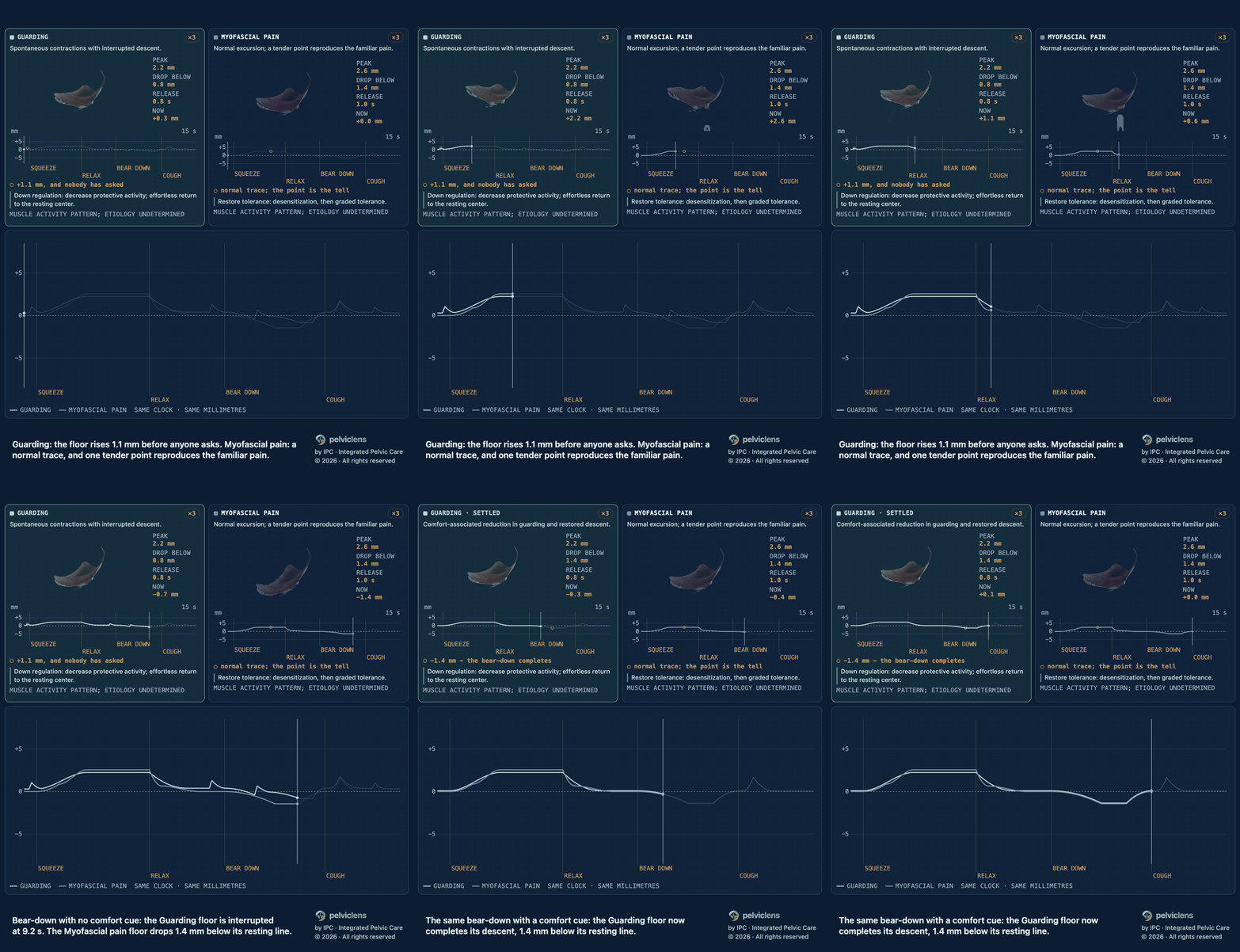
The Guarding floor completes its bear-down only after a comfort cue, while the Myofascial pain floor moves normally and one tender point reproduces the familiar pain, on the Pelvic Lens pelvic floor model.
Pelvic floor trigger points, charted as tender points
If your patient asks about pelvic floor trigger points, your notes chart a tender point instead. A tender point records what your finger finds and claims no diagnosis.
The AUA guideline explains why it left the older term: "there is no agreement as to what a trigger point is, and inter-tester reliability in identifying these trigger points is low" [1]. The European Association of Urology (EAU) guideline adds: "There is no accepted standard for diagnosing myofascial trigger points" [3]. The AUA writes "pelvic floor myalgia" and "pelvic floor tension myalgia" instead, splitting the finding by tone [1]. The pelvic floor patterns sort it by the capacity lost.
Tenderness in CP/CPPS is spread through the pelvis, not confined to the prostate: in one study, prostatic tenderness was present in 75 percent of men with CP/CPPS and in 50 percent without [4]. Tenderness that does not reproduce your patient's familiar pain, "Local PFM tenderness without clear familiar symptom reproduction", stays a minor criterion.
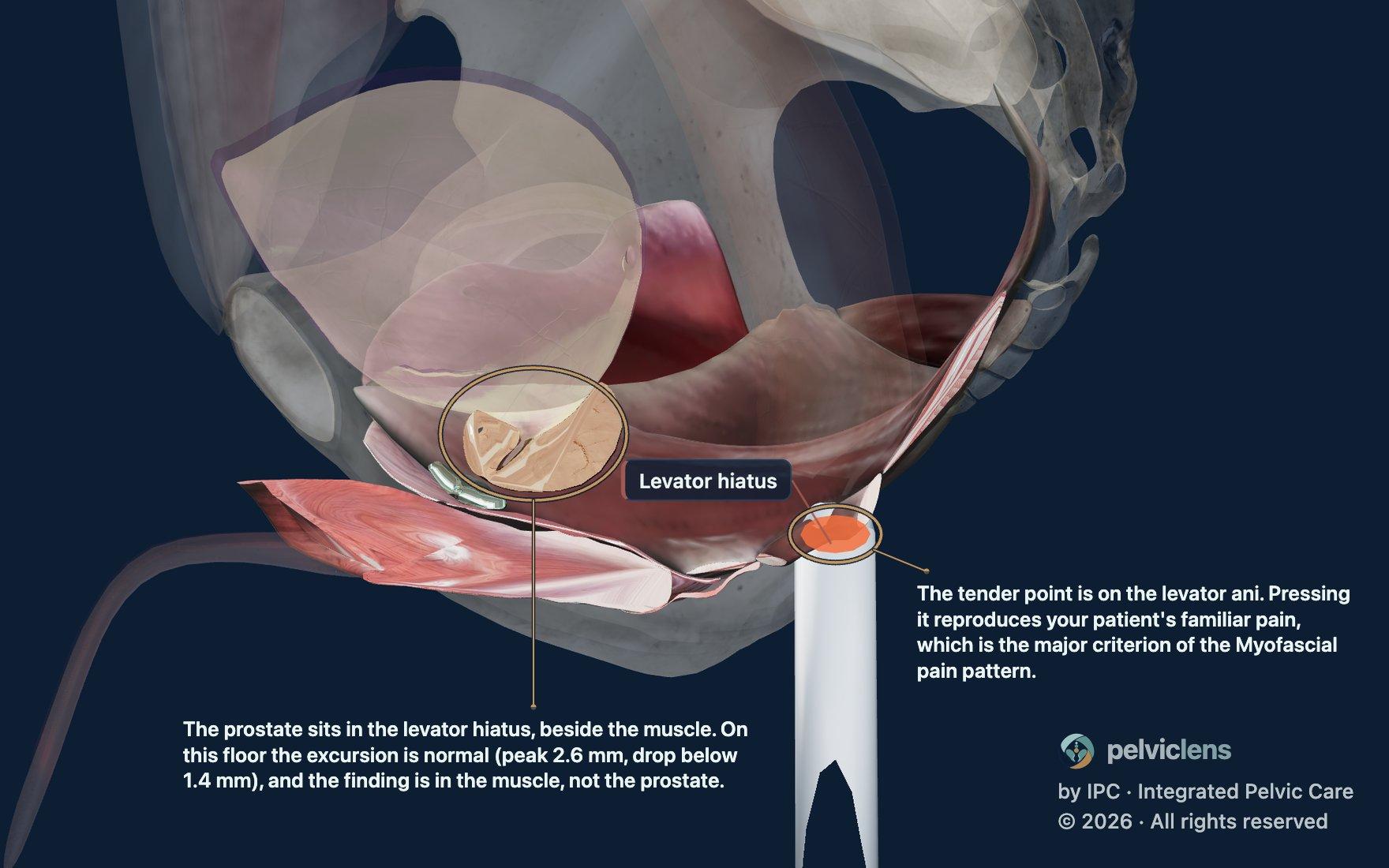
The levator ani carries one lit tender point in the Myofascial pain pattern, beside the prostate in the levator hiatus, on the Pelvic Lens pelvic floor model.
How a tender point is palpated, charted and treated is worked through on one muscle in the obturator internus trigger point article.
How is prostatitis diagnosed?
Chronic prostatitis without a bacterial cause, CP/CPPS, is diagnosed by exclusion, and your patient's negative culture was one step of that exclusion. The NIH classification, as the AUA guideline tables it, places CP/CPPS in category III, with two subclasses [1]:
| NIH category | Name |
|---|---|
| I | Acute bacterial prostatitis |
| II | Chronic bacterial prostatitis |
| IIIA | CP/CPPS with inflammation |
| IIIB | CP/CPPS without inflammation |
| IV | Asymptomatic inflammatory prostatitis |
White blood cells on microscopy, not the culture, separate IIIA from IIIB [1]. No clinically significant differences between the two subclasses have been demonstrated, so that split does not choose your physiotherapy [1]. The EAU guideline writes primary prostate pain syndrome (PPPS) and calls "chronic prostatitis" an inappropriate term, despite its long history of use [3].
The NIH Chronic Prostatitis Symptom Index (NIH-CPSI) has 9 items. It scores pain from 0 to 21, urinary symptoms from 0 to 10 and quality of life from 0 to 12, for a total of 0 to 43 [2]. You score it at the first visit and at follow-up, as the EAU recommends [3]. A 6-point fall in the total was the threshold that best predicted a response to treatment [5].
UPOINT, the urologists' phenotype, has six domains; in one study of 90 men, its tenderness domain was positive in 53 percent [6]. That is one box, which the pelvic floor patterns split by the capacity lost.
The label says nothing about how long the pain will last either. In one general-population survey, about a third of men with prostatitis-like symptoms had resolution a year later, usually those with shorter, milder symptoms [7]. In the rest, severity barely changed [7].
Central sensitization: the Neuro horseman
Pelvic horseman pain stays within the pelvic territory, the area boxer shorts cover. Pain that spreads beyond it points to another horseman. The Neuro horseman, type 3, is neuropathic or nociplastic pelvic pain. It is highly irritable and less mechanically predictable, flares with load or psychosocial stress, and settles slowly even with rest. Its nociplastic form is pain driven by central sensitization: an over-sensitive nervous system, not a primary tissue-loading limitation.
Pain beyond the pelvis is common: in the AUA guideline, 70 percent of men with chronic pelvic pain also reported pain outside the pelvis [1].
In the Neuro horseman, pelvic floor work treats secondary dysfunction: the Guarding, Restriction and Myofascial pain patterns that maintain sensitization. You explain that a sensitized nervous system, not only tissue injury, drives his symptoms, and his loading aims at graded desensitization, not avoidance.
Pain in the pudendal territory that builds with sitting has its own criteria and re-tests in the pudendal neuralgia article.
Chronic prostatitis physiotherapy: what trials show
Chronic prostatitis physiotherapy was tested in a randomized feasibility trial that assigned 23 men and 24 women to myofascial physical therapy or to global therapeutic massage [2]. In its 21 men with CP/CPPS, the two did not separate: 64 percent responded to myofascial physical therapy and 40 percent to massage, p = 0.39 [2]. The headline result came from the pooled sample, which included women with bladder pain syndrome [2].
The EAU guideline makes myofascial treatment the first line for pelvic floor dysfunction, as a weak recommendation [3]. For shortened muscles, it adds that "relaxation alone is not enough" [3]. The plan follows the pattern your examination found:
- Guarding pattern: down-regulation back to the resting center, with no push. Blanket advice to push the floor down fails this floor.
- Myofascial pain pattern: desensitization at the tender point first, then tolerance. The work is not expected to be pain-free.
- Restriction pattern: mobility work, not downtraining, restores the opening and descent a stuck floor has lost.
What to say to your patient
- With the thoracolumbar referral playing, before you screen his back: "Watch where this signal starts. Testicle pain can begin in your back."
- After the exam finds Guarding: "Your pelvic floor keeps bracing. Our work is to let it settle, not to push."
- After a tender point reproduces his pain: "Your muscle moves well, but pressing one spot brings on your pain. Expect to feel the work."
Frequently asked questions
Where does it hurt in chronic pelvic pain syndrome?
Chronic pelvic pain syndrome hurts in the perineum, the lower abdomen or suprapubic area, the testes or the penis, the four sites the AUA definition names. The pain may occur with ejaculation or during urination. The site does not name the mechanism.
Is chronic prostatitis the same as chronic pelvic pain syndrome?
Without a bacterial cause, yes: the NIH classification files both names under category III, chronic prostatitis/chronic pelvic pain syndrome, apart from the bacterial categories I and II and from category IV. The EAU guideline prefers primary prostate pain syndrome and calls "chronic prostatitis" an inappropriate term, despite its long history of use.
Is it normal for prostatitis symptoms to come and go?
Yes, symptoms that come and go fit the condition: the EAU guideline defines the pain as "persistent or recurrent episodic pain". When the Neuro horseman dominates, flares follow increased load or psychosocial stress and settle slowly. Pain that returns in the same place with pelvic floor loading points to the Pelvic horseman instead.
What are the causes of pelvic floor pain?
In men, pelvic floor pain has four possible dominant mechanisms, which Integrated Pelvic Care calls the Four Horsemen. The spine can refer pain into the pelvis, the pelvic floor can carry its own patterns, a sensitized nerve or nervous system can drive it, and a local tissue change such as a scar can maintain it. Examination findings and the response over time identify the dominant one.
What is the ICD-10 code for chronic pelvic pain syndrome in men?
ICD-10-CM, the US code set, has no entry for chronic pelvic pain syndrome, so the code follows the diagnosis written [8]. Chronic prostatitis is N41.1, prostatodynia (painful prostate) syndrome is N42.81, and pelvic, perineal or suprapubic pain is R10.20 to R10.24 [8]. WHO ICD-10 has N41.1, R10.2 with no fifth character, and N42.8 where ICD-10-CM has N42.81 [9]. No code names the horseman driving the pain or the pelvic floor pattern, so your notes record both.
References
- Male Chronic Pelvic Pain: AUA Guideline: Part I Evaluation and Management Approach. The Journal of Urology, 2025.
- Randomized multicenter feasibility trial of myofascial physical therapy for the treatment of urological chronic pelvic pain syndromes. The Journal of Urology, 2009.
- EAU Guidelines on Chronic Pelvic Pain. European Association of Urology, 2026.
- Pelvic tenderness is not limited to the prostate in chronic prostatitis/chronic pelvic pain syndrome (CPPS) type IIIA and IIIB: comparison of men with and without CP/CPPS. BMC Urology, 2007.
- Responsiveness of the National Institutes of Health Chronic Prostatitis Symptom Index (NIH-CPSI). Quality of Life Research, 2006.
- Clinical phenotyping of patients with chronic prostatitis/chronic pelvic pain syndrome and correlation with symptom severity. Urology, 2009.
- Prostatitis-like symptoms: one year later. BJU International, 2002.
- ICD-10-CM Tabular List of Diseases and Injuries and Alphabetic Index, FY2027. Centers for Disease Control and Prevention, National Center for Health Statistics, 2026.
- International Statistical Classification of Diseases and Related Health Problems, 10th Revision (ICD-10), Version 2019. World Health Organization, 2019.
Related articles
 Men’s healthPelvic floor courses for physiotherapistsPelvic floor courses for physiotherapists: what to check before booking, what a 3D model adds, and where to learn male pelvic health.16 min read
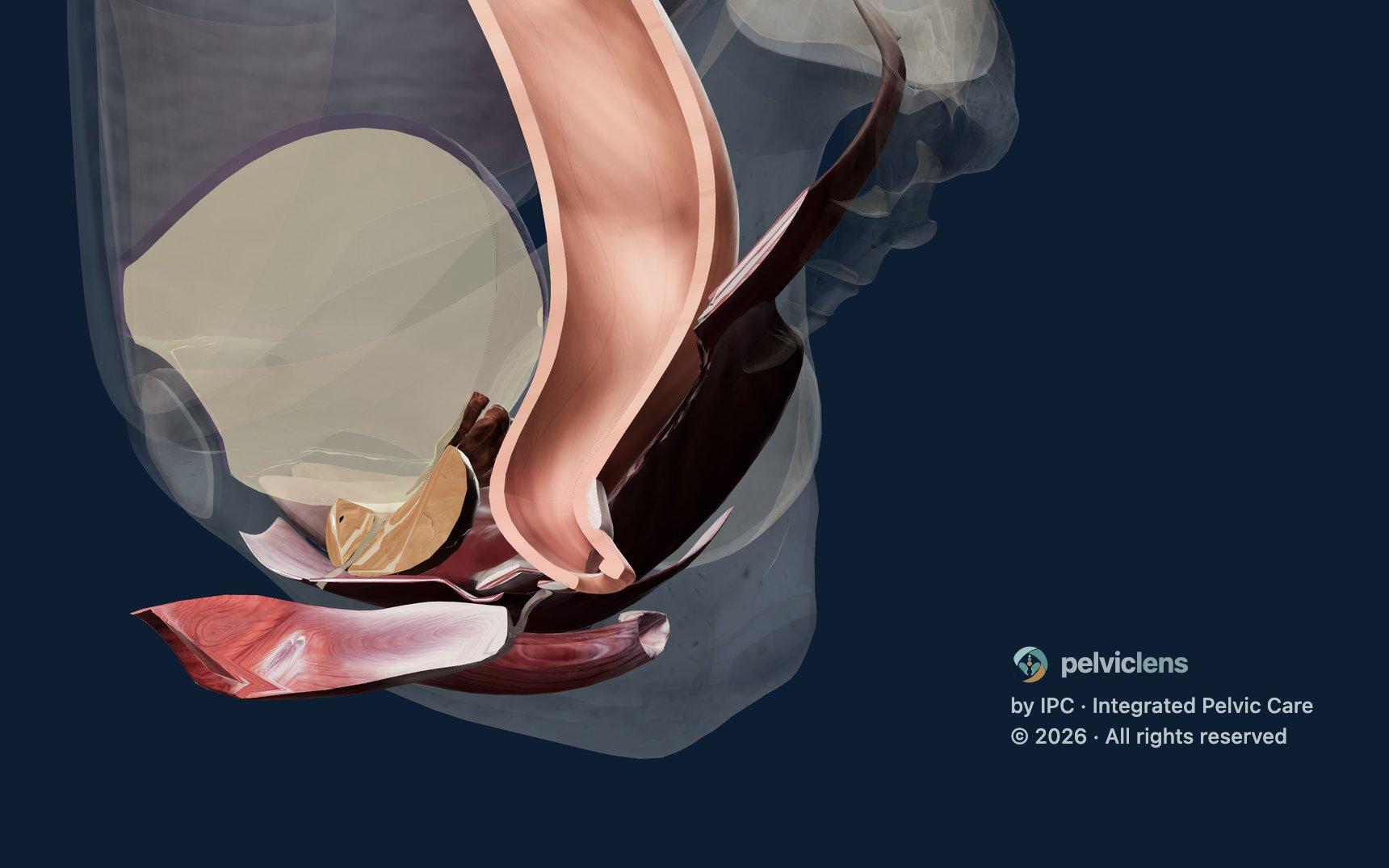 Men’s healthAnorectal angle: normal range in menNormal anorectal angle: about 85 to 96° at rest, sharper on a squeeze, wider on straining, and the exam cue that splits Guarding from Restriction.18 min read
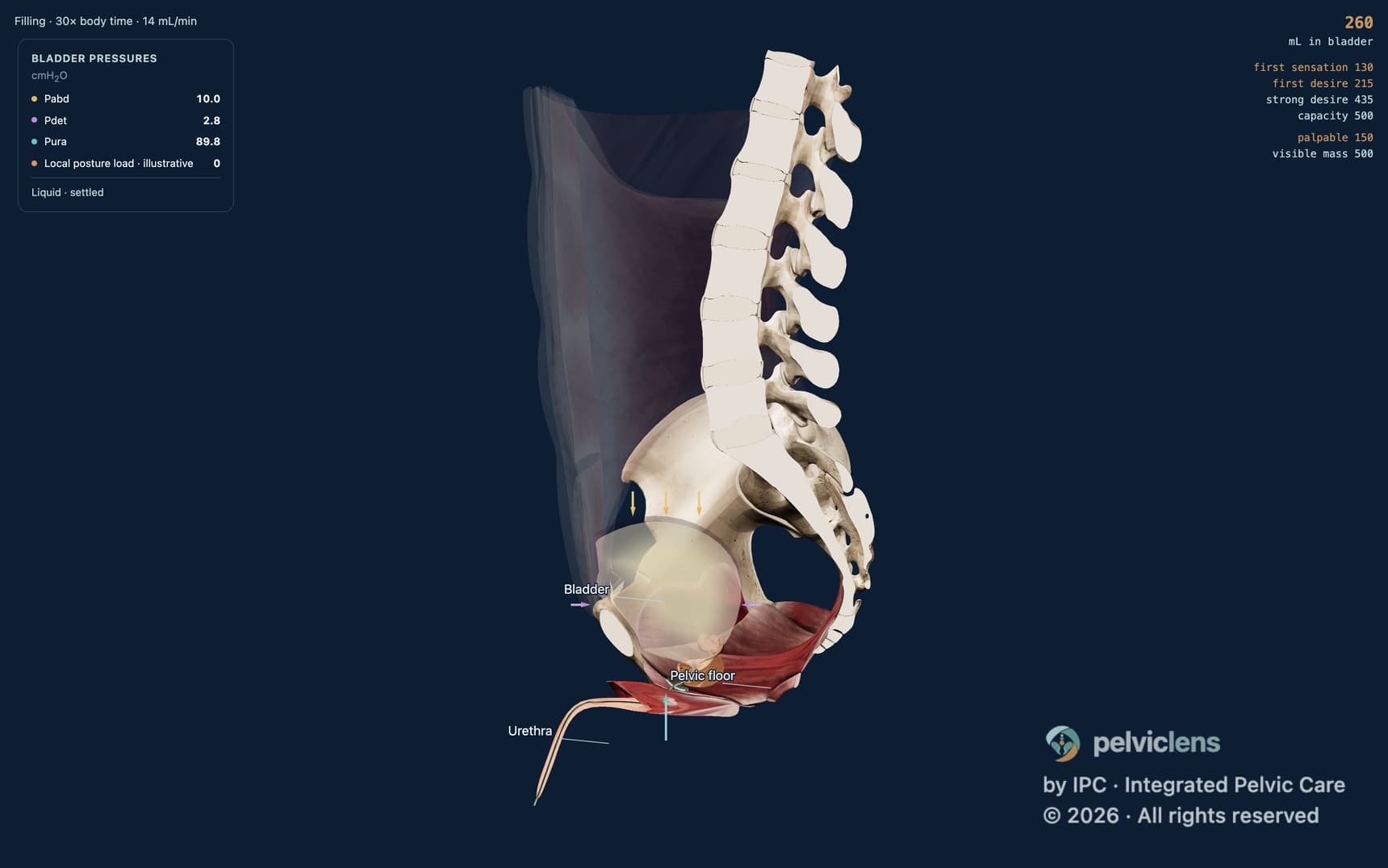 Cystometrogram: how to read the traceCystometrogram for the pelvic health clinician: the filling curve read as pressure, Pves = Pabd + Pdet, and what to tell your patient.16 min read
Read this article in Français · Español · Português · Deutsch
This article is education for health professionals. It is not medical advice, not a diagnosis and not a treatment plan for any person. Clinical decisions rest on your own assessment of the patient in front of you. If you are a patient reading this, talk it through with your own health professional. Evidence changes: the review date above tells you when this article was last checked.