
Proctalgia fugax: causes and treatment
Proctalgia fugax under Rome IV: what the anal sphincter does in an attack, what shortens it, and how levator ani syndrome differs.

The short answer. Proctalgia fugax is a sudden, severe pain in the rectum that lasts seconds to minutes, never longer than 30 minutes, and then disappears completely [1]. There is no pain between episodes, and reassurance and explanation are the usual treatment [1]. Rectal pain that lasts longer, with a tender puborectalis, is levator ani syndrome [1].
Key takeaways
- Rome IV defines proctalgia fugax by a clock: episodes last seconds to minutes, 30 minutes at most, and there is no anorectal pain between them [1].
- The cramp is thought to arise in the internal anal sphincter, a ring of smooth muscle that no voluntary cue reaches, and that cause is not proven [2].
- A rectal ache of 30 minutes or longer with a tender puborectalis is levator ani syndrome [1], and pain between episodes, bleeding or weight loss sends your patient to a doctor first.
Proctalgia fugax reaches you as a story and never as a finding. Your patient is woken by a cramp deep in the rectum, which he calls an anal spasm. It is gone before he can describe it, and your examination a week later finds nothing. The temptation is to treat his pelvic floor anyway, because a pelvic floor is what the referral asked you to treat. Rome IV points the other way: for most patients the attacks are too brief to treat, so the treatment it names is reassurance and explanation [1]. Here, your explanation is the treatment.
Proctalgia fugax: a cramp no cue can reach
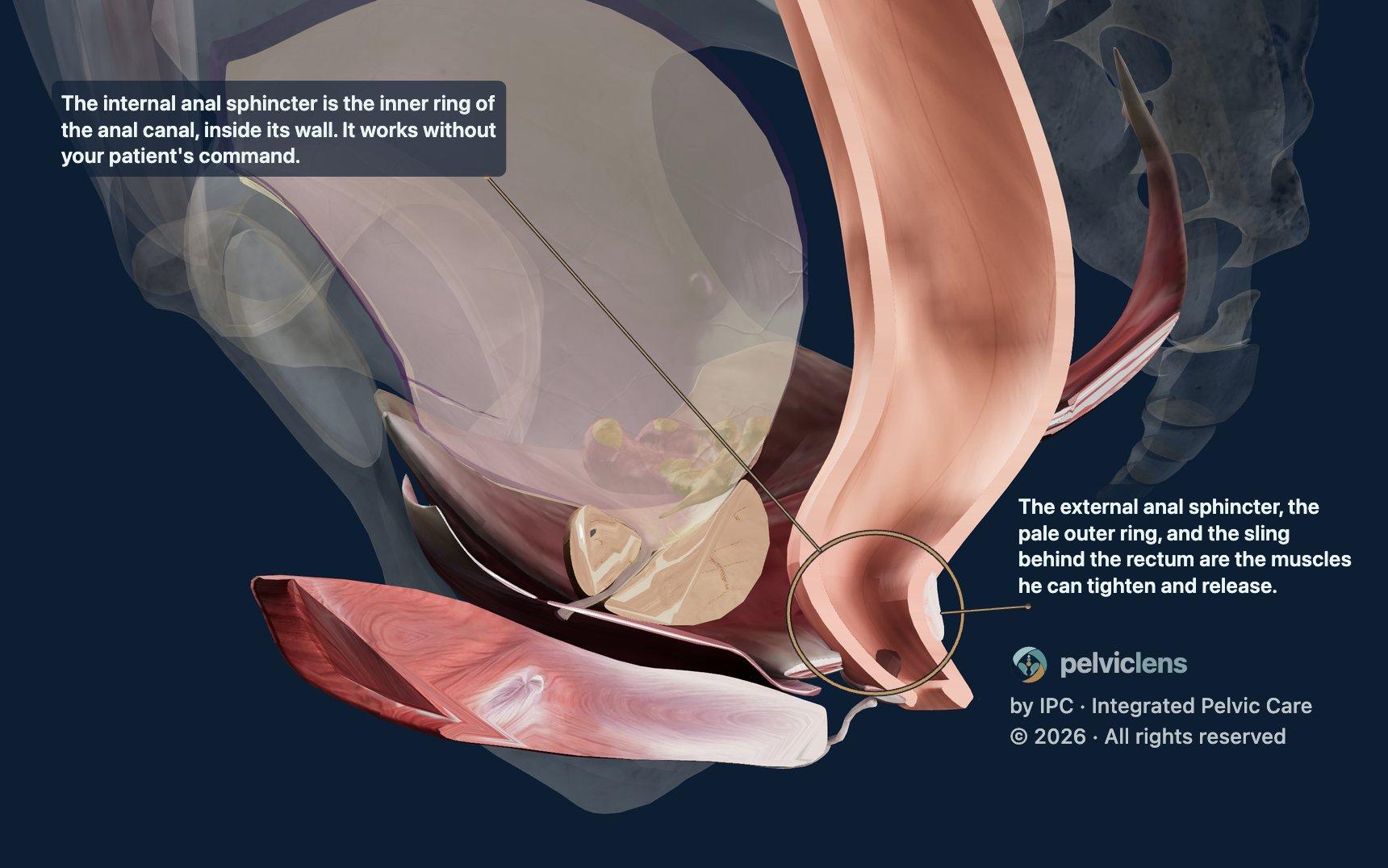
Two rings close the anal canal, and only one of them answers to your patient. The inner ring is the internal anal sphincter, smooth muscle that supplies most of the resting anal pressure [1]. The outer ring is the external anal sphincter, the muscle of a voluntary squeeze [1]. Behind the anorectal junction lies the puborectalis, the sling that sets the anorectal angle and works with the outer ring under his command.
That inner ring is where the evidence places the cramp. In a study of 18 adults with sporadic proctalgia fugax, squeeze pressure, the reflex relaxation and the thickness of both sphincters matched those of controls between attacks [2]. Two of the 18 had an attack while under study, and each came with a rise in anal resting tone and in slow wave amplitude [2]. The authors concluded that the anal smooth muscle may show a motor abnormality during an attack [2], and Rome IV says only that abnormal smooth muscle contractions may be responsible [1].
For you, this sets the limit of a cue. A breath, a drop of the pelvic floor or a bearing-down effort reaches the external sphincter and the sling. Nothing voluntary reaches the internal anal sphincter, so your patient cannot relax the cramp away, and its return is not a failure on his part.
Your patient is sure the cramp is something he does, a muscle he clenches and could learn to let go of.
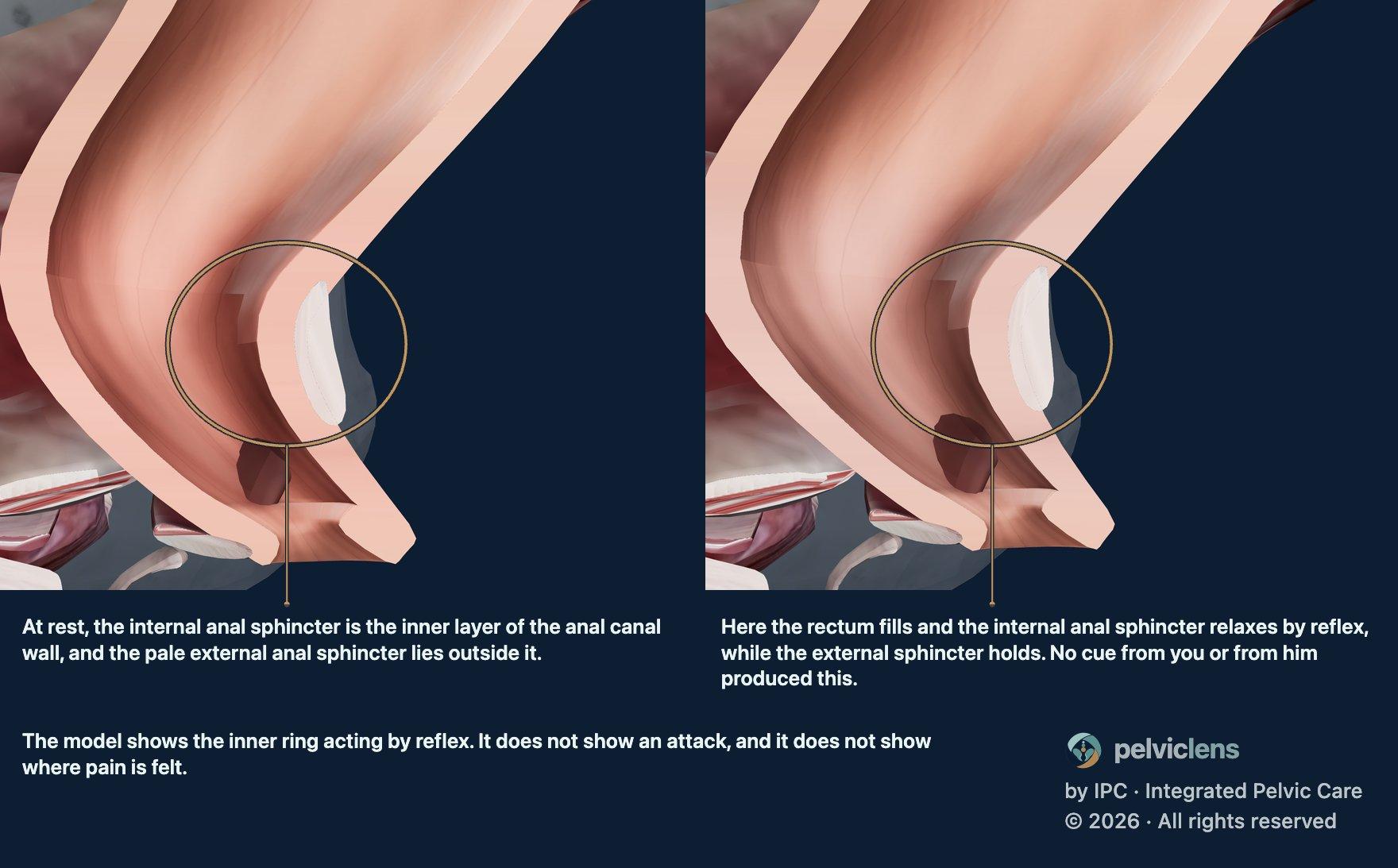
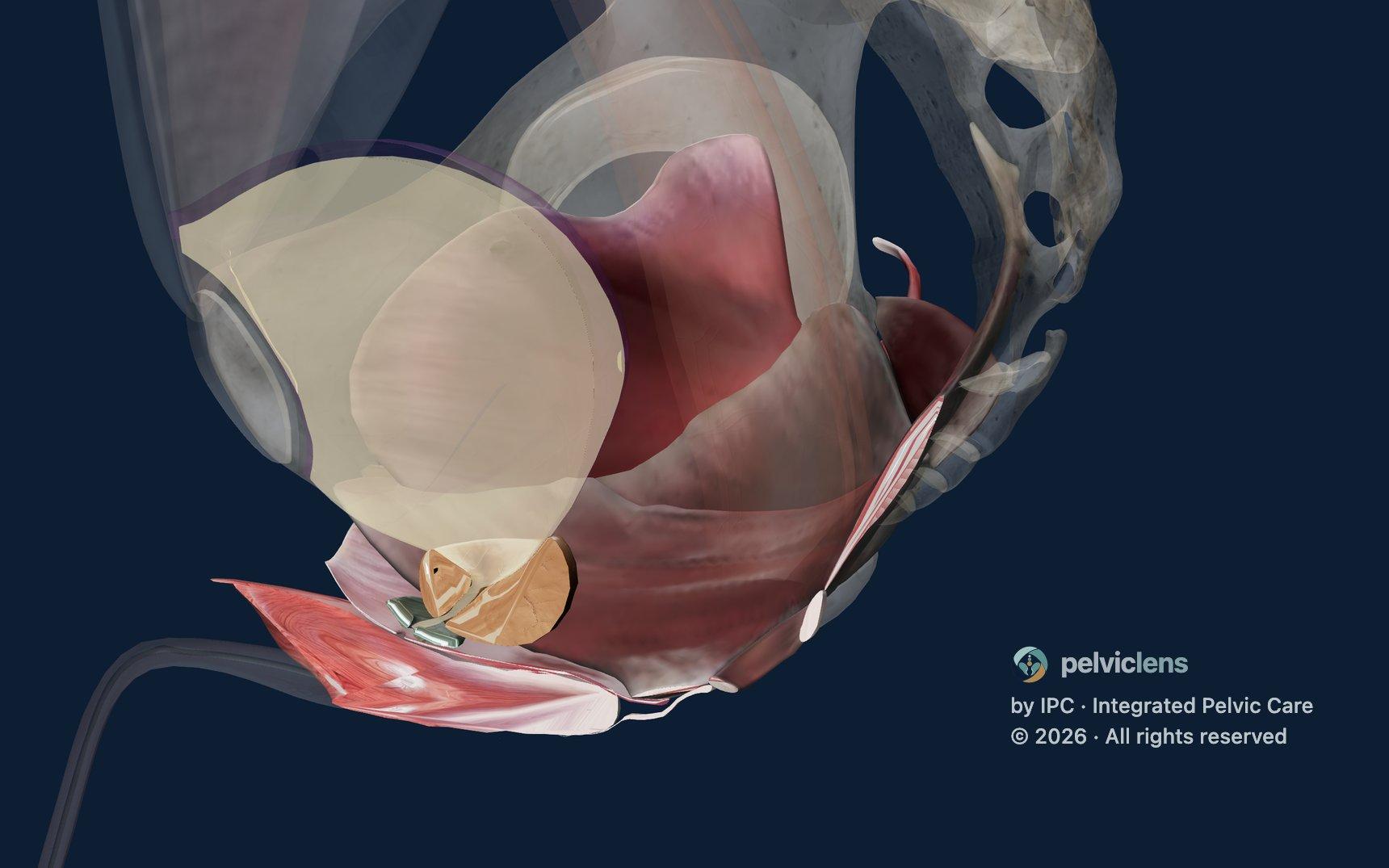
The internal anal sphincter, the inner layer of the canal wall, relaxes by reflex as the rectum fills while the pale external sphincter holds around it, on the Pelvic Lens defecation model.
Rome IV criteria for proctalgia fugax
The referral letter uses Rome's words, so their exact wording matters. Rome IV names three functional anorectal pain disorders: proctalgia fugax, levator ani syndrome and unspecified functional anorectal pain. It separates them mainly by the duration of the pain and by anorectal tenderness, and the first two require all of their criteria [1]:
| Criterion | Proctalgia fugax | Levator ani syndrome |
|---|---|---|
| The pain | "Recurrent episodes of pain localized to the rectum and unrelated to defecation" | "Chronic or recurrent rectal pain or aching" |
| How long | "Episodes last from seconds to minutes, with a maximum duration of 30 minutes" | "Episodes last 30 minutes or longer" |
| What decides | "There is no anorectal pain between episodes" | "Tenderness during traction on the puborectalis" |
| Exclusions | "Exclusion of other causes of rectal pain, such as inflammatory bowel disease, intramuscular abscess and fissure, thrombosed hemorrhoids, prostatitis, coccygodynia, and major structural alterations of the pelvic floor" | The same exclusions |
Rome IV places the pain in the rectum, no longer the anal canal, because visceral pain is poorly localized [1]. ICD-10 codes proctalgia fugax under K59.4, anal spasm.
What causes proctalgia fugax?
The cause of proctalgia fugax is unproven, largely because an attack is over before anyone can measure it [1]. The strongest evidence points to the smooth muscle of the anal canal, and it consists of the two attacks recorded in the study above [2].
A rare inherited form implicates the same muscle. In one family, members of five generations had severe proctalgia fugax, with pain by day and hourly at night, and constipation [3]. Endosonography showed a grossly thickened internal anal sphincter, and the authors described an autosomal dominant myopathy of that muscle [3]. Hourly night attacks with constipation and a family history are worth naming in your letter to the doctor.
Rome IV adds that attacks are often precipitated by stressful life events or anxiety [1].
Proctalgia fugax in men: how often, how long
Every honest answer to how common his pain is comes with its sample. Across surveys, 8 to 18 percent of people report proctalgia fugax [1]. In a US householder survey, the figure for men was 7.5 percent [4].
The data on sex are mixed. Rome IV reports no difference between the sexes, while a prospective series from a Paris proctology unit found mostly women among its 54 cases [1][5].
In that Paris series, an attack lasted 15 minutes on average and came about 13 times a year, mostly suddenly and without a trigger [5]. Rome IV's own summary is that attacks are infrequent, with fewer than five a year in about half of cases [1].
Between attacks, a quiet exam is the expected finding [2], and how its pressures and reflex are recorded is set out in anorectal manometry.
Levator ani syndrome: the pain that lasts
Past 30 minutes, Rome stops asking about the clock and asks about your finger: levator ani syndrome requires tenderness during traction on the puborectalis [1]. With the same symptoms and no tenderness, Rome calls the pain unspecified functional anorectal pain [1]. Your patient describes a vague, dull ache or a pressure high in the rectum, often worse with sitting, and the tenderness is more often on the left side [1]. The puborectalis is one part of the levator ani, which the male pelvic floor anatomy pillar places in the deep layer. Rome excludes coccygodynia, and a pain at the tailbone rather than high in the rectum is assessed as coccydynia.
Integrated Pelvic Care's masterclass reads the finding more strictly than Rome does. "Local PFM tenderness without clear familiar symptom reproduction" is only a minor criterion. The major criterion of the Myofascial pain pattern, a tolerance deficit, asks for more: "Palpation of a PFM tender point reproduces the patient's familiar/recognized pain, with or without a familiar referral pattern". You chart the finding as a tender point, and a pattern is suggested by "1 major criterion or 3 minor criteria".
For the Myofascial pain pattern, the work is to restore tolerance. The pain is reduced first, and tolerance is then built by graded exposure, at a level your patient recovers from within 24 to 48 hours. The order of work when patterns coexist is set out in pelvic floor downtraining.
One randomized trial measured what Rome's exam finding predicts. With biofeedback that trained relaxation during straining, 87 percent of the adults with tenderness on traction reported adequate relief, and those without tenderness benefited from no treatment [6]. Beforehand, few in the tender group could lower anal pressure on straining or expel a balloon, the findings of dyssynergic defecation [6]. That result is the trial's biofeedback, not tolerance work.
Red flags: when anal pain is not proctalgia fugax
Proctalgia fugax is a diagnosis of exclusion, and you are often the first clinician to hear the whole story. A systematic review adds anorectal carcinoma to the causes excluded before the diagnosis is made [7]. A story that does not fit the criteria sends your patient to his doctor:
- Pain that stays between episodes, or an episode that lasts longer than 30 minutes [1].
- Pain tied to defecation, as with an anal fissure, which anoscopy may be necessary to identify [4].
- Bleeding, fever or unexplained weight loss.
- A recent trauma or procedure.
Night pain is on the masterclass's red-flag screen too, so a pain that wakes your patient goes to the doctor at first presentation. Once the exclusions are done, a cramp gone within minutes is the pattern of proctalgia fugax, and Rome IV notes that an attack may wake him [1].
A burning pain in a skin territory that is worse with sitting is assessed as pudendal neuralgia. Pain at more than one pelvic site with urinary symptoms, the picture long labeled prostatitis, is sorted in chronic pelvic pain syndrome in men.
Any anal pain that is not fleeting is sorted first by the Four Horsemen. A dull ache worse after sitting can be Spinal, a constant deep pressure with altered sensation Neuro, and pain after an anal procedure Tissue.
Proctalgia fugax treatment: what trials show
There is one randomized trial of a treatment for proctalgia fugax, and it enrolled 18 patients [8]. That is why the first line of treatment is still what you say: the reassurance and explanation Rome IV names for a harmless condition [1].
The trial tested inhaled salbutamol against placebo in a double-blind crossover, and 16 patients completed it [8]. Salbutamol shortened severe pain, most in prolonged attacks, by a mechanism the authors could not explain [8]. Rome IV reads the benefit as applying to episodes of 20 minutes or longer [1]. Whether to prescribe it is the doctor's decision.
Everything else rests on smaller evidence. A systematic review found little high level evidence, and it lists warm baths, topical glyceryl trinitrate or diltiazem, and salbutamol, with nerve blocks, clonidine or botulinum toxin considered in persistent cases [7]. Behind most of those names stand case reports and small uncontrolled series.
Your part is clear even so. You recognize the clock, screen for the red flags, explain the muscle, and treat a pattern only when your exam between attacks finds one. A quiet exam is not a reason to start downtraining: the Pelvic horseman's pain is reproduced by loading the pelvic floor, and this pain is not.
What to say to your patient
- With the anal canal on the model, when he describes the cramp: "This has a name: proctalgia fugax. It is a brief cramp in this inner muscle. You do not control it, and it is harmless."
- When he asks whether it is serious: "Your exam is normal. Bleeding, weight loss or pain that stays would change that. Tell your doctor if one appears."
- During an attack: "It will pass within minutes. A warm bath may help."
- When attacks are long or frequent: "Your doctor has options. One is an inhaler that a small trial tested."
Frequently asked questions
Is proctalgia fugax a sign of cancer?
No, proctalgia fugax is not a sign of cancer. It is a brief, harmless functional pain with no pain between episodes. The diagnosis is made only after other causes of rectal pain, anorectal cancer among them, have been excluded. Bleeding, weight loss or pain that stays between episodes sends your patient to his doctor.
What relieves a proctalgia fugax attack naturally?
Most attacks of proctalgia fugax end by themselves before any remedy can act. In one prospective series, two thirds of attacks stopped spontaneously. A warm bath is the non-drug measure that a systematic review lists, and the only randomized trial tested an inhaled medicine, not a supplement or an exercise. Reassurance and explanation remain the usual treatment.
Why does proctalgia fugax happen at night?
Proctalgia fugax does not happen mainly at night. In the one prospective series, attacks came by day about as often as by night, in 33 against 35 percent of cases. Rome IV notes that an attack may wake your patient from sleep. The mechanism is unknown, and a first episode of night pain is still checked by a doctor.
What is the difference between proctalgia fugax and levator ani syndrome?
The difference is the duration of the pain and one exam finding. Proctalgia fugax lasts seconds to minutes, 30 minutes at most, with no pain between episodes. Levator ani syndrome is a rectal pain or ache in episodes of 30 minutes or longer, with tenderness during traction on the puborectalis. Rome IV separates the two on those points.
What is the ICD-10 code for proctalgia fugax and rectal pain?
Proctalgia fugax is coded K59.4, anal spasm, in ICD-10-CM, the US code set, and in WHO ICD-10, which both list it by name [9][10]. Rectal or anal pain without that diagnosis is K62.89, other specified diseases of anus and rectum, in ICD-10-CM [9]. WHO ICD-10 stops at K62.8, with the same title [10].
References
- Functional Anorectal Disorders. Gastroenterology, 2016.
- Anorectal function and morphology in patients with sporadic proctalgia fugax. Diseases of the Colon and Rectum, 1996.
- Hereditary internal anal sphincter myopathy causing proctalgia fugax and constipation. A newly identified condition. Gastroenterology, 1991.
- Anorectal and Pelvic Pain. Mayo Clinic Proceedings, 2016.
- Proctalgia fugax: demographic and clinical characteristics. What every doctor should know from a prospective study of 54 patients. Diseases of the Colon and Rectum, 2007.
- Biofeedback is superior to electrogalvanic stimulation and massage for treatment of levator ani syndrome. Gastroenterology, 2010.
- Proctalgia fugax, an evidence-based management pathway. International Journal of Colorectal Disease, 2010.
- Treatment of proctalgia fugax with salbutamol inhalation. The American Journal of Gastroenterology, 1996.
- ICD-10-CM Tabular List of Diseases and Injuries and Alphabetic Index, FY2027. Centers for Disease Control and Prevention, National Center for Health Statistics, 2026.
- International Statistical Classification of Diseases and Related Health Problems, 10th Revision (ICD-10), Version 2019. World Health Organization, 2019.
Related articles
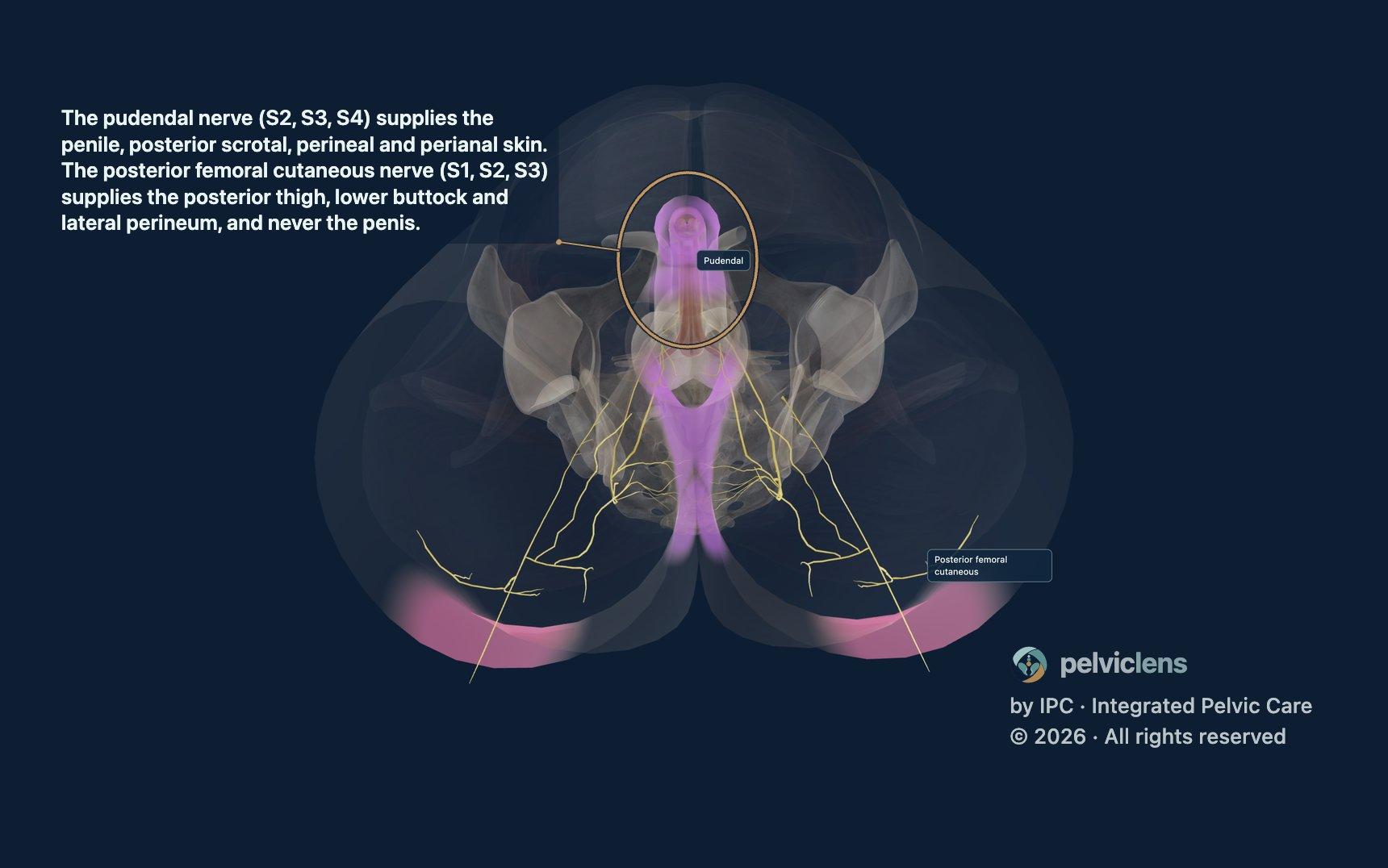 Men’s healthPudendal neuralgia: criteria and testsPudendal neuralgia in men: the Nantes criteria, the P slump test and the pudendal nerve tests, from EMG to the CT-guided block, read by Four Horsemen.10 min read
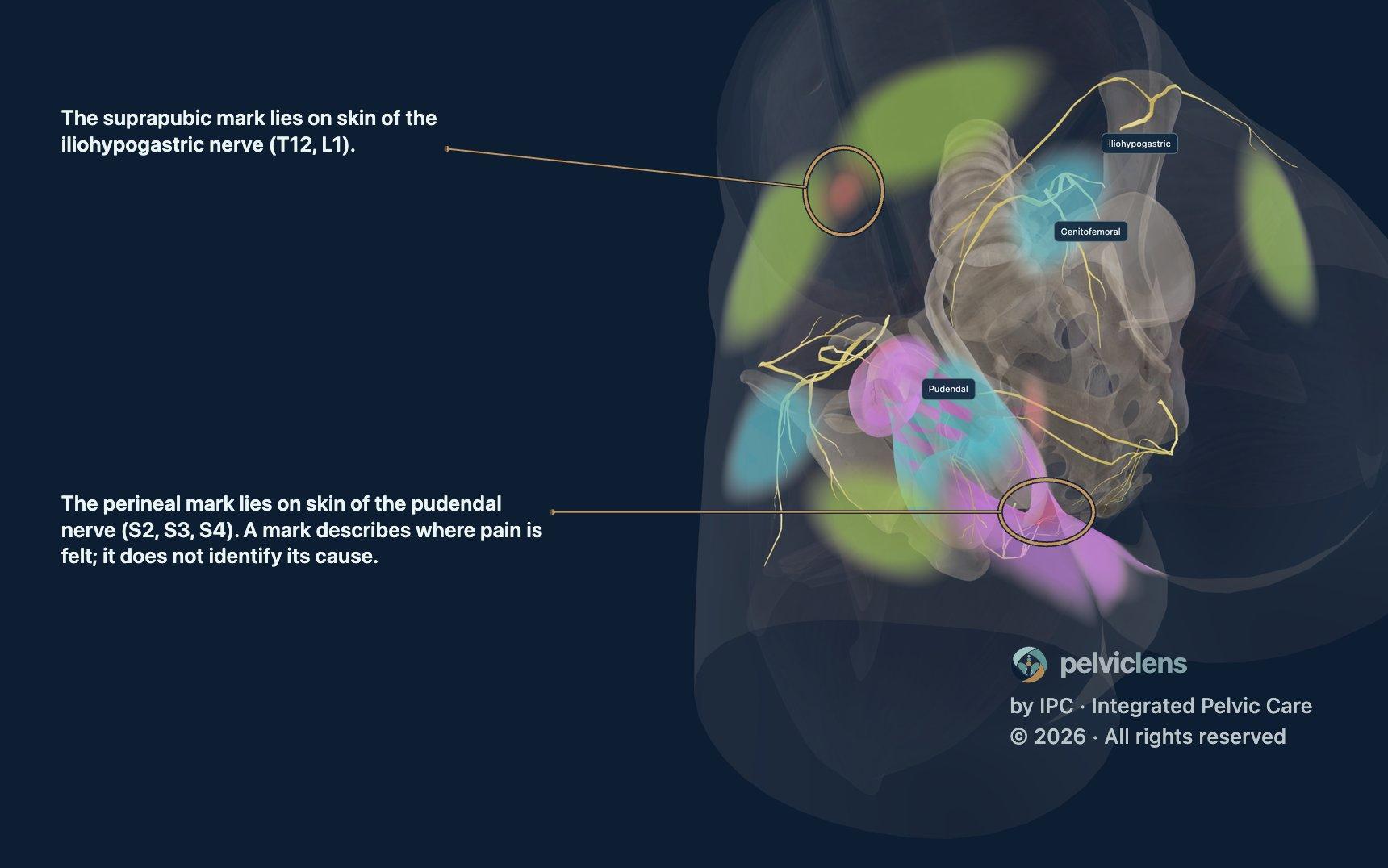 Men’s healthChronic pelvic pain syndrome in menChronic pelvic pain syndrome in men, long called chronic prostatitis: sort it by the Four Horsemen, then by the pelvic floor pattern.10 min read
 Men’s healthPelvic floor downtraining in menHypertonic pelvic floor in men is a label, not a finding: pelvic floor downtraining is down-regulation for the Guarding pattern the exam finds.17 min read
Read this article in Français · Español · Português · Deutsch
This article is education for health professionals. It is not medical advice, not a diagnosis and not a treatment plan for any person. Clinical decisions rest on your own assessment of the patient in front of you. If you are a patient reading this, talk it through with your own health professional. Evidence changes: the review date above tells you when this article was last checked.