
Modified Oxford scale: grades and limits
The modified Oxford scale for clinicians: what a 0 to 5 pelvic floor grade measures, what it misses, and how to read it in men and women.

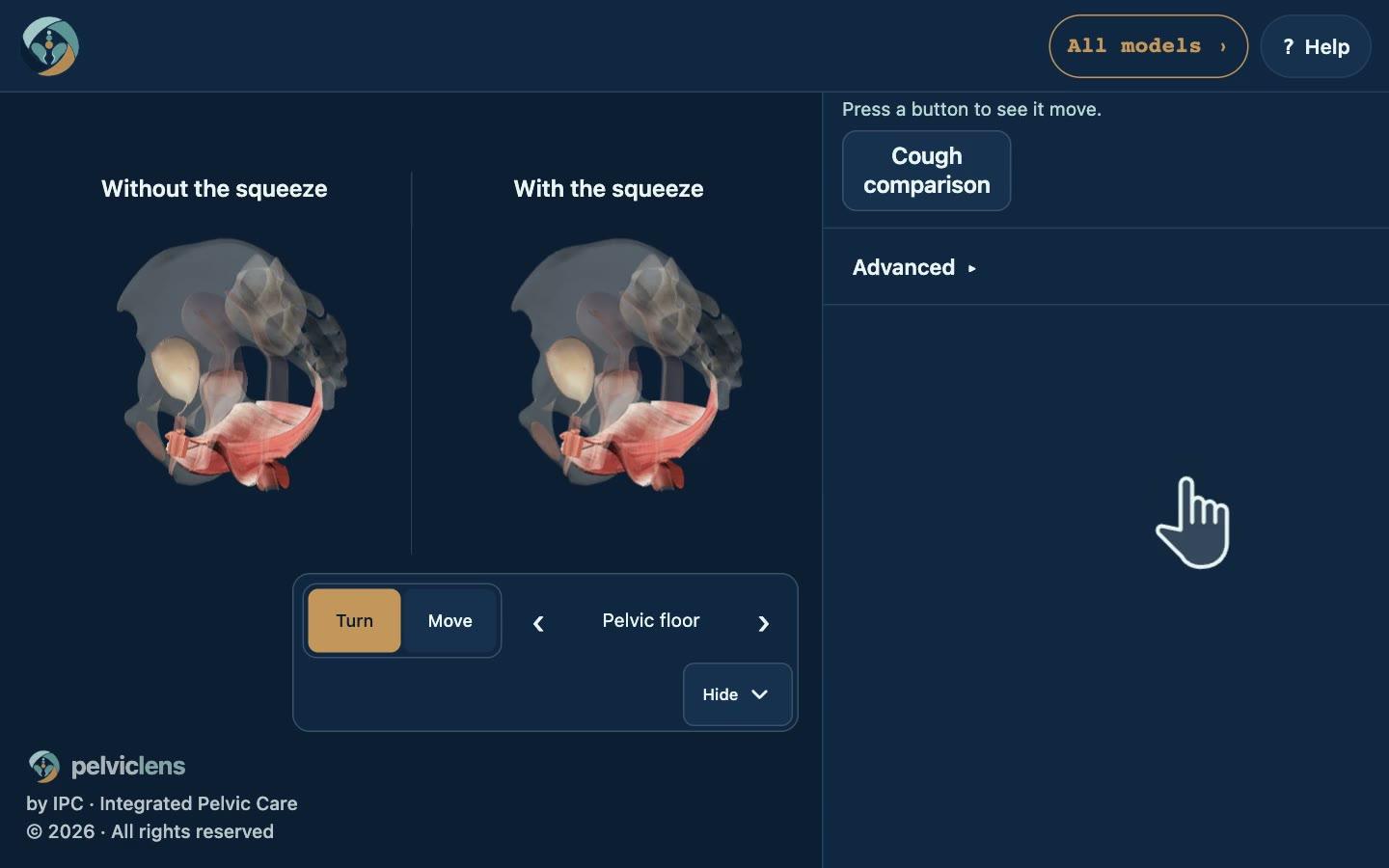
The short answer. The modified Oxford scale grades a voluntary pelvic floor contraction from 0 (no discernible contraction) to 5 (strong, lifting against strong resistance), by vaginal or rectal palpation [1] [2]. It measures the squeeze and lift made on request. The involuntary contraction before a cough, the relaxation afterwards and pain on palpation are separate signs the grade does not record [2].
Key takeaways
- The grade answers one instruction, a maximal squeeze and lift on request, and leaves the cough response, the relaxation and pain as separate signs.
- No strength scale is validated, and in one study two experienced examiners gave the same grade in 45 percent of women.
- In men, the grade speaks to Underactivation A, and a strong squeeze can sit beside the Restriction pattern, Underactivation B, the Guarding pattern or the Myofascial pain pattern.
The letter from the ward reads "modified Oxford scale 4/5, good lift". Your patient, eight weeks after his radical prostatectomy, still leaks each time he stands up from a chair. A woman who leaks when she coughs can arrive with the same 4/5. The grade may well be accurate in both. It answers a question the leak never asked: how hard your patient can squeeze when told to, lying still.
The grade is also the finding most likely to reach you secondhand, because the ICS called the Oxford scale the one used most frequently [2]. Read for what it measures, it tells you whether your patient can find and drive a voluntary contraction. Read as a verdict on the whole floor, it discharges your patient with a grade 4 and the same leak.
What does the modified Oxford scale measure?
Every grade on this scale answers one instruction, and the instruction decides what the grade can see. Your patient lifts and squeezes as strongly as possible for up to five seconds, and the best of three maximal contractions is graded [1].
The descriptors below come from a trial protocol grading men per rectum around radical prostatectomy [1].
| Grade | Label | What your finger feels |
|---|---|---|
| 0 | Nil | No discernible contraction |
| 1 | Flicker | A flicker or pulsing under the finger: a very weak contraction |
| 2 | Weak | A rise in tension, with no discernible lift or squeeze |
| 3 | Moderate | Some lift of the posterior wall and a squeeze at the base of the finger, with the perineum drawing in |
| 4 | Good | Elevation of the posterior wall against resistance, with the perineum drawing in |
| 5 | Strong | Elevation of the posterior wall held against strong resistance |
Everything in that table happens on request. The ICS records three more signs, each on its own: the involuntary contraction before a cough or other rise in abdominal pressure, the voluntary relaxation, and pain that digital pressure reproduces or intensifies [2]. In the ICS definition, normal pelvic floor muscles show a normal or strong voluntary contraction, a complete voluntary relaxation, and an involuntary contraction and an involuntary relaxation [2]. A grade 5 meets only the first of those four, and a grade 0 does not rule out an involuntary contraction [2].
The 2021 ICS terminology keeps that structure. It counts more than 25 published scales for digital muscle testing, the modified Oxford grading scale among them, and for its own scale it proposes moderate in place of normal [3]. On the clinical proforma drawn from the report, the cough response, the relaxation, resting tone, tenderness and the tender point each have a row of their own [3].
Biofeedback records what a fingertip grade leaves out. On EMG the signal falls back to baseline or below as the floor relaxes, so the release is recorded beside the squeeze [2], and the pillar on pelvic floor biofeedback compares the methods.
The cough row matters most when your patient leaks. In 13 continent men on transperineal ultrasound, urethral motion during a cough implied that the striated urethral sphincter and the bulbospongiosus shortened while the levator ani lengthened [4]. Coughs evoked by capsaicin differed from coughs made on request, so a voluntary cough may not test the whole continence mechanism [4]. IPC's teaching reads that cough as a high-speed coordination task, in which different regions of the floor do different things at the same time rather than the whole floor lifting as one. The article on the external urethral sphincter follows that closure from the cough to the leak.
Your patient from the ward letter is sure his 4/5 squeeze is strong enough to keep him dry.
Modified Oxford scale in men: grading per rectum
Most of the literature on this scale grades women, and the male floor is graded by another route. The ICS examines men per anus, with the patient in the left lateral position for anal palpation [2]. The prostatectomy protocol above grades in crook lying [1].
Check the direction before you grade the force, because a push downward is not a weak squeeze. The cue "Lift your testicles." gives your patient a target he can see and feel. The ICS proforma lists closure of the anus, a testicular lift and penile retraction as the male movements on a contraction [3]. The layers behind those movements are mapped in the pillar on male pelvic floor anatomy.
Per rectum, your finger meets the external anal sphincter and then the puborectalis at the anorectal junction [3]. In 39 healthy young men, digital testing of those muscles and the bulbospongiosus was largely reproducible on retest [5]. The internal muscles proved more reliable to test than the superficial ones [5]. Where the grade falls in the whole examination is set out in the male pelvic floor examination.
Oxford grade and the six pelvic floor patterns
A low grade is one finding, and a high grade is no clean bill of health. The IPC Male Pelvic Floor Patterns were written and taught for the male pelvic floor, so this section reads the grade in men only. Taught in Integrated Pelvic Care's masterclass Peter Pan and the Lost Boys, the patterns group examination findings by the capacity they show, in an order that reflects the clinical assessment sequence. Under the Pattern Classification Rule, a pattern is suggested by 1 major criterion or 3 minor criteria, so one minor finding alone suggests none.
| Pattern (capacity) | What the grade or test shows | Criterion, word for word |
|---|---|---|
| Restriction pattern (mobility deficit) | Any grade, even 5, in a floor that cannot open on bearing down | Major: "Absent or clearly limited PFM/perineal descent or opening during bearing down when relaxation is expected, without evidence of active protective contraction" |
| Underactivation A (voluntary recruitment deficit) | Grade 0 that persists after good cueing | Major: "Absent voluntary PFM contraction after appropriate instruction/cueing: no clear tightening, lift, or closure on observation or palpation" |
| Underactivation A | Grade 1 or 2, a short hold, few repetitions, weak fast contractions | Minor: "Weak / incomplete voluntary contraction"; "Poor sustained contraction / reduced endurance"; "Poor repeatability or early fatigue"; "Weak rapid contractions" |
| Underactivation B (involuntary/reflexive timing deficit) | Grade 4 or 5 with an absent or late response to a cough or a quick stand | Major: "Absent or consistently delayed expected PFM response during repeated cough, rapid increase in IAP, or functional loading despite an available voluntary contraction" |
| Underactivation B | Slow fast contractions | Minor: "Slow response during rapid contraction testing" |
| Guarding pattern (regulation deficit) | Grade 5 that will not let go | Minor: "Strong contraction with difficulty releasing" |
| Myofascial pain pattern (tolerance deficit) | Grading that provokes the pain | Minor: "Pain with contraction or resistance" |
The major criterion of Underactivation B starts where the grade stops: its last clause takes the voluntary contraction as given. Your patient from the ward letter meets it if his response to a repeated cough or a quick stand is absent or consistently delayed. Good strength therefore does not make a Normal pattern, which requires ruling out the other patterns first.
Nor can the grade set the order of treatment. The pattern that best explains the main symptom comes first, and mobility and regulation come before strengthening. When Underactivation A and B coexist, recruitment comes before timing in function. A floor squeezed again and again without time to relax can lose its mobility, which is one reason a leak can persist on a strengthening program.
The patterns are read in assessment order, each with its treatment, in the pillar on pelvic floor downtraining.
The PERFECT scheme: endurance, repetitions, speed
The PERFECT scheme reads like a fuller examination, yet each of the three numbers it adds to the grade is still measured on request. P is power, graded on the modified Oxford scale; E is endurance; R is repetitions; and F is fast contractions [6]. In 80 young nulligravid women, agreement between two examiners was moderate at best with two fingers, from 0.65 for fast contractions down to 0.27 for repetitions, and only power reached fair agreement with one finger [6].
In men, the patterns table above reads each of those numbers. IPC's teaching times endurance on a submaximal hold in lying, sitting and standing, with the symptoms noted during and after: the gentle squeeze that Continence Control places right before a cough.
Is the modified Oxford scale reliable?
Two experienced physiotherapists grading the same squeeze can agree less often than they disagree. In 20 female physical therapy students, two examiners gave the same grade in 9 (45 percent), with a kappa of 0.37, and all but one disagreement was a single grade [7]. Squeeze pressure did not differ between contractions graded weak, moderate, good and strong [7].
A single examiner re-grading the same floor agrees with the first grade far better. When the same therapist re-graded 20 female physiotherapists two to six weeks apart, kappa was 0.69 in bent-knee lying and in supine, 0.86 in sitting and 0.79 in standing [8]. The ICS concluded in 2005 that no scale for contraction strength is validated, and it recommended nothing finer than absent, weak, normal or strong [2].
These reliability studies graded women only; in men, the data are the series of 39 above [5]. The grade works best as your own measure over time, taken by the same examiner with the same instruction and the position written in the notes. So read the 4/5 in the ward letter for what it records: a squeeze your patient can find on request, graded by one examiner in one position.
What to say to your patient
- With the cough playing on the model: "Your squeeze is good. Watch what it does just before a cough."
- Before you grade his squeeze: "Lift your testicles. Hold them there. Now let go."
- Before you grade her squeeze: "Squeeze as if you are holding in gas. Now let go."
- If grading brings back the pain: "Tell me if this feels like your usual pain."
Frequently asked questions
What is a normal Oxford grade for the pelvic floor?
There is no validated normal grade: in 2005 the ICS found no validated strength scale and recommended nothing finer than absent, weak, normal or strong. In its definition, normal pelvic floor muscles give a normal or strong contraction on request, relax completely, and contract and relax involuntarily. A grade of 4 or 5 speaks only to the first of those four conditions.
What does a grade 3 pelvic floor contraction mean?
A grade 3 is a moderate contraction: some lift of the posterior wall and a squeeze at the base of your finger, with the perineum drawing in. It shows that your patient can contract the floor in the right direction. It does not show whether the floor contracts before a cough, lets go afterwards or tolerates pressure.
Is a weak pelvic floor the same as a hypotonic one?
No, weakness and low tone are different findings. A weak pelvic floor grades low on a voluntary squeeze, and a hypotonic one feels soft at rest. Tone does not equal function. The ICS keeps hypotonicity for a patient with a neurological disorder; without one, the finding is decreased tone.
References
- A pilot randomized trial of conventional versus advanced pelvic floor exercises to treat urinary incontinence after radical prostatectomy: a study protocol. BMC Urology, 2015.
- Standardization of terminology of pelvic floor muscle function and dysfunction: report from the pelvic floor clinical assessment group of the International Continence Society. Neurourology and Urodynamics, 2005.
- An International Continence Society (ICS) report on the terminology for pelvic floor muscle assessment. Neurourology and Urodynamics, 2021.
- Dynamics of male pelvic floor muscle contraction observed with transperineal ultrasound imaging differ between voluntary and evoked coughs. Journal of Applied Physiology, 2014.
- Reproducibility of digital testing of the pelvic floor muscles in men. Archives of Physical Medicine and Rehabilitation, 1996.
- Reliability of the PERFECT scheme assessed by unidigital and bidigital vaginal palpation. International Urogynecology Journal, 2021.
- Vaginal palpation of pelvic floor muscle strength: inter-test reproducibility and comparison between palpation and vaginal squeeze pressure. Acta Obstetricia et Gynecologica Scandinavica, 2001.
- Reliability of pelvic floor muscle strength assessment using different test positions and tools. Neurourology and Urodynamics, 2006.
Related articles
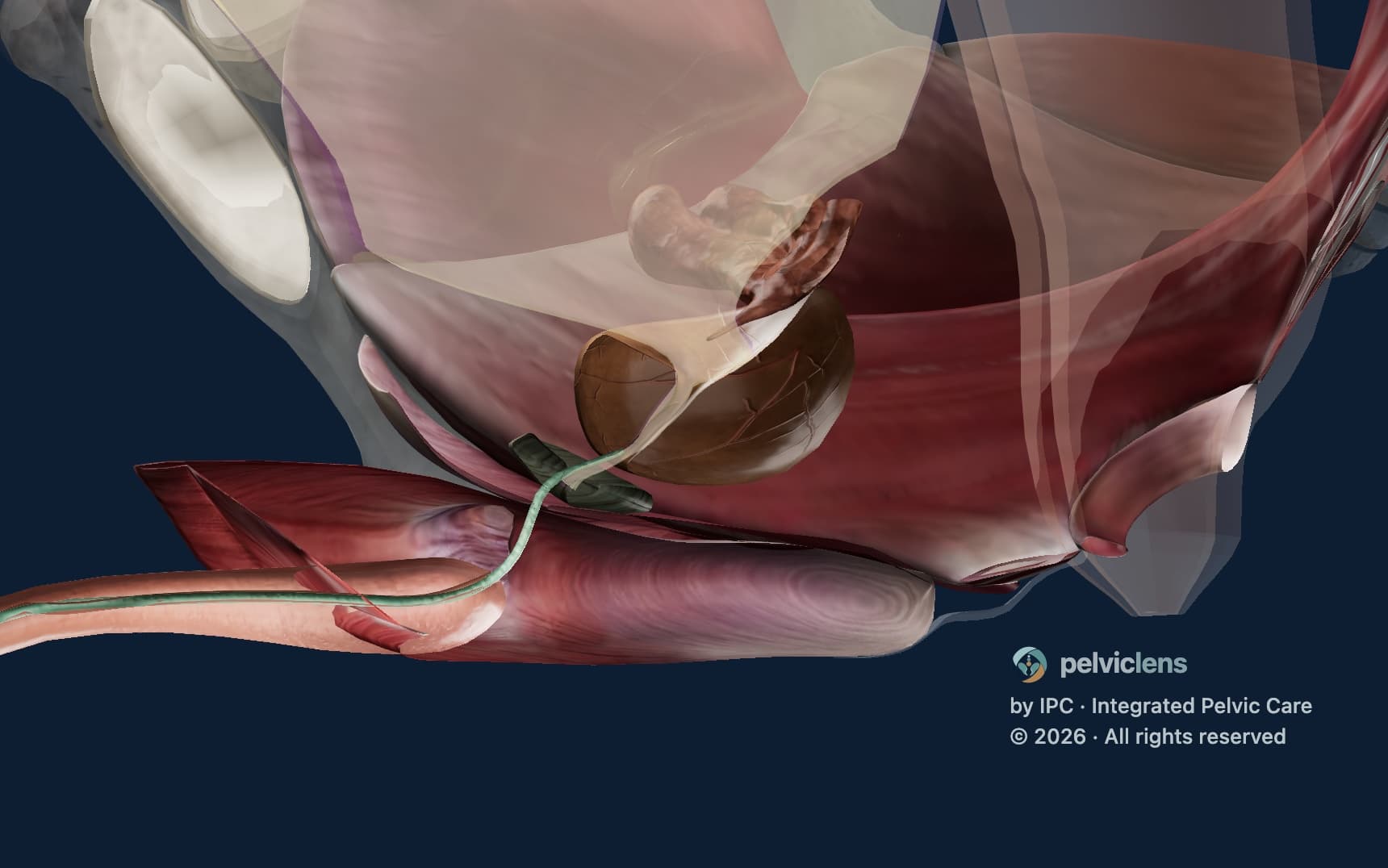 External urethral sphincter: functionThe external urethral sphincter for the pelvic health clinician: how it differs from the internal sphincter, how a cough moves it, and how to train it.10 min read
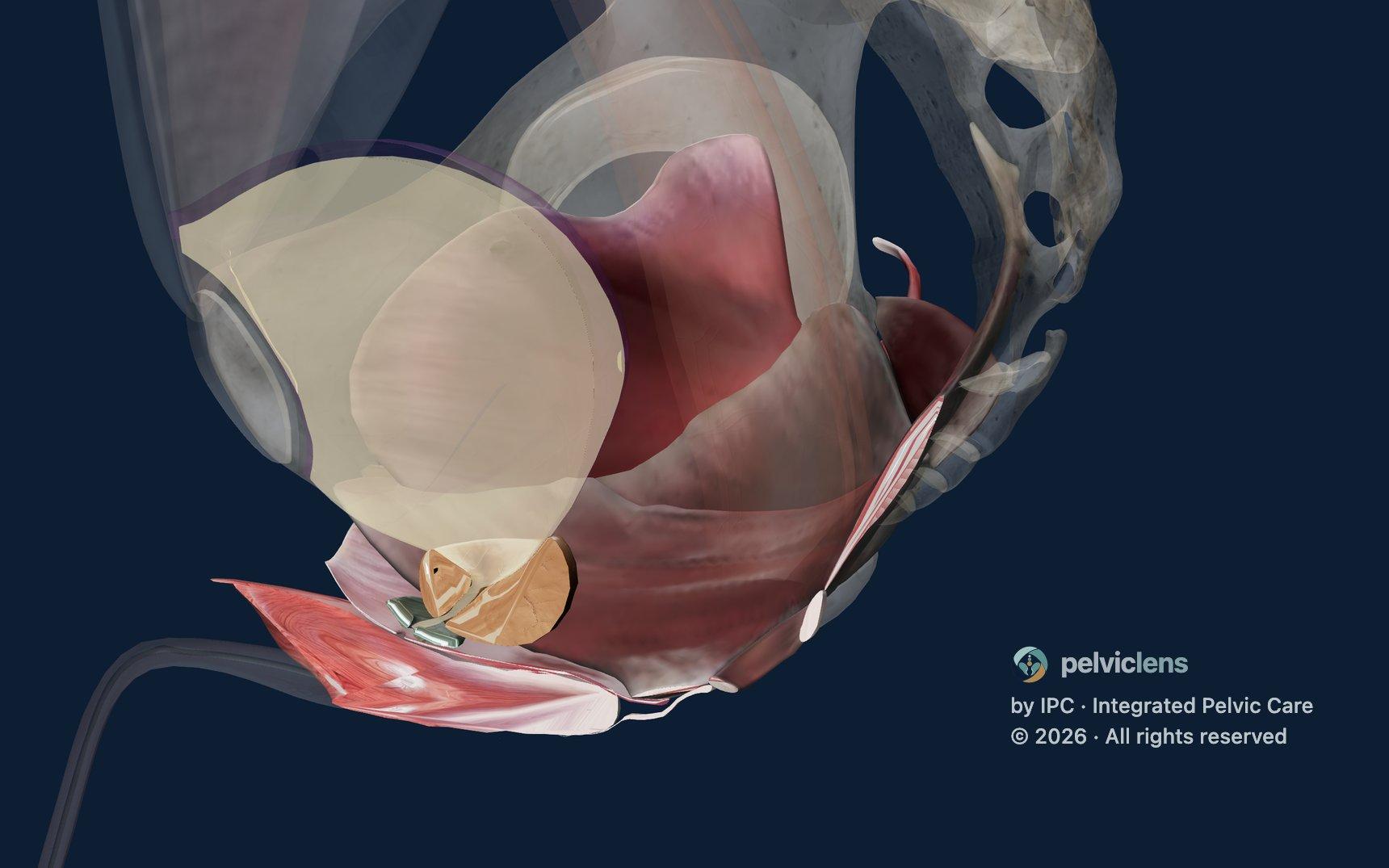 Men’s healthPelvic floor downtraining in menHypertonic pelvic floor in men is a label, not a finding: pelvic floor downtraining is down-regulation for the Guarding pattern the exam finds.17 min read
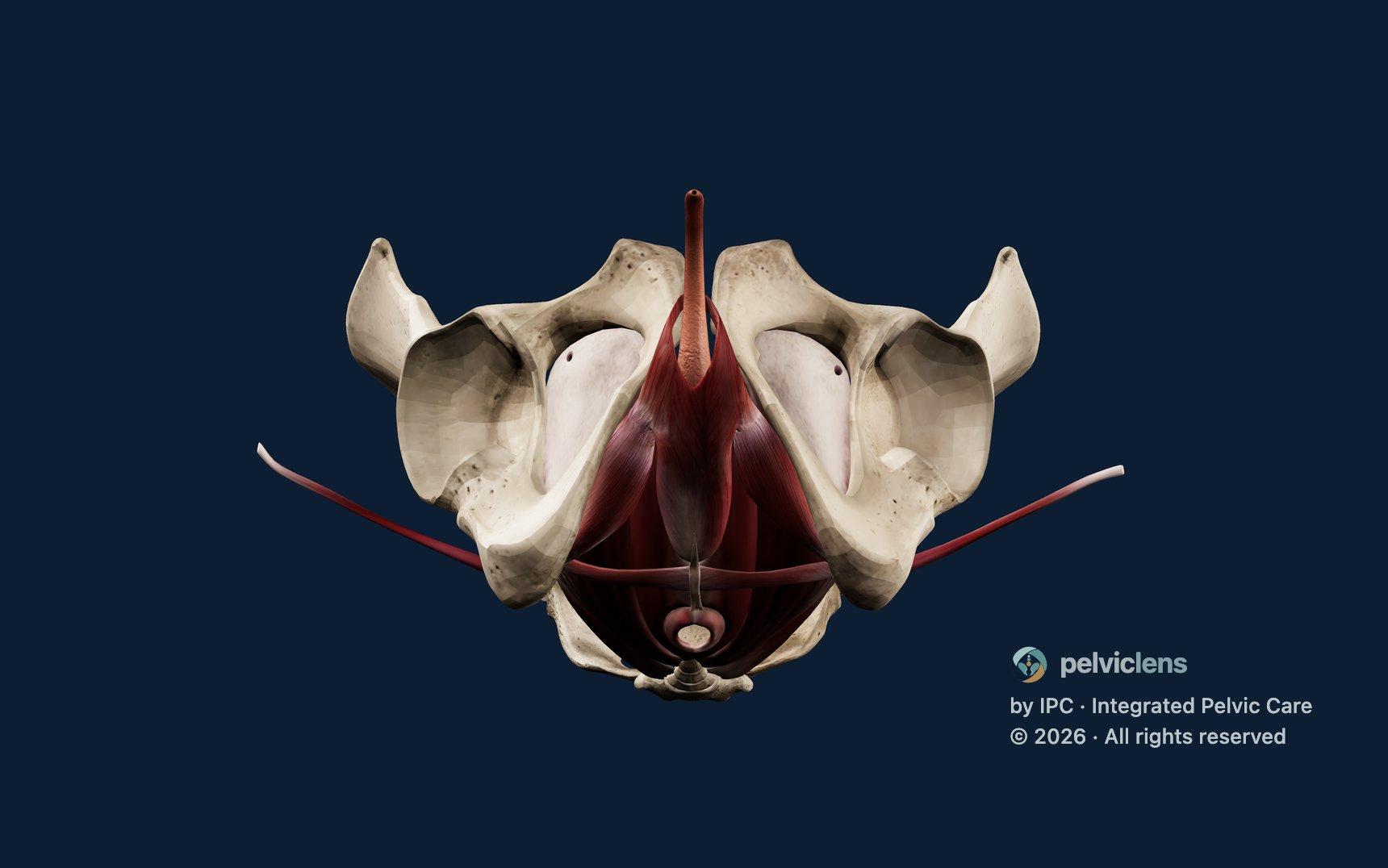 Men’s healthMale pelvic floor anatomy: the three layersMale pelvic floor anatomy for clinicians: three muscle layers, the two sphincters, the pelvic wall and the pudendal supply, in exam order.17 min read
Read this article in Français · Español · Português · Deutsch
This article is education for health professionals. It is not medical advice, not a diagnosis and not a treatment plan for any person. Clinical decisions rest on your own assessment of the patient in front of you. If you are a patient reading this, talk it through with your own health professional. Evidence changes: the review date above tells you when this article was last checked.