
Male pelvic floor examination, in order
Male pelvic floor examination for clinicians: consent, observation, palpation and resting anal sphincter tone, each read as a pattern.

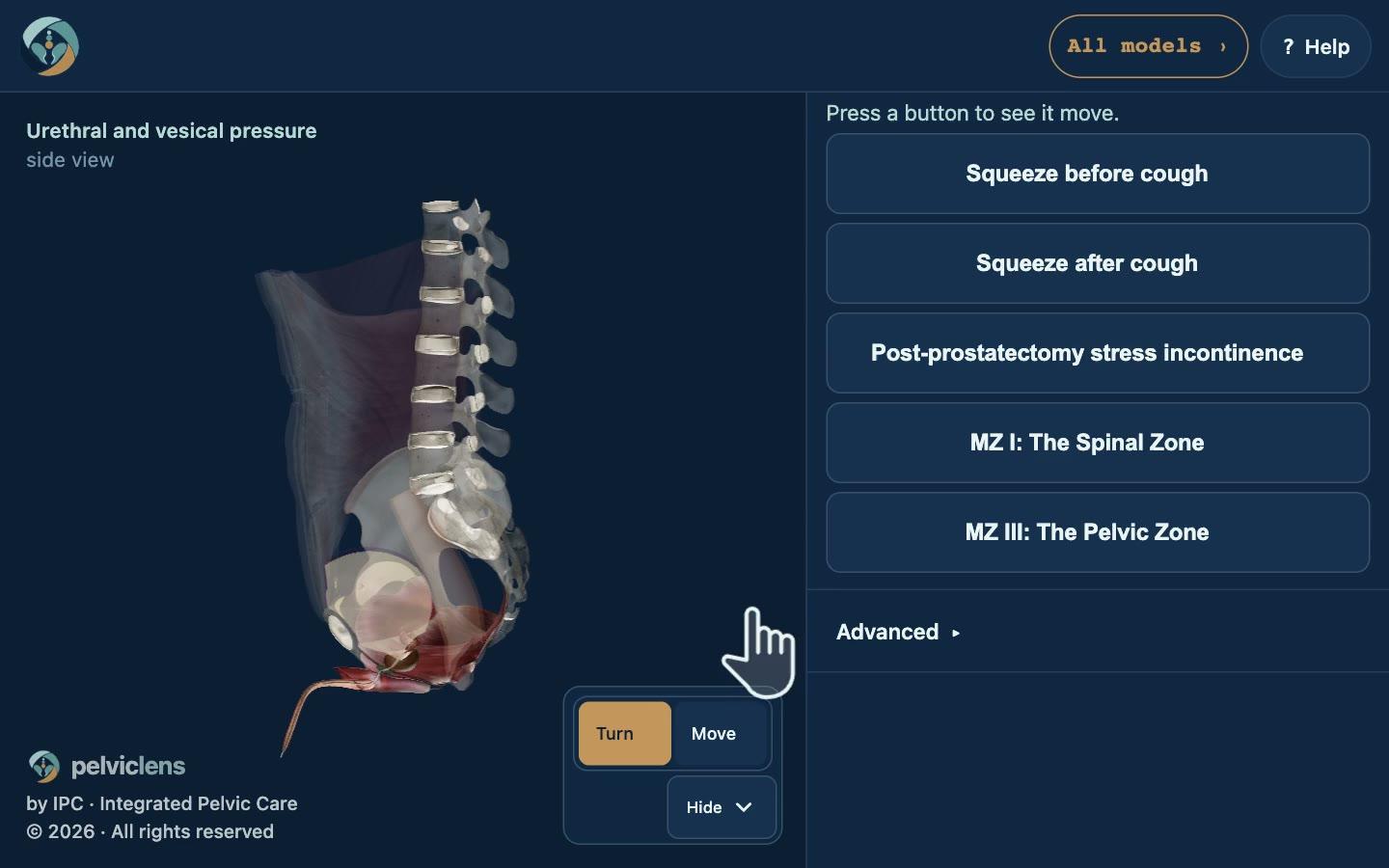
The short answer. A male pelvic floor examination is a consented assessment in a fixed order: observation of the perineum, external palpation, then a digital rectal examination of the sphincters and the levator ani [1]. Each finding is read against the IPC Male Pelvic Floor Patterns, where one major criterion can suggest a pattern early.
Key takeaways
- Observation comes first, and the cough is watched before any pre-contraction is taught [1].
- A perineum that rises during the push meets a Guarding major criterion; one that barely descends, with no protective contraction, meets a Restriction major criterion.
- Resting anal tone is mostly the internal anal sphincter [2], and the finger reads normal tone better than abnormal tone [3].
The referral says tight pelvic floor, and the male pelvic floor examination it asks for seems to need one gloved finger. Start with the finger, though, and you may create the finding you were sent to confirm. A floor that guards will contract as the finger reaches the anal verge, and every test after that contraction reads as tight. Integrated Pelvic Care's masterclass runs the examination the other way round, with your eyes first and your finger last.
How is a male pelvic floor exam done?
The examination order puts mobility first, as in a joint examination, and part of the Restriction pattern is visible before you touch your patient. So the clinical assessment sequence, which the order of the patterns reflects, starts with your eyes: observation, then external assessment, then internal examination. The ICS terminology also puts visual observation before digital palpation and leaves each test to clinical judgement [1]. Each step's structures are mapped in the male pelvic floor anatomy pillar.
Under the Pattern Classification Rule of the six IPC Male Pelvic Floor Patterns, a pattern is suggested by 1 major criterion or 3 minor criteria. Restriction has a major criterion you can see from the foot of the plinth: "Absent or clearly limited PFM/perineal descent or opening during bearing down when relaxation is expected, without evidence of active protective contraction". A Normal pattern requires ruling out the other patterns first, so only a complete examination calls a floor normal.
Findings are read against fixed references: the perineal body against the plane of the ischial tuberosities, and anal findings on a clock face with 12 o'clock anterior [1].
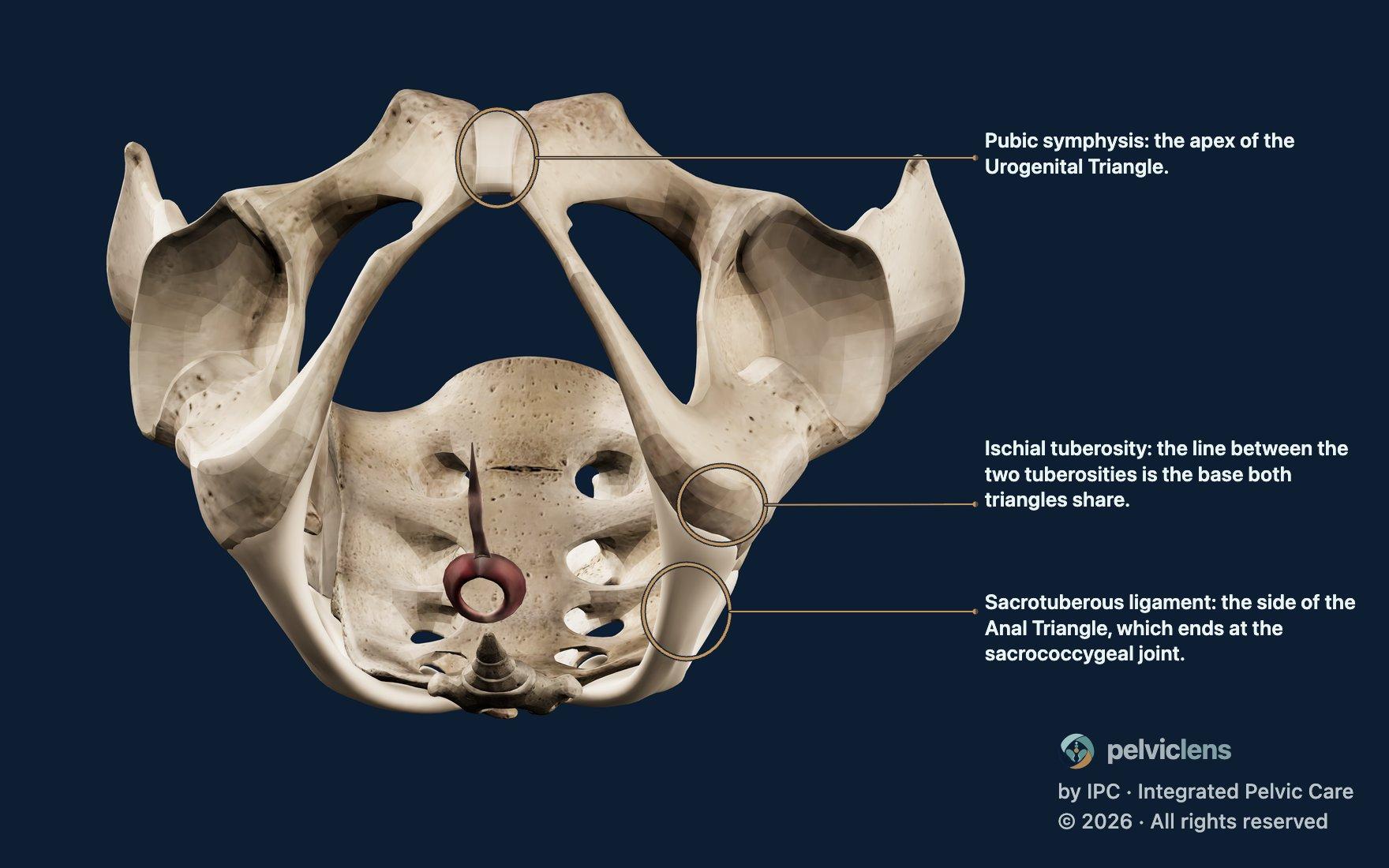
The ischial tuberosities set the reference plane for the perineal body, seen from below on the Pelvic Lens Base Anatomy model.
Consent, chaperone and explanation first
The examination starts with what you say, because an internal examination can mean far more than the procedure. Close the door, choose a room where nothing is overheard, and cover your patient with a sheet. Set the boundary first: this session is an evaluation, and understanding comes before touch. Explain and ask permission before each stage, and lead the next step yourself.
Offer a chaperone and record the answer. In a urology clinic survey of 200 people, 3.8% of the men preferred a chaperone and 84.8% wanted the right to refuse one [4]. The offer is made every time, and the choice is his.
Recent cancer treatment, pelvic radiation, rectal cancer surgery, a recent hemorrhoid removal, a history of trauma and widespread nerve sensitivity each call for a more cautious start. Acute urinary retention is a reason to refer, not to examine internally, because the floor can tense under the finger and worsen the retention. A withheld consent is never pressed.
Observation and external palpation
Your patient's perineum answers three questions before your hands do: where it rests, how it moves and whether a cue changes it. At rest, the perineal body normally sits at or slightly above the ischial tuberosities [1]. A perineal body below that plane is descended, and one significantly indrawn at rest is elevated [1]. A cue then separates two patterns. "Elevated/indrawn resting perineum that improves with cueing" is a Guarding minor criterion. "Elevated/indrawn resting perineum that is non-modifiable (Y sign)" is a Restriction minor criterion.
Then ask for a contraction: "Lift your testicles." In men the ICS signs are the anus closing, the testicles lifting and the penis drawing in [1]. Watch for "Gluteal, abdominal, adductor, or breath-holding compensation", a minor criterion of Underactivation A. An anal squeeze with no movement in front means the front of the floor has not been recruited, which matters when the symptom is urinary.
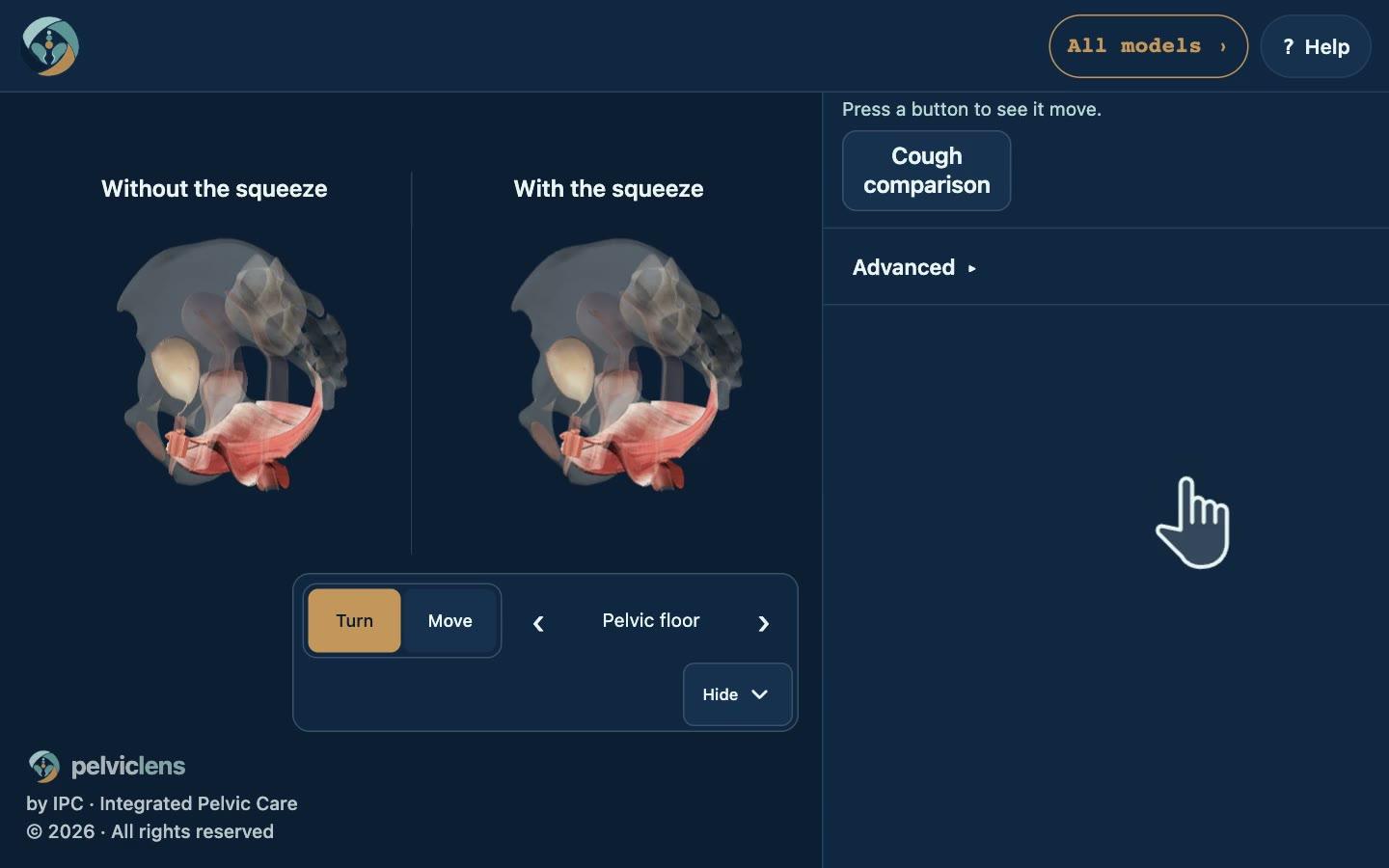
Watch the cough before you teach any pre-contraction, so that a newly taught squeeze does not mask the reflex response [1]. Then ask him to bear down as if opening his bowels. The perineum is expected to descend, and the ICS counts 3 cm or more below rest as excessive [1]. A perineum that rises during the push, at its start or partway through, meets the Guarding major criterion "Paradoxical contraction/elevation when relaxation or descent is functionally required". The Pelvic Lens pelvic floor model plays both floors through one push.
Your patient with that rise is sure he lets go when he pushes.
External palpation comes next. Press across the fibres of the bulbospongiosus for tone, slide any scar, and record each tender point with its location and referral [1]. A tender point that reproduces his familiar pain is the finding, as it is for an obturator internus trigger point on the pelvic side wall.
Resting anal sphincter tone on digital examination
Your finger first meets resting tone, the finding a referral calls tight. Place the palmar surface of a well-lubricated, gloved finger at the anal verge and wait for the external anal sphincter to relax [1]. Then insert along the posterior wall of the anal canal [1]. If the external sphincter grips as you advance, you may have moved too fast or pressed too hard.
At rest you feel mostly the internal anal sphincter, which produces the greater part of resting anal pressure [2]. It is autonomic, with an even grip that no cue changes, and anorectal manometry measures its share. The digital rectal examination scoring system (DRESS) grades rest and squeeze from 0, no discernible pressure, to 5, extremely tight, with 3 as normal [5]. In 209 people with chronic constipation, the finger appeared reliable for detecting "normal, but not abnormal, sphincter tone" [3].
"Hypertonic" is the referral's word for a grip that feels tight. The ICS reserves hypertonicity for raised tone in a patient with a neurological disorder [1]. It also names transient increased muscle tone, which eases with verbal instruction, reassurance or gentle pressure [1]. A tight sphincter can be one of three findings:
- A closure your contact triggers is a Guarding major criterion: "Protective involuntary contraction/withdrawal triggered by contact, palpation, insertion, movement, or pressure".
- An opening that stays narrow whatever the cue is "Restricted anal opening during insertion", a Restriction minor criterion.
- Pain as the finger enters is "Pain with anal contact or insertion", a Myofascial pain minor criterion.
Digital rectal examination of the pelvic floor
Past the sphincters, the question changes from tone to movement. Keep the finger on the posterior wall and advance slowly over the puborectalis at the anorectal junction [1]. A cue decides the reading here, as it did at the perineum. "Acute puborectalis position that is modifiable" is a Guarding minor criterion. "Acute/restricted puborectalis or anorectal position that is non-modifiable" is a Restriction minor criterion.
Then ask for a contraction, felt as a tightening, lifting and squeezing action under the finger [1]. Test its endurance, its repeatability and the return to rest [1]. Grade its strength on the modified Oxford scale, one of more than 25 published digital scales [1]. In 39 healthy young men, digital testing of the bulbospongiosus, the external anal sphincter and the puborectalis was largely reproducible on retest [6]. The internal tests proved more reliable than the superficial one [6].
Repeat the cough with the finger in place, then the push. In the same 209 people, the finger looked for impaired perineal descent, paradoxical anal contraction and impaired push effort. Two or more identified dyssynergia with 75% sensitivity and 87% specificity [3]. Dyssynergic defecation sets out the tests that confirm it.
The rectal finger has a blind spot in men. The external urethral sphincter lies out of its reach, so the ICS notes that a digital rectal examination may be less useful in male urinary dysfunction [1].
Pelvic floor ultrasound when he declines
A declined internal examination changes the route, not the assessment. Three routes remain: the external assessment, ultrasound with his clothing lowered, and a trial of pelvic floor exercises judged by his response. In 28 men treated for prostate cancer, transabdominal ultrasound correlated moderately with the digital rectal examination (r = 0.57) [7]. It was also reliable between therapists (intraclass correlation 0.90) [7]. Transperineal ultrasound reaches the front of the floor the finger misses. In three healthy men on electromyography, the mid-urethra moved with the external urethral sphincter, and the penile bulb with the bulbospongiosus [8].
Ultrasound shows only how the muscle moves. On bearing down it can show the rise the loop above plays. It cannot classify the Guarding pattern on its own, because the pattern's other criteria are read by touch and from his history. It cannot identify the Myofascial pain pattern, and it shows Underactivation and Restriction only in part, along one plane. It serves as pelvic floor biofeedback for training, never as a replacement for your hands.
From exam findings to the six patterns
A list of findings is not yet a plan; the pattern turns it into one. The six IPC Male Pelvic Floor Patterns each name a capacity:
- Restriction pattern: mobility deficit.
- Underactivation A: voluntary recruitment deficit.
- Underactivation B: involuntary/reflexive timing deficit.
- Guarding pattern: regulation deficit.
- Myofascial pain pattern: tolerance deficit.
- Normal pattern.
One or two minor findings are not a pattern. A relaxation that takes three or four seconds may be normal variation. A pattern becomes clinically meaningful only when it connects to symptoms and impaired capacities. Patterns can coexist, and the front and back of the floor can show different ones.
No single gold-standard test diagnoses pelvic floor dysfunction. The examination is examiner-dependent, and evidence of its reliability in men is limited. The patterns are IPC's clinical classification, neither validated nor part of the ICS terminology. A letter to a urologist therefore describes the findings in ICS terms [1], and the referral that said tight pelvic floor gets a reply about what the floor does. Pelvic floor downtraining sets out which pattern is treated first when several coexist.
What to say to your patient
- With the model playing the bear-down, before consent: "Watch this floor drop when you push. This one tightens partway. I will look, feel outside, then check inside. Say stop at any time."
- At the anal verge, before you insert: "Breathe out slowly. I will wait until the muscle lets go."
- When you ask for a contraction: "Lift your testicles. Now let them go back down."
Frequently asked questions
Is a male pelvic floor exam painful?
A male pelvic floor exam is meant to be tolerable: discomfort is acceptable, and pain is a finding. In 39 healthy young men, digital testing was well tolerated by all of them. Pain with anal contact or insertion is a Myofascial pain minor criterion, and your patient can stop at any point.
Do men always need an internal pelvic floor exam?
No, men do not always need an internal pelvic floor exam. A major criterion of the Restriction pattern is visible on bearing down, and the ICS leaves each test to clinical judgement. A Normal pattern, though, requires ruling out the other patterns first, and that takes the full examination.
What is normal anal sphincter tone?
Normal anal sphincter tone is an even grip around the finger at rest, scored 3 on the 0 to 5 DRESS scale. In the series that developed the scale, a resting score of 3 matched a mean manometric pressure of about 72 mmHg.
References
- An International Continence Society (ICS) report on the terminology for pelvic floor muscle assessment. Neurourology and Urodynamics, 2021.
- Functional Anorectal Disorders. Gastroenterology, 2016.
- Digital rectal examination is a useful tool for identifying patients with dyssynergia. Clinical Gastroenterology and Hepatology, 2010.
- Patient Perceptions of Chaperones during Intimate Examinations and Procedures in Urology Clinic. Urology Practice, 2019.
- The digital rectal examination scoring system (DRESS). Diseases of the Colon and Rectum, 2010.
- Reproducibility of digital testing of the pelvic floor muscles in men. Archives of Physical Medicine and Rehabilitation, 1996.
- Assessing muscle function of the male pelvic floor using real time ultrasound. Neurourology and Urodynamics, 2011.
- Validity of Estimation of Pelvic Floor Muscle Activity from Transperineal Ultrasound Imaging in Men. PLoS One, 2015.
Related articles
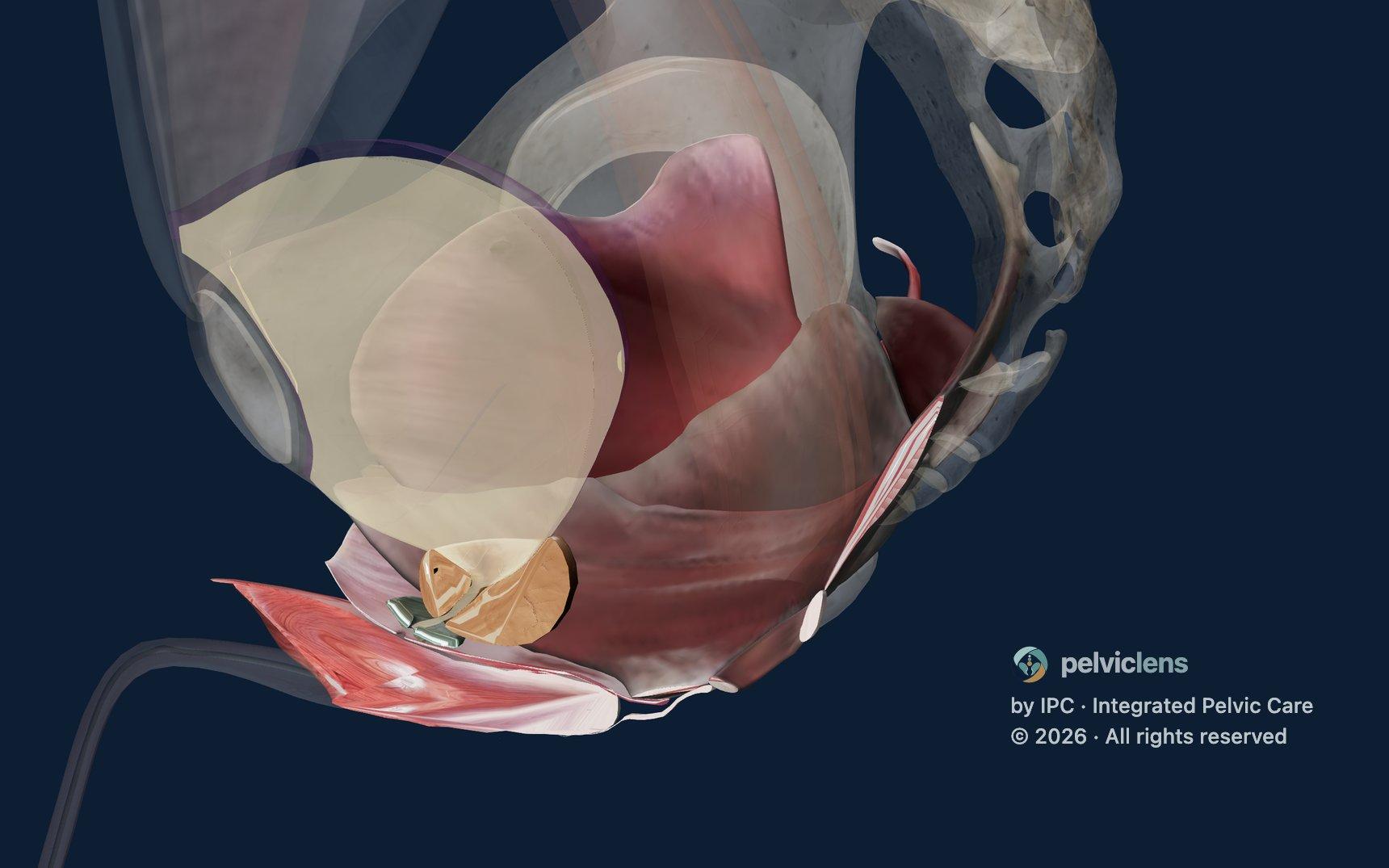 Men’s healthPelvic floor downtraining in menHypertonic pelvic floor in men is a label, not a finding: pelvic floor downtraining is down-regulation for the Guarding pattern the exam finds.17 min read
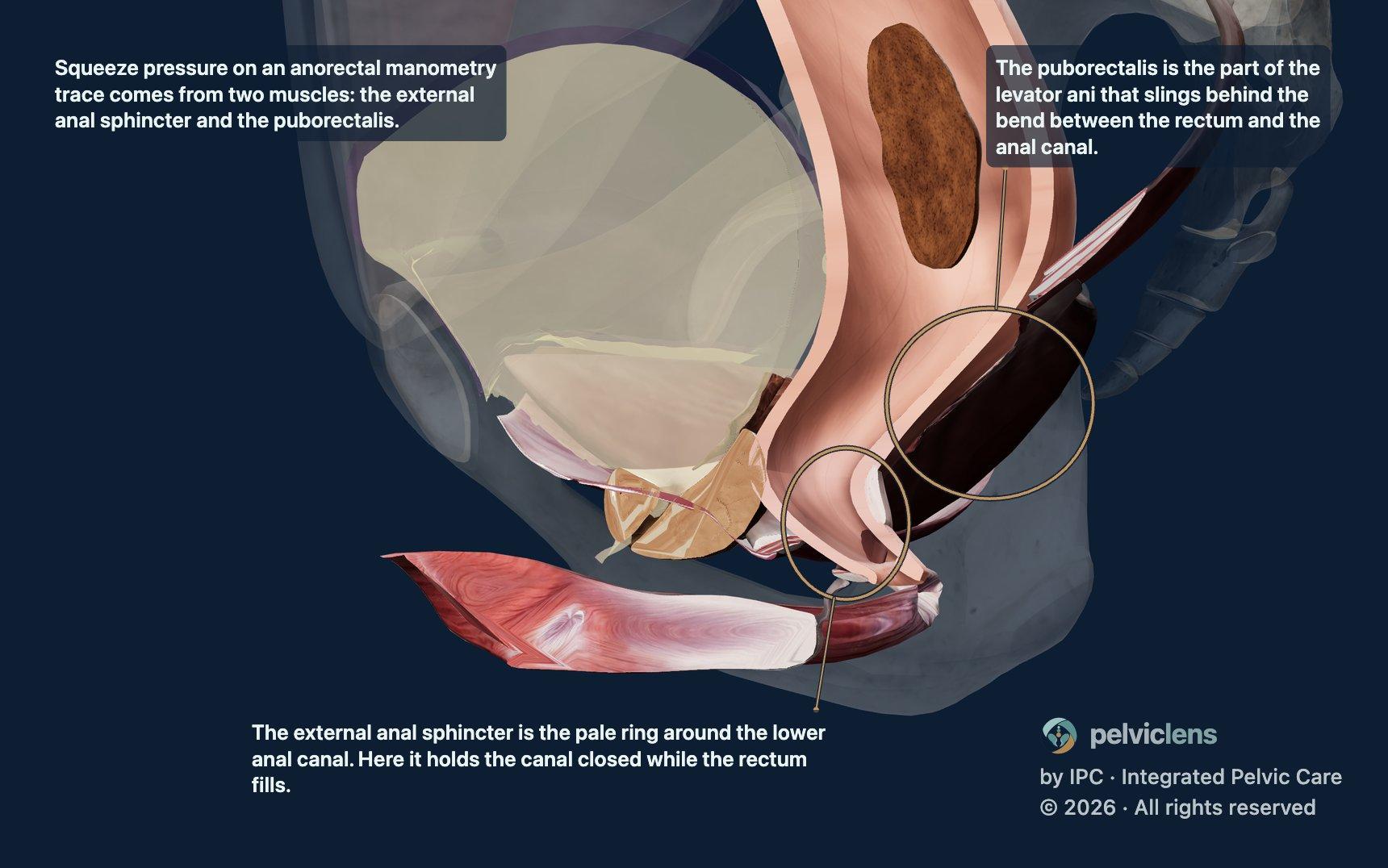 Men’s healthAnorectal manometry: how to read the traceAnorectal manometry read as muscle: resting and squeeze pressure, the reflex, sensation and the push, and what each changes in treatment.12 min read
 Modified Oxford scale: grades and limitsThe modified Oxford scale for clinicians: what a 0 to 5 pelvic floor grade measures, what it misses, and how to read it in men and women.10 min read
Read this article in Français · Español · Português · Deutsch
This article is education for health professionals. It is not medical advice, not a diagnosis and not a treatment plan for any person. Clinical decisions rest on your own assessment of the patient in front of you. If you are a patient reading this, talk it through with your own health professional. Evidence changes: the review date above tells you when this article was last checked.