
Sacral neuromodulation (SNM) and PTNS
Sacral neuromodulation for the pelvic health clinician: the reflex it modulates, who is a candidate, what the test phase shows, and PTNS.

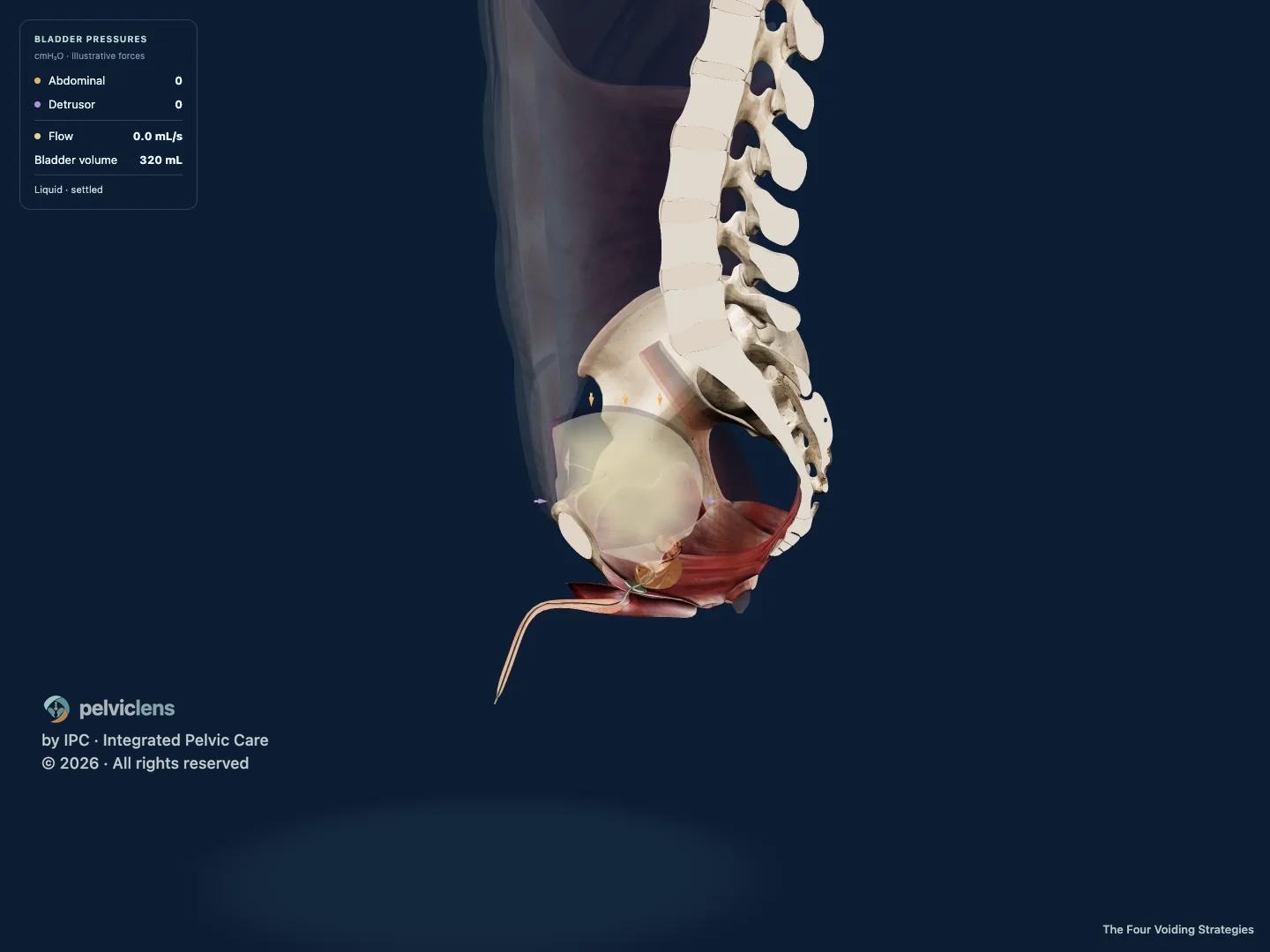
The short answer. Sacral neuromodulation (SNM) sends a steady signal through an implanted lead to the S3 nerve root, modulating the afferent traffic of bladder reflexes [1]. For overactive bladder, the AUA/SUFU guideline recommends offering it when behavioural therapy or medication has helped too little or was not tolerated [2]. It also treats non-obstructive urinary retention, studied mostly in women, and faecal incontinence [3] [4].
Key takeaways
- Sacral neuromodulation works on the afferent side of the reflex. It can quiet an overactive voiding reflex, or suppress the guarding reflex that holds the outlet shut [1].
- The AUA/SUFU guideline recommends offering it when behavioural therapy or medication has not been enough, beside percutaneous tibial nerve stimulation (PTNS) and botulinum toxin [2]. In one centre, a staged tined lead found more responders than a peripheral nerve evaluation: 69 against 47 percent of the same 100 people [5].
- Tibial nerve stimulation reaches the same sacral segment from the ankle, and about half of those treated with PTNS improved over 12 weekly sessions [6]. Fluid intake, posture, abdominal pressure and the pelvic floor remain your work before and after either.
The urology letter ends on one line: "Refractory overactive bladder; for consideration of sacral neuromodulation." Your patient has done eight weeks of bladder training with you and tried two medications. She asks whether the stimulator replaces that work. It does not. Sacral neuromodulation changes the signal her bladder sends, and the diary she keeps through the test phase decides whether she goes on to the permanent implant.
How sacral neuromodulation works on the reflex
Urgency in one patient and retention in another can end in the same operation, because the nerve root at S3 carries traffic in both directions. Integrated Pelvic Care's masterclass draws the loop at two speeds. At a small volume, the sensory fibres of the pelvic nerve report the stretch to the sacral cord at a slow pace. Sympathetic outflow from the thoracolumbar cord then relaxes the detrusor through beta 3 receptors and contracts the internal sphincter through alpha 1 receptors.
At a large volume, the report runs past the sacral cord to the brain. The pontine micturition centre inhibits the sympathetic hold. The parasympathetic fibres of the pelvic nerve contract the detrusor, and the activity of the external sphincter falls. The cortex keeps a veto: when the time or the place is wrong, it drives the pudendal nerve, and the pelvic floor raises urethral pressure until the moment is right.
Sacral neuromodulation enters that loop at S3. The lead sits beside the S3 root, one of the S2 to S4 roots that drive detrusor contraction, and gives the reflex a steady signal. Leng and Chancellor summarise the mechanism as somatic afferent inhibition of sensory processing in the spinal cord [1]. Pudendal afferent input to the sacral cord can switch voiding back on by suppressing the guarding reflex pathways. It can also switch overactive voiding off by blocking the ascending sensory input [1]. That is why one lead serves a bladder that will not hold and a bladder that will not empty. The Pelvic Lens nerve model draws this loop on a male pelvis, and it runs the same way in a woman.
Your patient is sure the implant will take over her bladder, so the diary and the training can stop.
The urodynamic workup records the storage half of this loop: a cystometrogram sets the sensations your patient reports against volume and pressure. The AUA/SUFU guideline does not require urodynamics to diagnose overactive bladder. It keeps the study as an option when the diagnosis is uncertain or treatment has not worked [2].
Who is a candidate for sacral neuromodulation?
"Refractory" on a referral describes the care your patient received as much as it describes her bladder. For idiopathic overactive bladder, the AUA/SUFU guideline recommends offering sacral neuromodulation, PTNS or intradetrusor botulinum toxin. The recommendation applies when behavioural therapy or medication has not helped enough or was not tolerated [2]. The masterclass sets its own ladder: exercise first, then the medical options, then the implant when nothing else has changed the symptom.
In the 4Is, refractory urgency is a Storage Impairment label, and Fluid Imbalance comes before it: a stimulator does not change how much urine your patient makes. Refractory also means she applied the storage strategies with the right timing. They run in the order of the Mechanical Zones: spinal posture, reduced abdominal pressure, a gentle pelvic floor contraction, then a larger bladder capacity.
Non-obstructive urinary retention brings two different candidates. For a detrusor that cannot sustain a contraction, the masterclass finds no procedure proven, sacral neuromodulation included, and treats the problem as functional rather than structural. Physiotherapy leads there: consistent intake and output, the voiding strategies, and bladder sensation improved before contraction is retrained.
Retention behind a striated sphincter that does not relax is the second candidate. Fowler's syndrome is an EMG abnormality of the external urethral sphincter in women with retention. In 62 implanted women, failure came in 9 of the 30 with Fowler's syndrome and in 19 of the 32 without it [3].
Your male patient is a less certain candidate. Men made up 10 percent of the 1,181 people in the nine studies the guideline cites on testing or implantation. They responded during the test phase much as women did, yet they were less likely to proceed to an implant [2]. The guideline also stops at idiopathic overactive bladder [2]. A cord lesion between the pons and the sacral cord, as in detrusor sphincter dyssynergia, changes the loop itself and belongs to a neuro-urology plan.
Faecal incontinence is the third indication. Its workup often includes anorectal manometry, which records the sphincter pressures and rectal sensation a referral may quote.
The test phase: PNE or a staged tined lead
A negative test can be a failure of the test rather than of your patient. A peripheral nerve evaluation (PNE), also called a percutaneous nerve evaluation, tests through a temporary wire placed through the S3 foramen. A staged implant places the permanent tined lead first, tests through an external stimulator, and adds the pulse generator only after a successful test.
In one centre that tested the same 100 people both ways, 47 percent responded to PNE and 69 percent to the first-stage tined lead [5]. A response meant more than 50 percent improvement in at least two symptoms on the bladder diary, and the staged response fell with age [5]. So a failed PNE alone does not settle whether your patient can respond to sacral neuromodulation.
The diary is where your work shows. A baseline diary and a test diary kept the same way decide whether the pulse generator goes in. Change the fluid plan or add a strategy during the test, and the diary can no longer say which change worked. Teach the test days as ordinary days, with the stimulator the only new thing.
Sacral nerve stimulation outcomes and risks
The trials show a clear benefit and a real bill. One trial randomised 147 people with mild to moderate overactive bladder after at least one failed anticholinergic. At six months, 61 percent assigned to SNM succeeded, against 42 percent on standard medical therapy [7]. In 381 women with refractory urgency incontinence, onabotulinumtoxinA cut daily urgency incontinence episodes slightly more over six months, by a mean of 3.9 against 3.3. The trial called that gap of uncertain clinical importance, and the toxin brought more urinary tract infections, 35 against 11 percent [8]. At 24 months the reductions were similar [2].
The bill is surgical. A systematic review of the early implant literature found a reoperation rate of 33 percent, pain at the implant or lead site in 25 percent, and lead problems such as migration in 16 percent [9].
Tibial nerve stimulation: PTNS and TTNS
The neuromodulation a physiotherapist can deliver, where their scope of practice and local service allow it, starts at the ankle and arrives at the same sacral segment. The posterior tibial nerve shares innervation with the sacral plexus that controls the bladder [2]. For percutaneous stimulation (PTNS), the AUA/SUFU guideline describes the SUmiT protocol: a 34-gauge needle beside the nerve, 30 minutes once a week for 12 weeks [2]. In 220 adults with overactive bladder, 54.5 percent reported moderate or marked improvement after those 12 sessions, against 20.9 percent with sham [6].
Transcutaneous stimulation (TTNS) reaches the same nerve through the skin, with no needle. In 60 women with idiopathic overactive bladder, PTNS or TTNS added to bladder training improved the diary and symptoms more than bladder training alone, with similar efficacy. TTNS took less time to set up and caused less discomfort [10].
About half respond to PTNS, the course is long, and many feel no change. Tibial nerve stimulation helps when an overactive reflex drives the urge. It is not expected to change an urge that comes from abdominal pressure, the pelvic floor or the spine, or from a bladder still clearing blood and inflammation after surgery. So the candidate is your patient whose urge did not change with the Mechanical Zones work.
Before and after SNM: the clinician's part
The implant changes one signal and leaves the rest of the 4Is with you. Before the referral, write down what was tried, for how long, and what the diary showed, so the implanting team reads "refractory" as a finding. Urgency driven by a pelvic floor that does not relax is treated first, and pelvic floor downtraining sets out how. For a retention candidate, leave out urge suppression and pelvic floor contraction drills, because holding past capacity in a bladder that does not empty risks acute retention.
After the implant, the storage strategies stay in place: an upright posture, a breath out, and a gentle pelvic floor contraction before the trigger. If her urgency returns, a fresh diary separates a change in fluid or habits from a loss of effect, which goes back to the implanting team.
What to say to your patient
- When your patient asks how it works, with the sacral loop playing on the model: "Watch these lights climb to your spinal cord. That is your bladder's message. The stimulator does not squeeze your bladder. It changes the messages your bladder sends."
- When the referral mentions a stimulator: "This starts with a test. A thin wire sits near a nerve in your lower back. Your diary decides if you get the implant."
- During the test days: "Keep your days the same as before. Then the diary shows what the wire did."
- When symptoms come back after the implant: "Keep your diary for three days. Then we call your implant team."
Frequently asked questions
What is the success rate of sacral neuromodulation?
Most trials count success as the main symptom cut by at least half, and by that measure most people who pass the test phase succeed. In a randomised trial in overactive bladder, 61 percent of those assigned to the stimulator succeeded at six months, against 42 percent on medication. In faecal incontinence, 83 percent of those implanted had at least halved their weekly episodes at one year. Full continence is rarer: 41 percent in that study.
Is PTNS as effective as sacral neuromodulation?
No large trial has compared them head to head in overactive bladder, and the AUA/SUFU guideline notes that comparative trials of PTNS against the other minimally invasive therapies are lacking. In its sham-controlled trial, PTNS improved about half the people treated over 12 weekly sessions. Sacral neuromodulation means surgery and a risk of revision, while PTNS means a fine needle and a long course of visits.
Is sacral neuromodulation permanent?
Sacral neuromodulation is reversible: the stimulator can be switched off, and the lead and pulse generator can be removed. While it works it is a long-term commitment. In the early implant literature, a third of people had a second operation, 9 percent had the electrodes removed for good, and benefits were still reported three to five years after implantation.
Does sacral nerve stimulation help bowel incontinence?
Sacral nerve stimulation helps most people with faecal incontinence who pass the test. In a 120-person multicentre study, 83 percent of those implanted had at least halved their weekly episodes at one year, and 41 percent were fully continent. Episodes fell from about nine a week to about two. The workup before referral often includes the sphincter pressures and rectal sensation that anorectal manometry records.
References
- How sacral nerve stimulation neuromodulation works. Urologic Clinics of North America, 2005.
- The AUA/SUFU Guideline on the Diagnosis and Treatment of Idiopathic Overactive Bladder. The Journal of Urology, 2024.
- The presence of Fowler's syndrome predicts successful long-term outcome of sacral nerve stimulation in women with urinary retention. European Urology, 2007.
- Sacral nerve stimulation for fecal incontinence: results of a 120-patient prospective multicenter study. Annals of Surgery, 2010.
- PNE versus 1st stage tined lead procedure: a direct comparison to select the most sensitive test method to identify patients suitable for sacral neuromodulation therapy. Neurourology and Urodynamics, 2011.
- Randomized trial of percutaneous tibial nerve stimulation versus Sham efficacy in the treatment of overactive bladder syndrome: results from the SUmiT trial. The Journal of Urology, 2010.
- Results of a prospective, randomized, multicenter study evaluating sacral neuromodulation with InterStim therapy compared to standard medical therapy at 6-months in subjects with mild symptoms of overactive bladder. Neurourology and Urodynamics, 2015.
- OnabotulinumtoxinA vs Sacral Neuromodulation on Refractory Urgency Urinary Incontinence in Women: A Randomized Clinical Trial. JAMA, 2016.
- Efficacy and safety of sacral nerve stimulation for urinary urge incontinence: a systematic review. The Journal of Urology, 2006.
- Efficacy of percutaneous and transcutaneous tibial nerve stimulation in women with idiopathic overactive bladder: A prospective randomised controlled trial. Annals of Physical and Rehabilitation Medicine, 2022.
Related articles
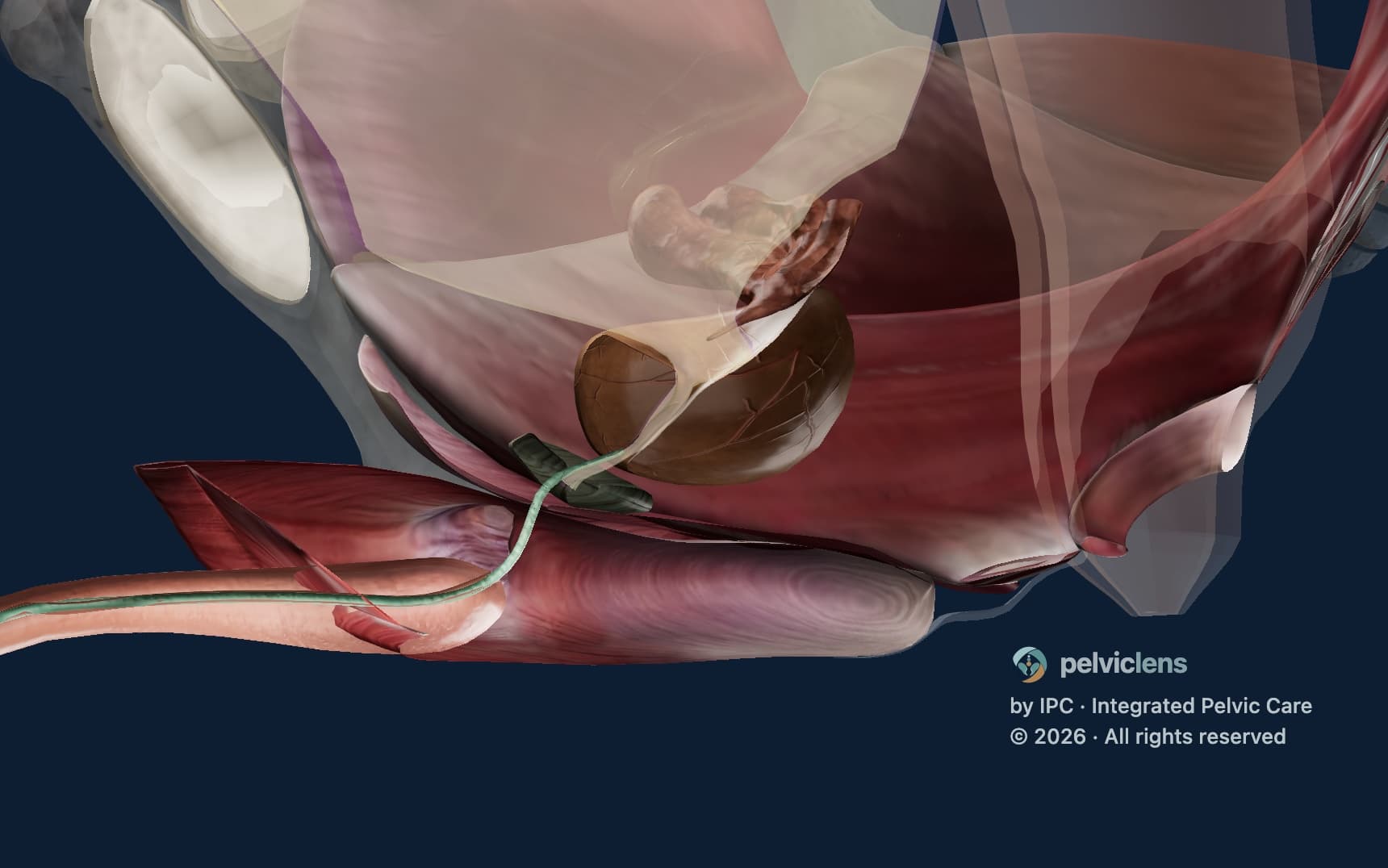 External urethral sphincter: functionThe external urethral sphincter for the pelvic health clinician: how it differs from the internal sphincter, how a cough moves it, and how to train it.10 min read
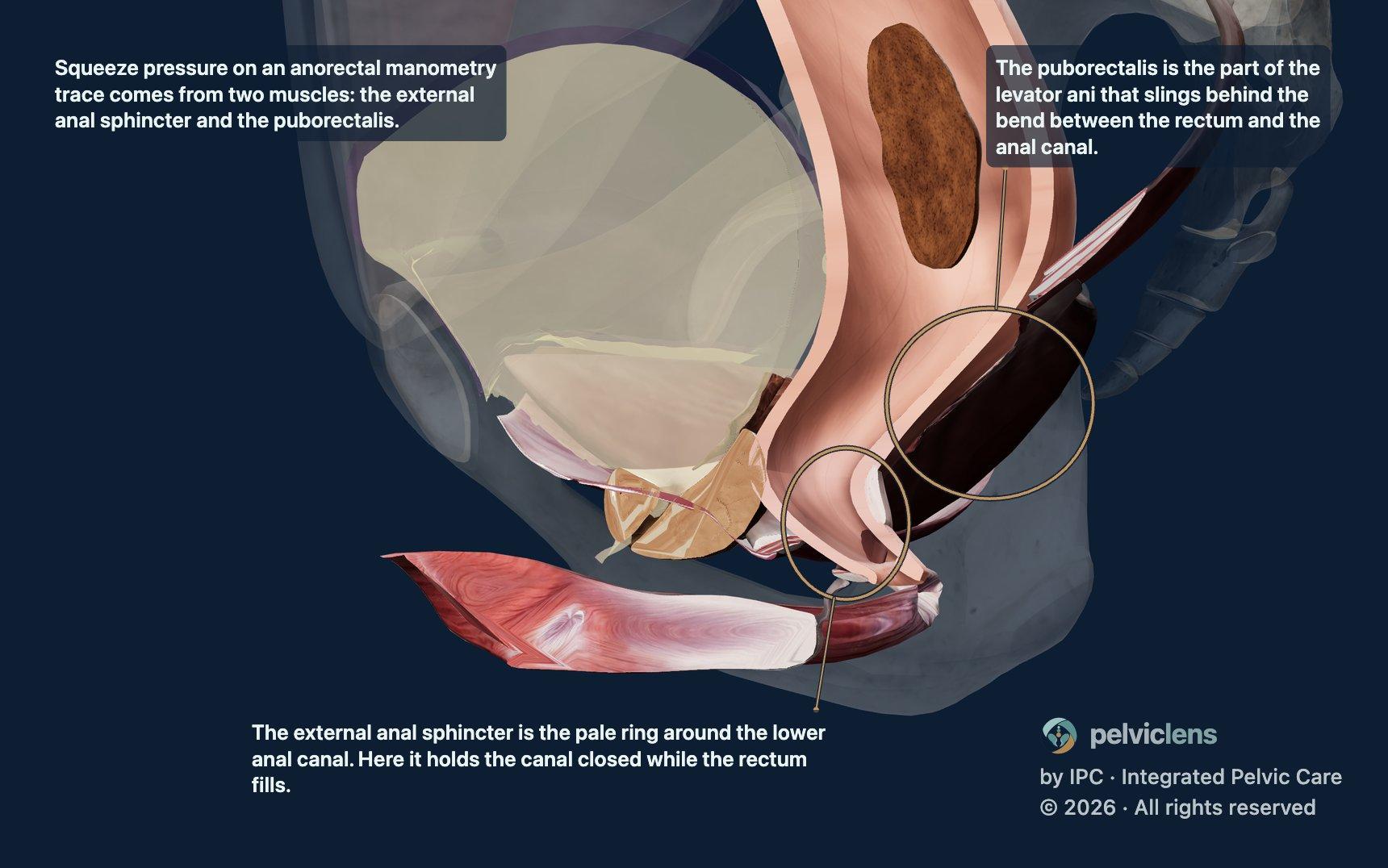 Men’s healthAnorectal manometry: how to read the traceAnorectal manometry read as muscle: resting and squeeze pressure, the reflex, sensation and the push, and what each changes in treatment.12 min read
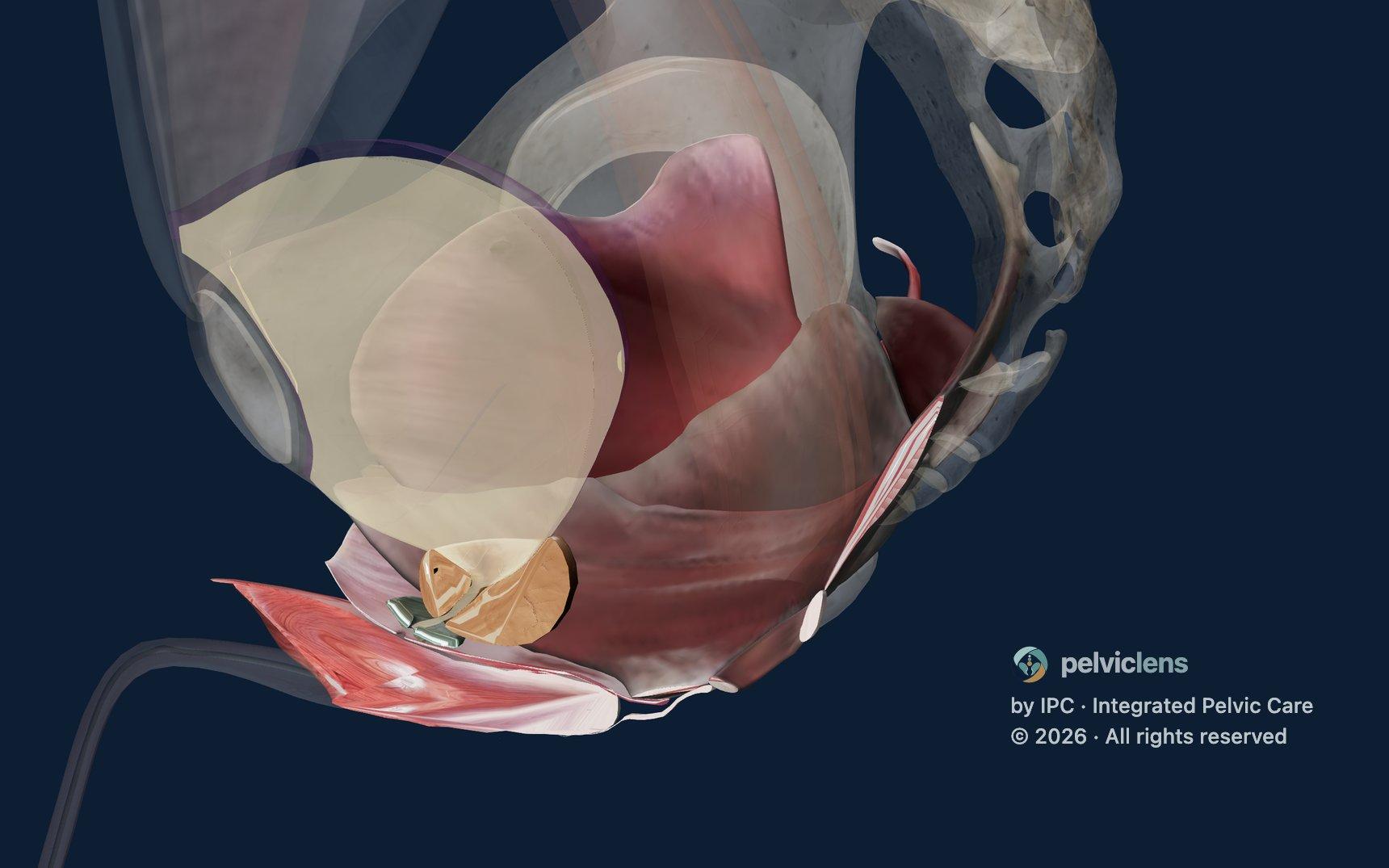 Men’s healthPelvic floor downtraining in menHypertonic pelvic floor in men is a label, not a finding: pelvic floor downtraining is down-regulation for the Guarding pattern the exam finds.17 min read
Read this article in Français · Español · Português · Deutsch
This article is education for health professionals. It is not medical advice, not a diagnosis and not a treatment plan for any person. Clinical decisions rest on your own assessment of the patient in front of you. If you are a patient reading this, talk it through with your own health professional. Evidence changes: the review date above tells you when this article was last checked.